MOEL Ordinance No. 448: heat exposure, rest and daily records (Partial amendment to the Rules on Occupational Safety and Health Standards)
Korea defined prolonged work at a workplace apparent temperature of at least 31°C as heatwave work and specified periodic rest at 33°C and above.
Change at a glance
Promulgated: 2025-07-17
Effective: 17 Jul 2025
Current-text check:
| Item | Before | After |
|---|---|---|
| Definition | No such heatwave-work definition | Prolonged work at apparent temperature ≥31°C |
| At ≥33°C | No identical statutory interval in these provisions | ≥20 minutes rest within every two hours, subject to a narrow proviso |
| Daily record | No identical daily-record provision | Temperature and actions retained through year-end |
Assess the actual workplace
Article 559(4) defines heatwave work as prolonged work at a location where heatwave conditions produce an apparent temperature of at least 31°C under Annex 13-2. Air temperature alone or a regional forecast is not a substitute for that assessment.
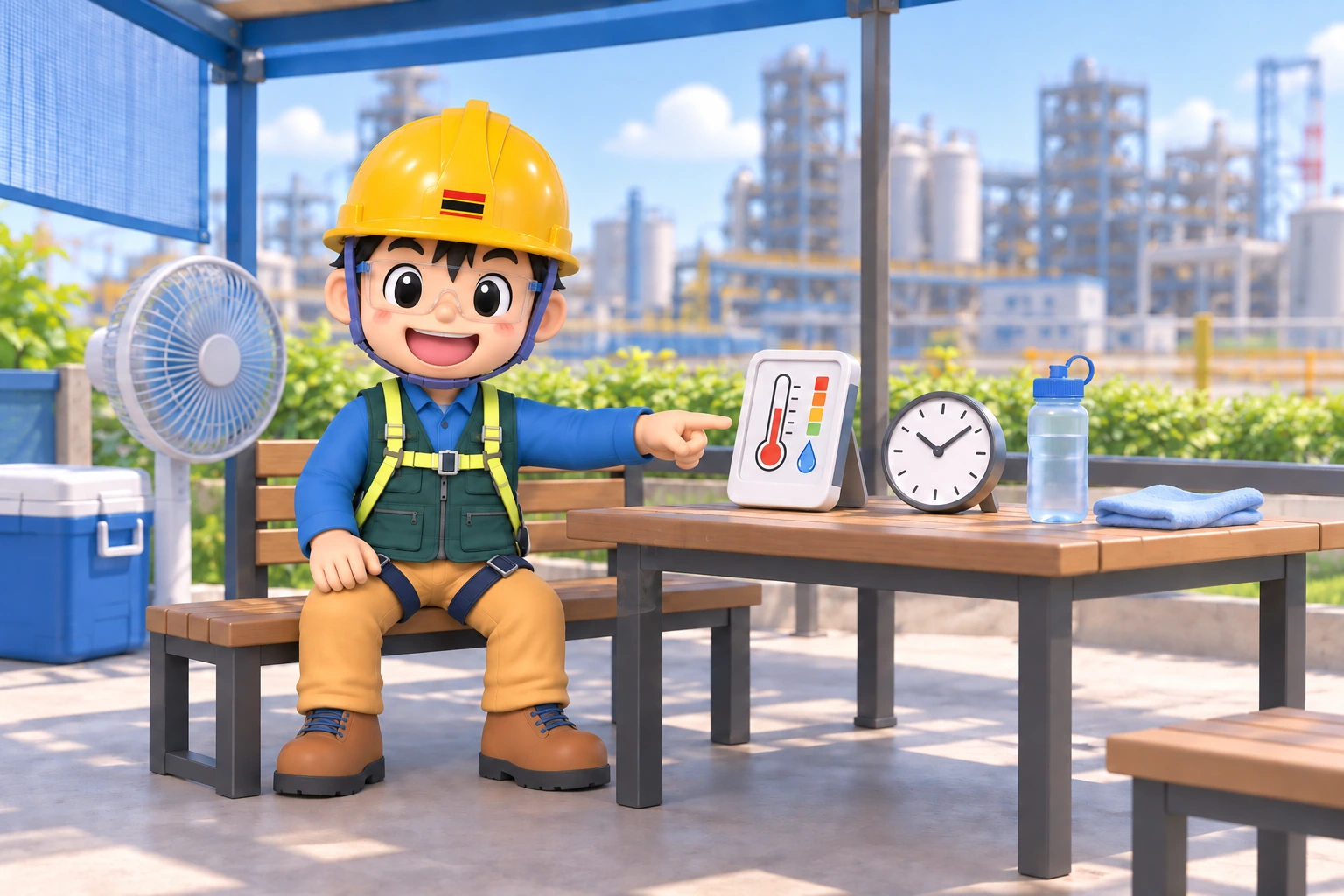
Keep temperature/humidity instruments available where heatwave work is expected. A value below 31°C does not prove absence of heat risk; work involving process heat may also fall under separate high-temperature provisions.
Understand the two thresholds
For heatwave work, implement at least one specified measure: cooling/ventilation, exposure-reducing schedule changes, or suitable rest. If cooling or schedule changes still leave the task within the definition, rest is required.
At an apparent temperature of 33°C or above, heatwave workers must receive at least twenty minutes of rest within every two hours. A narrow proviso concerns tasks whose nature makes rest very difficult, with measures such as personal cooling or cooling garments to reduce body-temperature rise.
Production pressure alone is not that exception.
Check your workplace
- Are temperature, humidity and the Annex method checked?
- Are required breaks actually available?
- Are daily controls recorded and emergency contacts understood?
Record conditions and action each day
Article 562 requires advance instruction on symptoms, prevention and emergency action, plus daily records of measured workplace apparent temperature and the measures taken. Keep those records through 31 December of the year in which the heatwave work occurred.
Do not confuse this with the three-year confined-space record rule. Article 571 also strengthens wording on adequate access to drinking water and salt.
Records must reflect real controls and real rest.
Respond to suspected illness without delay
Where heatstroke or other health impairment occurs or is suspected due to high-temperature or heatwave work, arrange prompt notification to the competent fire service and appropriate action. Do not make a symptomatic person wait for the scheduled break.
Prepare a stop-work and emergency-contact procedure. The amendment took effect on 17 July 2025.
It also revised general rest wording and regulatory-review provisions; a government review interval does not automatically terminate employer duties.
Putting it into practice
Record location, time, apparent temperature and cooling/schedule/rest action together. Tell the team where and when to rest, while making clear that suspected illness triggers immediate action rather than waiting for a scheduled break.
Technical insight
Distinguish the legal trigger from individual heat burden
The specified apparent-temperature method determines the South Korean provision’s trigger. Process heat, workload, clothing and individual condition remain relevant to prevention.
Link readings to the task and measures actually provided. Do not interchange this legally specified metric with another heat index merely because both are expressed numerically.
Sources
- 국가법령정보센터 · 제448호 개정문 / Amendment text대한민국 / Republic of Korea
- 산업안전보건기준에 관한 규칙 · 현행 / Current OSH Standards Rules대한민국 / Republic of Korea