MOEL Ordinance No. 454: confined-space measurement, records and response (Partial amendment to the Rules on Occupational Safety and Health Standards)
The amendment explicitly requires measuring equipment to be supplied, three-year retention of measurement/evaluation records, and clearer emergency notification and understanding checks.
Change at a glance
Promulgated: 2025-12-01
Effective: 1 Dec 2025; record duty applies to measurements from commencement
Current-text check:
| Item | Before | After |
|---|---|---|
| Measurement | Appointment and assessment already required | Equipment supply explicitly added |
| Records | No paragraph 4 in this article | Names, time/place and results retained three years |
| Abnormal condition | General rescue action; notify supervisor | Notify fire service and cooperate; inform employer and supervisor |
| Instruction | Inform before work | Check understanding and train as necessary |
Supply equipment as well as appointing a competent person
Article 619-2(1) already required a person with measurement/evaluation knowledge and practical experience to assess oxygen and hazardous gases before work. The amendment explicitly adds provision of measuring equipment.
Measurement itself is not a new duty introduced here. The existing pre-work requirement includes restarting after a temporary interruption, and earlier provisions address the measurer’s understanding and training.
Appointment without usable equipment is not an adequate operational arrangement.
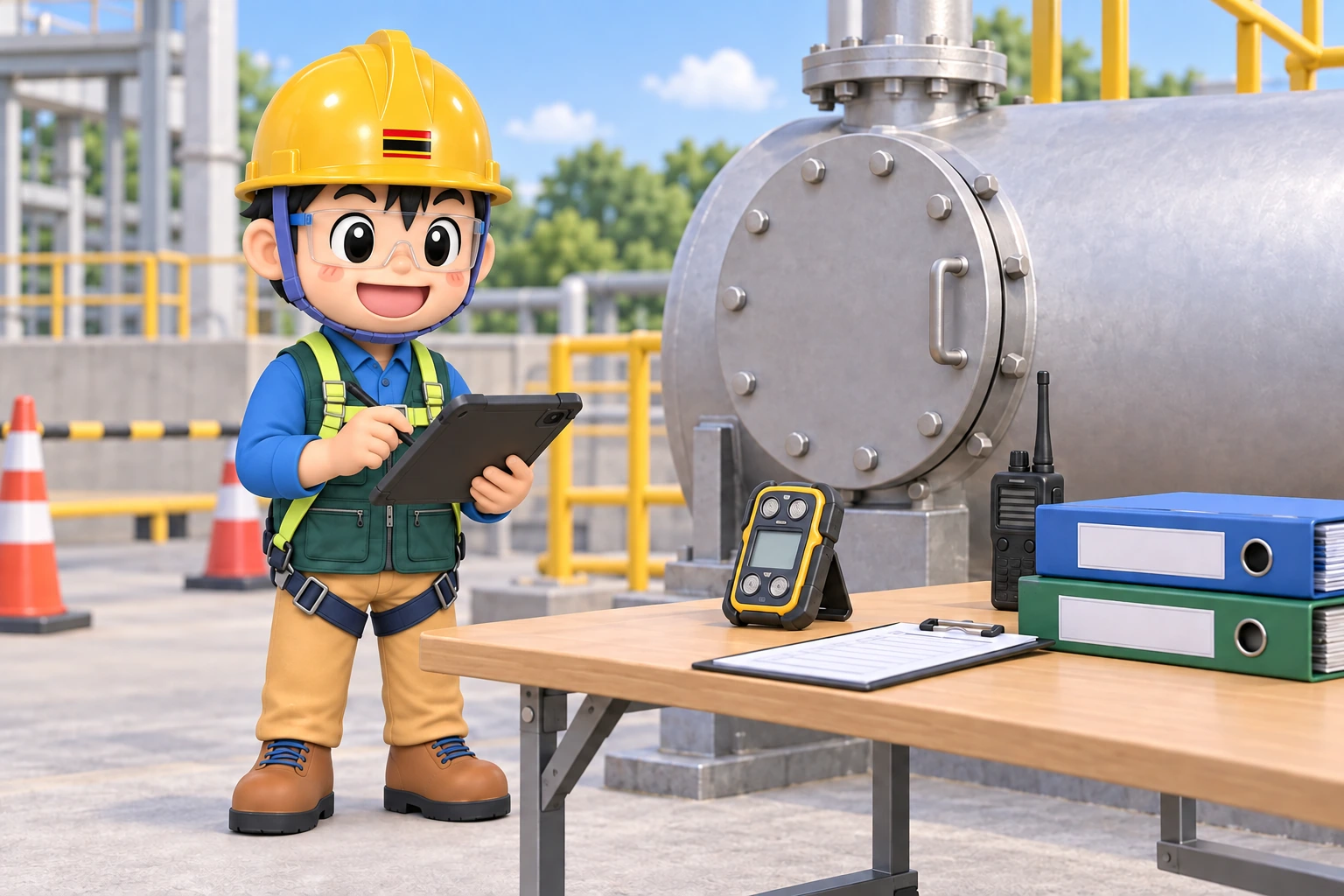
Retain an identifiable measurement and evaluation record
New paragraph 4 requires the name of the person measuring/evaluating, date and time, location and results, retained for three years. Fixed or mobile video equipment can be used for recording; the wording does not mandate video for every job.
Records should make the assessment traceable rather than simply saying normal. The transitional provision applies to measurements under the article from 1 December 2025.
Adding instrument identity, sampling points and retest reasons is an practical suggestion.
Check your workplace
- Has the competent person received suitable equipment?
- Can names, times, locations and results be retained for three years?
- Can workers and attendants explain the response procedure?
The attendant must not wait only for an internal response
Article 623(2) now specifies prompt notification to the competent fire service when a worker shows an abnormal condition, appropriate action with its cooperation, and immediate notification to the employer and supervisor afterwards. This clarifies the earlier general rescue-request wording and expands the internal recipients.
It does not instruct an unprotected attendant to enter for rescue. Separate rescue requirements, including respiratory protection in Article 643, must also be addressed.
Confirm understanding before work
Article 641 covers workers and attendants: confined-space hazards, measurement, ventilation and work methods, protective equipment, emergency contacts/first aid, and escape-equipment location/use. The amendment adds a duty to check understanding and provide necessary instruction.
Asking the person to identify the contact route and equipment is a useful practical method. A related fire-service definition was adjusted in Article 562.
A measurement record is not an automatic entry clearance; ventilation, attendance and emergency arrangements still matter.
Putting it into practice
Link names, time, space, sampling points, measurement and evaluation results in the entry record. Add a fresh assessment on restart, and have the attendant identify emergency contacts and escape equipment.
Technical insight
Make the meaning of a reading recoverable
Retaining a record does not establish that sampling represented the space. Location, time and work conditions affect what a value can explain.
Read the location, method, instrument and resulting action as a chain. Completing a form and deciding whether entry conditions are established remain separate tasks.
Sources
- 국가법령정보센터 · 제454호 개정문 / Amendment text대한민국 / Republic of Korea
- 산업안전보건기준에 관한 규칙 · 현행 / Current OSH Standards Rules대한민국 / Republic of Korea