What changes during a shutdown?
HSE chemical-plant permit guidance considers isolation, draining, flushing, risk assessment and communication together.
Understand the situation
Shutdowns change boundaries and routes: temporary power, open lines, removed protection and contractor work can coexist. Stopped production does not mean the whole area is safe.
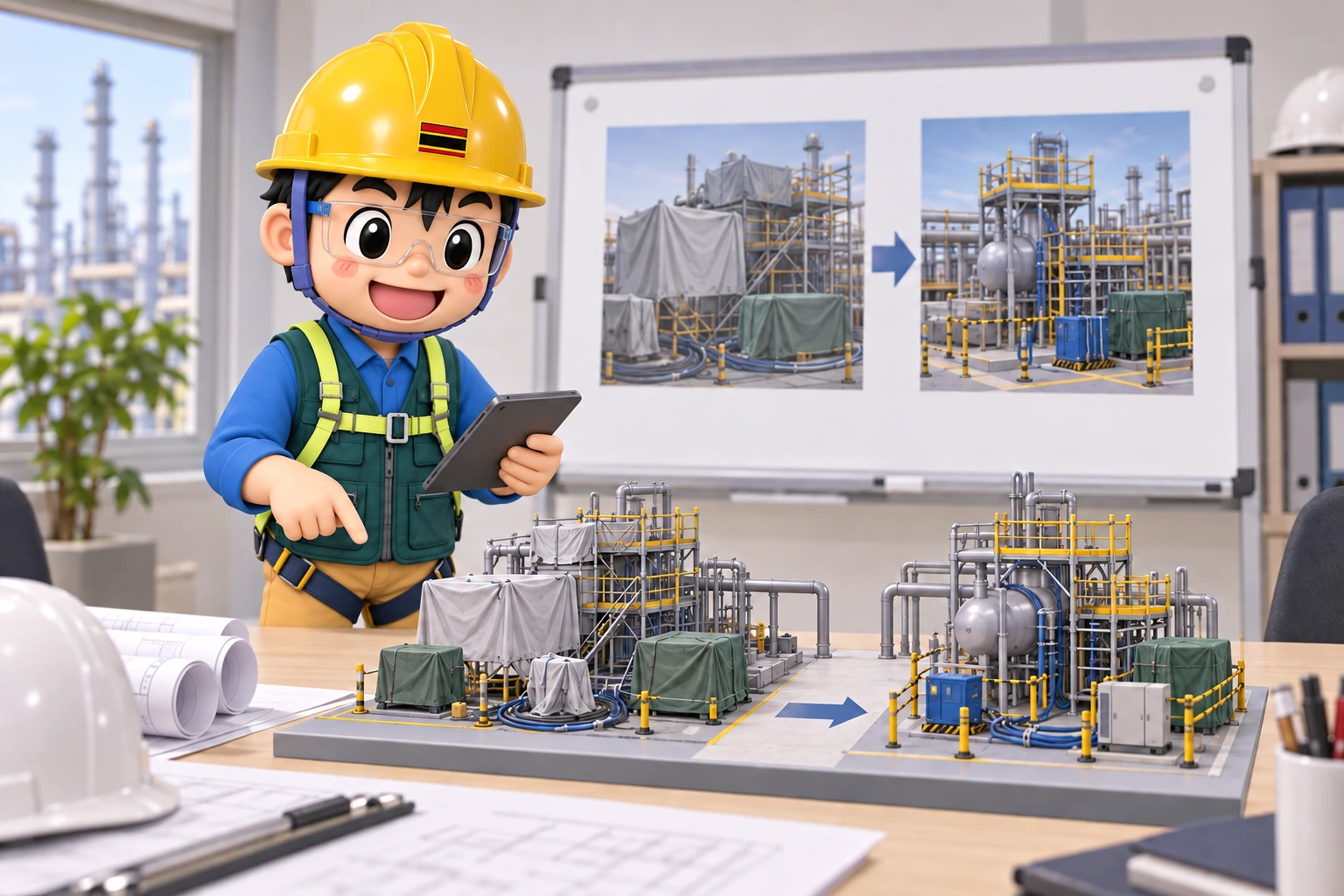
Review the task
Compare normal and temporary conditions in the plan. Give each change an owner and an end condition.
Communicate changes affecting other permits to those crews.
Check your workplace
- Are there temporary bypasses?
- Are protections or alarms unavailable?
- Who verifies reinstatement?
Apply the lesson
For example: a temporary hose affects both installation work and material or evacuation routes. Mark its position, agree an alternative route and tell affected workers.
Avoid a common mistake
Maintenance completion and plant reinstatement are distinct. Address temporary arrangements, protections, alarms and outstanding personnel or work through the restart process.
An elapsed shutdown schedule is not authorisation.
Putting it into practice
Compare valve states, temporary power, simultaneous work and access routes between operation and shutdown.
Technical insight
Manage transitions during shutdown work
Normal operation, draining, intrusive maintenance and reinstatement have different hazards. A control valid in one stage may not be sufficient in the next.
Track the current state and the conditions for each transition. Check whether restarting nearby equipment changes the isolation boundary of unfinished maintenance.
Apply through process-specific shutdown, change and restart procedures.
Korean safety resources
- KOSHA GUIDE C-C-2-2025 · Chemical plant maintenance planning
Korean-language PDF on maintenance planning and preparation; technical recommendations.