Reading hot-work rules 240 and 241
Articles 240 and 241 of South Korea’s Rules on Occupational Safety and Health Standards address hot work on relevant pipes/vessels and broader precautions. Read the scope with each requirement.
Understand the situation
Korean articles 240 and 241 address different parts of hot-work control. Identify the relevant equipment and possible contents, then review preparation and precautions.
Fire-watch triggers in article 241-2 need separate consideration.
Review the task
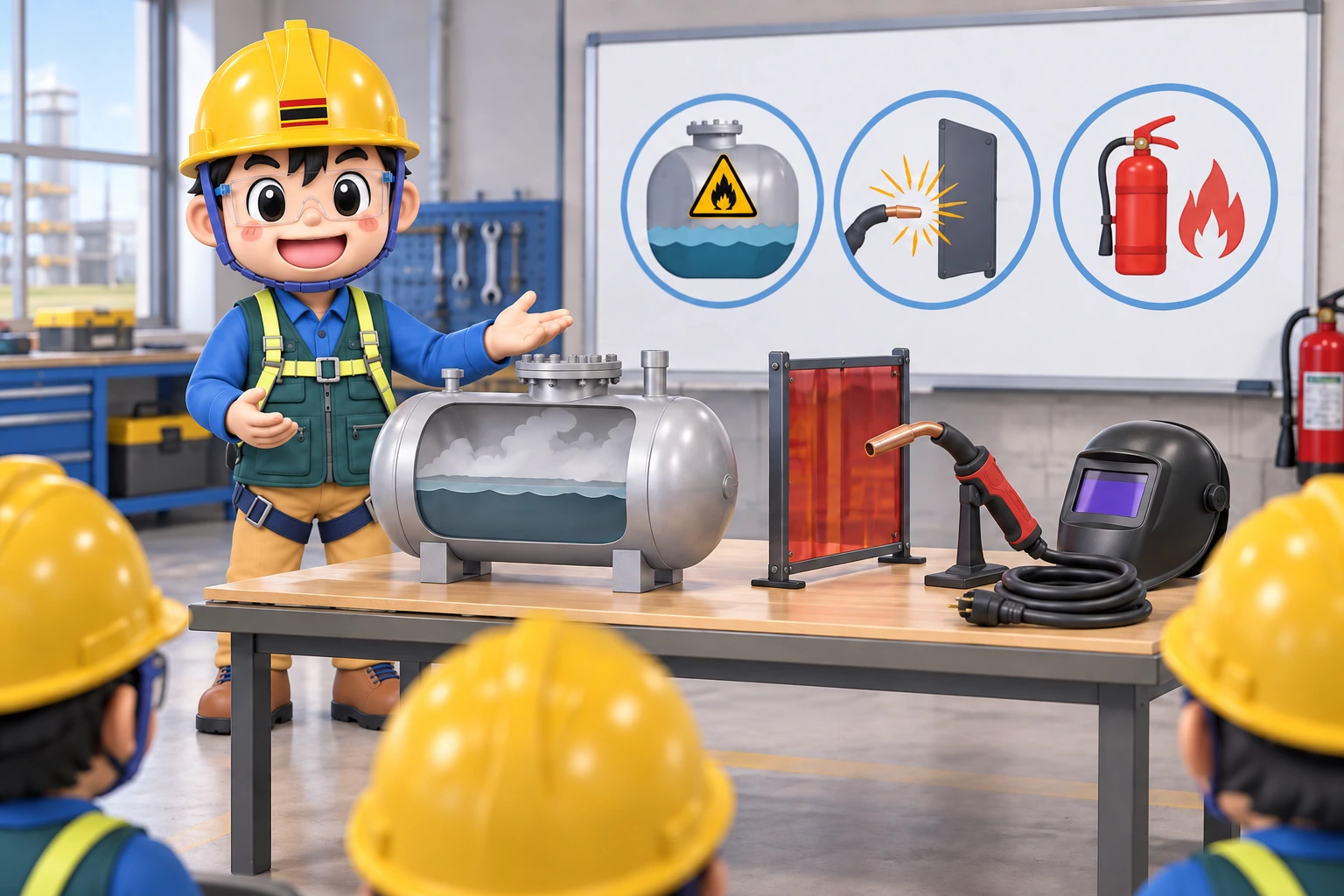
Article 240 addresses pipes and vessels where specified hazardous or flammable contents may be present, requiring preventive measures before hot work. “Unused” is not evidence that possible residues have been resolved.
Check your workplace
- Was potential residual material considered?
- Which paragraph covers this task and location?
- What verifies each control?
Apply the lesson
Article 241 covers oxygen misuse for ventilation, preparations, hazardous-material information, combustible protection, firefighting equipment, spark controls, ventilation and emergency instruction. It includes a welding-blanket certification requirement and pre-work verification.
Avoid a common mistake
Its written posting requirement has a stated repeated-work exception; that should not be read as removing other precautions. These are Korean provisions, not worldwide rules.
Our review table pairs each applicable measure with actual evidence and a verifier.
Putting it into practice
Review equipment, possible contents, preventive measures and verifier. A short checklist is not a complete legal compliance assessment.
Technical insight
Consider contents and surroundings separately
When reading Articles 240 and 241 of South Korea’s Rules on Occupational Safety and Health Standards, distinguish equipment contents from surrounding fire exposure. A spark barrier does not establish the internal condition of a tank.
A practical checklist can separate contents and connections, nearby combustibles and emergency arrangements. These controls should not disappear into one general completion tick.
Korean safety resources
- KOSHA GUIDE C-C-2-2025 · Chemical plant maintenance planning
Korean-language PDF on maintenance planning and preparation; technical recommendations.
Sources
- 국가법령정보센터 — 제240조대한민국 / Korea
- 국가법령정보센터 — 제241조대한민국 / Korea