Should you enter to rescue a colleague?: The FFG liquid nitrogen release (2021)
30-second summary
On 28 January 2021, liquid nitrogen overflowed from a freezer at FFG in Gainesville, Georgia. Vaporized nitrogen displaced oxygen indoors, killing six employees. The CSB identified a design in which deformation of one level-sensing tube defeated both normal control and emergency shutdown.
People approaching to investigate or rescue colleagues also became casualties. The practical focus is overflow prevention, room oxygen monitoring, isolation from outside the affected area and protected rescue. Check both whether supply stops on failure and where people go when an alarm sounds.
Work background and incident sequence
Line 4 combined an immersion freezer with a spiral freezer. Messer designed and owned the leased equipment, which FFG operated. The room was partly recessed and nearly enclosed at low level. It lacked dedicated mechanical ventilation and relied on building make-up air, allowing cold nitrogen to accumulate.
After commissioning in December 2020, uneven belt loading and incomplete freezing recurred. On 23 January, the nitrogen inlet end was modified and the control valve and transducer were replaced. Freezing problems persisted on 26–27 January and the level setting was adjusted. Equipment and settings were changing during troubleshooting.
Production began at about 07:16, but partially frozen product led to a processing stop around 08:14. Workers went on break around 08:20 while maintenance investigated. The CSB recorded maintenance without shutting down the freezer and with door and lid safety switches bypassed. Stopping product flow had not isolated the equipment.
The CSB considered it likely that the bubbler tube bent during maintenance, but could not determine the precise action or time. The deformed tube failed to sense the rising level and nitrogen overflowed. Investigators could not establish whether the first two victims had the awareness and opportunity to stop the supply or escape.

Returning workers saw white fog but associated it with normal conditions. Around 09:40, a worker looking for a colleague found someone motionless on the floor. The worker alerted others and returned with another employee. Investigating missing colleagues and rescue attempts exposed additional people to the atmosphere.
Equipment and work principles
A bubbler measures liquid depth through the pressure needed to discharge gas from a submerged tube. Its tip must remain in the intended position. The FFG freezer used the same tube for normal level control and the high-level interlock. Separate control functions sharing one physical input can fail together.
The bent tip rose above the overflow level. Even as liquid rose, the expected pressure signal could not develop with the tip above the liquid. Post-incident water testing examined this geometry. Changing a setpoint or rereading the display could not restore a damaged sensing point.
One support clamp was missing from manufacture and escaped inspection. The CSB found that unsupported length and clamp position increased the vulnerability to bending. Inspection needs to compare internal supports with drawings, not just check exterior panels. Maintenance verification should cover geometry, fastening and actual level response.
Liquid nitrogen boils near −196°C at atmospheric pressure; the report gives an expansion ratio of about 696 at 21°C. Nitrogen is colourless, odourless and nonflammable, but displaces oxygen. The white cloud is condensed atmospheric moisture, not the colour of nitrogen. Visibility cannot establish the hazardous boundary.
Nitrogen mixes with air at room temperature, while very cold nitrogen can collect at low level. Room geometry and ventilation affected breathing zones as well as the total release. Sensor placement should consider the source, low areas, airflow and access routes, with functional tests of detection and alarms.
An asphyxiation hazard crosses contractual boundaries. The CSB found that Messer’s stewardship for storage tanks did not extend adequately to the freezing process. Supplier failure information needs to connect with user ventilation, monitoring and emergency arrangements. Acceptance should identify who has verified each interface.
Inspection sequence also concealed the defect. The CSB found that the lid was already closed at the bubbler checklist step, which was understood to refer to exterior components. No instruction explicitly required inspection of the internal clamps. The supplier subsequently specified clamp checks and reordered the inspection so the interior was accessible. A signed checklist cannot establish a check of a component that was out of view.
Post-incident design changes added independent bubbler tubes and an external temperature detector. The external detector activates safety interlocks when cryogenic liquid reaches the inlet. This provides detection at another location and by another principle if a level tube is damaged. In view of the design and inspection changes, the CSB made no separate recommendations on those two issues.
Published chronology and investigation findings
The CSB identified level-control failure caused by tube deformation as the release cause. Single-point design, deficient process safety management, regulatory gaps and inadequate stewardship contributed. Missing atmospheric detection and emergency preparedness worsened consequences. Replacing the tube alone would leave other findings unaddressed.
Recommendations addressed supplier participation in customer hazard analysis, shutdown-device locations, atmospheric monitoring and alarms, and information for local responders. The CSB also recommended an OSHA standard for cryogenic asphyxiants. These are US investigation recommendations, not automatically Korean legal duties.
| When | Established account | Source |
|---|---|---|
| 2020-12 | Freezer commissioned | CSB p.23 |
| 2021-01-23 | Inlet modification; valve and transducer replacement | p.23 |
| 2021-01-28 07:16 / 08:14 | Production start / processing stop | p.24 |
| About 09:40 | Collapsed colleague discovered | pp.24–25 |
| 10:11 / about 10:18 | Emergency call / fire service arrival | pp.26–27 |
| About 10:15 | Estimated isolation at outside storage tanks | p.32 |
| 2023-12-11 | Final report published | CSB incident page |
Consequences and emergency response
The report records six employee deaths and serious injuries to three employees and one firefighter. Four deaths followed the initial two maintenance victims during response or rescue. At least fourteen other employees approached the room or surroundings. Prevent further entry, isolate from a safe position and provide hazard information to responders.
An emergency call was made at 10:11 and responders arrived around 10:18. The CSB estimated manual isolation at the outside tanks at about 10:15. Emergency shutdown should not require crossing the release zone. Assess accessible isolation and escape directions during layout design.
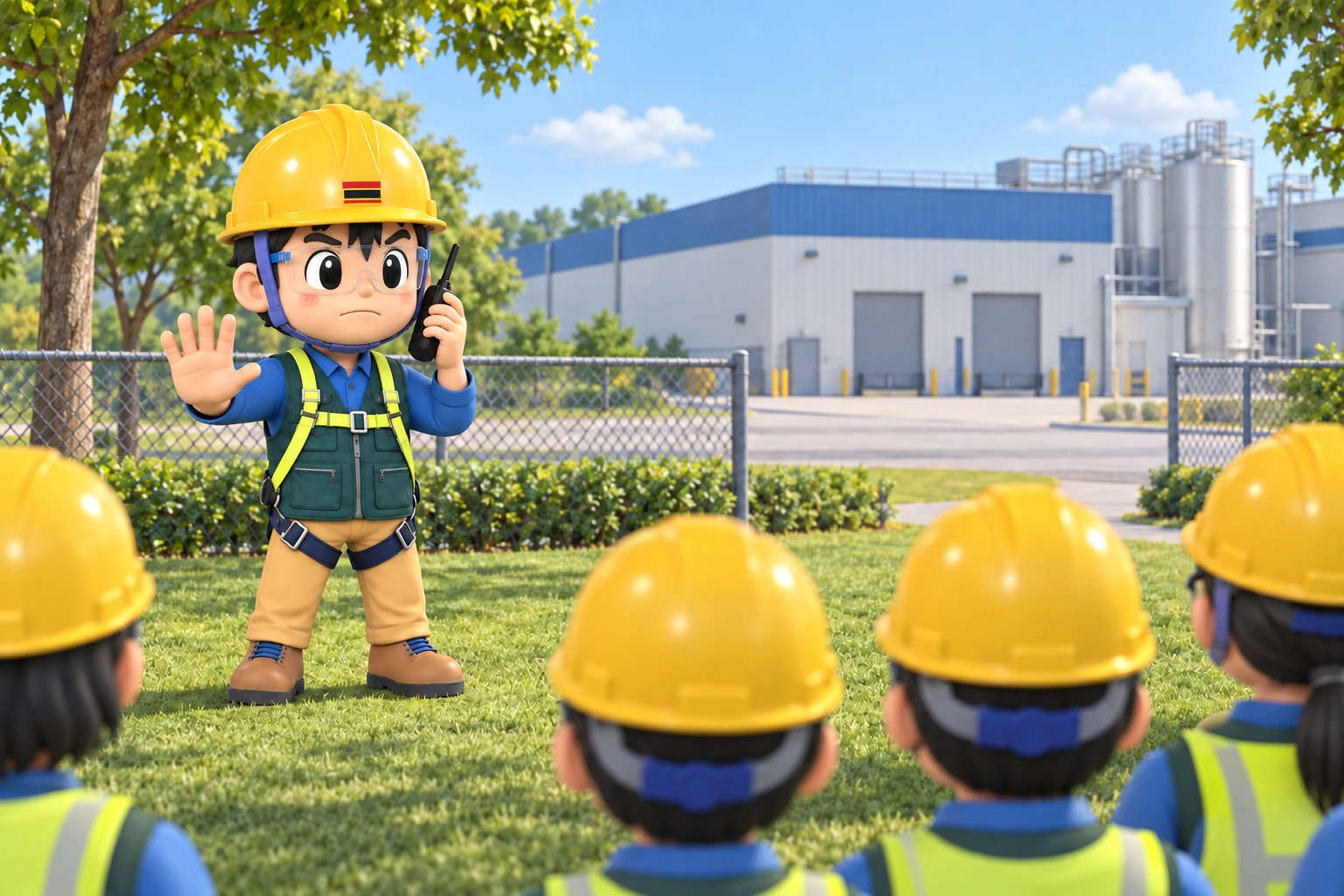
This does not depict the actual FFG layout, evacuation distance or rescue procedure.
Questions for your site
| Question | How to check |
|---|---|
| Do control and overfill shutdown share a sensor? | Trace inputs, power and valves and assess independent protection. |
| Does an alarm lead to isolation and evacuation? | Function-test oxygen detection, audible/visual alarms and shutdown, and train personnel. |
| Can isolation be reached safely during a release? | Compare shutdown access with release scenarios and escape paths. |
| How are tube geometry and supports verified after maintenance? | Compare internal parts with drawings and require a functional test at handover. |
Application at Korean sites
Comparable work in Korea is subject to the Rules on Occupational Safety and Health Standards, MOEL Ordinance No. 450, effective 2026-03-02. The following concerns present work; findings about the incident depend on its investigation and proceedings.
Article 619 requires a confined-space program covering locations, hazards, pre-entry checks and training. Before work, establish personnel, measurements and corrective actions, possible gas ingress or generation, protective equipment and emergency contacts. Post the information at the entrance until work ends. Include gas arriving through connected supplies.
Article 619-2 requires competent measurement and evaluation of oxygen and harmful gases before starting or resuming work. Use instruments suitable for the gases involved; an oxygen reading does not measure toxic contaminants. Paragraph 4 requires measurement and evaluation records to be retained for three years. Prepare for changing conditions as well as pre-entry readings.
Article 625 requires equipment for emergency escape and rescue, including breathing apparatus or supplied-air masks, ladders and ropes as appropriate. Check whether the equipment can actually be used through the entrance and along the extraction route. Rescuers must be protected from the atmosphere that caused the emergency; unprotected entry is not a rescue plan.
How I would approach this incident at work
I first consider whether rescue equipment can be used at the actual entrance and work position, rather than just counting the items available.
I check the readiness of lifting and evacuation equipment and respiratory protection, trained rescuers and access routes against the plan.