One task changes another: The DuPont La Porte methyl mercaptan release
Four workers died in the 15 November 2014 DuPont La Porte release. CSB reported that a pressure problem thought unrelated was connected to pipe-clearing work.
30-second summary
What happened: A piping alignment used to clear a blockage connected to an indoor release path.
Harm: Initial exposure and subsequent rescue entry resulted in four deaths.
Why: CSB identified flawed design, inadequate safeguards and process-safety deficiencies.
At your site: Separate the decision conditions for routine drainage and an abnormal release.
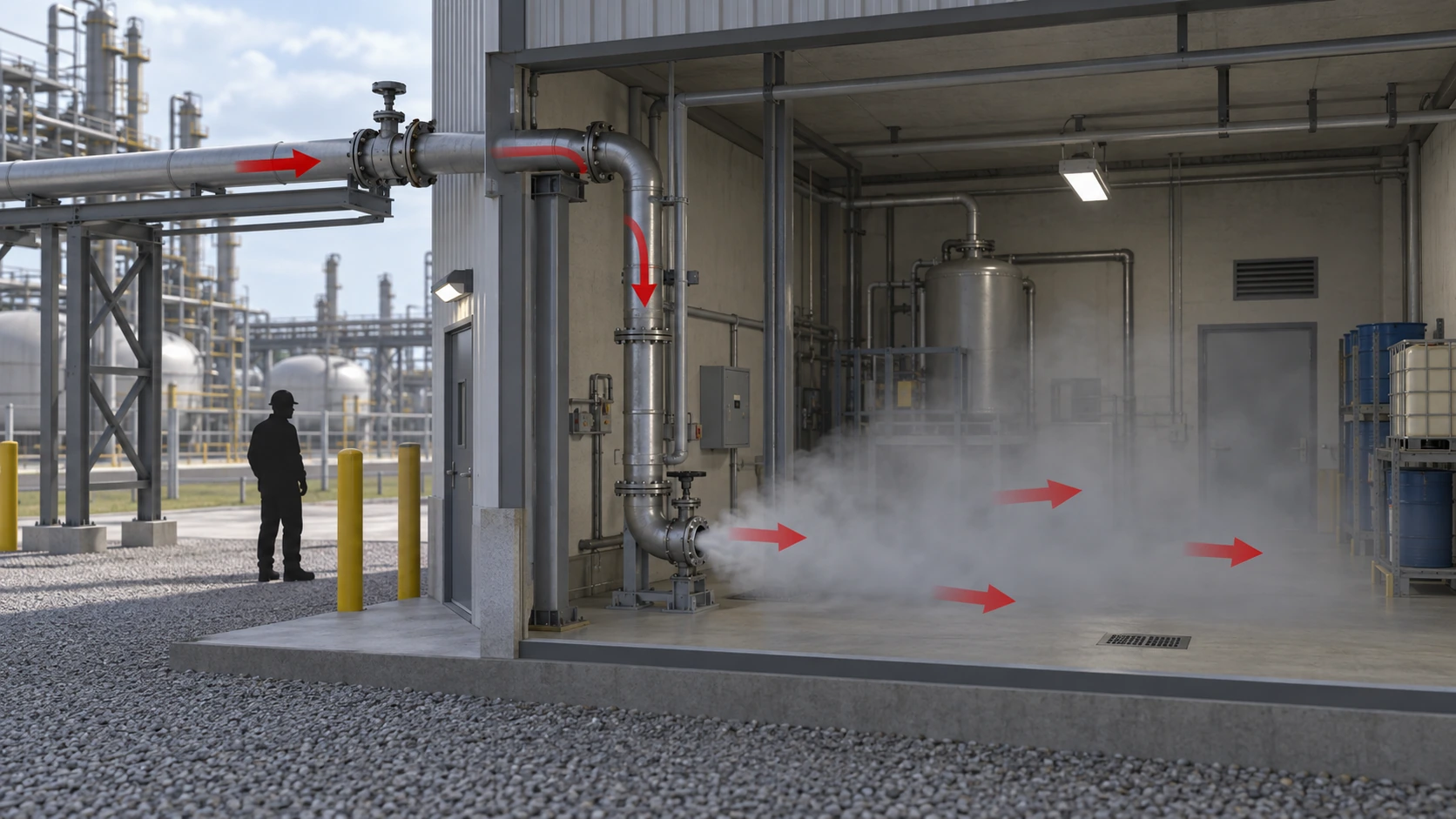
Incident sequence and working conditions
On November 10, five days before the incident, inadvertent chemical dilution caused operating problems and shut down the Lannate unit. Restart attempts on November 12 were halted by plugging in methyl mercaptan piping to the reaction section. Personnel initially tried to resolve the problem without knowing that a hydrate caused the blockage. These shutdown and restart events preceded the clearing work.
On the morning of November 14, a technical team of engineers and experienced personnel reviewed the problem with operations staff. They identified water entering the system and forming solid hydrate as a likely explanation, and requested hot water on piping beneath the insulation. Heating also required a vent path for expansion. Valves to a waste-gas vent header were opened, creating a path through which liquid could later escape inside the building when drains were opened.
During the 17 hours before the incident, the control panel registered 32 methyl mercaptan alarms. CSB found that some operations personnel associated the odour and alarms with ongoing troubleshooting and had normalised them. At 02:51 on November 15, high-pressure alarms began for equipment in the building. Personnel did not recognise liquid methyl mercaptan entering the header and attributed the pressure to a long-standing condensate accumulation problem.
CSB records a release of approximately 24,000 pounds of methyl mercaptan on November 15, 2014—approximately 10.9 metric tonnes after conversion. Three operators and one shift supervisor died (final report, p. 7).
Between 03:01 and 03:13, two sets of drain valves on the third floor were opened. Liquid methyl mercaptan escaped and vaporised instead of condensate. CSB also examined earlier external hot-water heating to clear hydrate blockage associated with water and low temperature (pp. 14–16).
Between 03:24 and 03:26, three detectors registered gas and sent alarms to the control room. At about 03:30 an urgent radio call requested help. Of four additional operators who approached, two died and two survived (pp. 16, 18).
At about 03:50 the site emergency response team was called. Information about the release location, substance and entry hazards must accompany respiratory protection and rescue preparation in the response following a call for help.
Equipment and process principles — technical explanation
The hydrate blockage investigated by CSB was associated with piping conditions involving water, methyl mercaptan and low temperature. During external hot-water heating to clear it, flow conditions in connected piping and headers could also change. Pages 14–16 place the heating and valve operations in sequence.
Technical explanation: A blocked flow path does not eliminate connected pressure sources. Clearing it can create a new route into a section that appeared separated. Trace the connected header and discharge destination, rather than examining only the valve nearest the task.
Temporary valve alignments during troubleshooting can differ from the normal operating drawing. Use the HSG253 isolation approach to identify connected pressure sources and the work boundary, then include removal of residual contents and proving isolation in the sequence. Even with the same discharge objective, changed substance or pressure conditions require a procedure review.
Methyl mercaptan presents both toxic and flammable hazards. Page 13 of the CSB report cites an immediately dangerous to life or health concentration of 150 ppm and flammability limits in air of 3.9–21.8%. These are cited substance-hazard data, not Korean occupational limits or rescue-entry criteria. Toxicity and ignition require separate assessment. Page 15 describes an odour threshold as low as 2 ppb; page 24 discusses olfactory fatigue during exposure. Weaker odour cannot establish that the atmosphere has become safe.
CSB findings — protection layers
| Layer | What is needed | Confirmed condition | Evidence |
|---|---|---|---|
| System design | Design a safe release route for troubleshooting | Troubleshooting alignment connected to indoor drains | CSB final-report release · 2019-06-25 · incident sequence paragraphs |
| Abnormal-task review | Assess heating and valve-alignment changes together | Hydrate-clearing work and header connection | CSB No. 2015-01-I-TX · 2019-06 · printed pp. 14–15 |
| Hazard recognition | Assess pressure deviations and toxic-gas alarms together | Pressure interpreted as familiar condensate accumulation | CSB final-report release · 2019-06-25 · incident sequence paragraphs |
| Ventilation | Verify design performance and review conditions during failure | Two ventilation fans were not working | CSB No. 2015-01-I-TX · 2019-06 · printed pp. 8, 100–101 |
| Rescue entry | Identify substance, zone and respiratory protection before rescue | Two initial deaths and two deaths during rescue approach | CSB final-report release · 2019-06-25 · incident sequence paragraphs |
| Emergency information | Share equipment location, release type and floor access information | Misinterpretation and mapping/air-monitoring deficiencies | CSB No. 2015-01-I-TX · 2019-06 · printed pp. 31–32 |
CSB describes multiple shortcomings, including design and safeguards. Reducing the event to one worker or one permit loses that system context. This account stays within the agency’s final-report release. Ask how a team learns that another activity has changed its conditions.
Our application is to map connections and discharge destinations across job boundaries. Share abnormal pressures, temporary actions and draining work with operations and affected crews.
CSB examined implementation of process safety management as well as equipment-level failure. Its 2015 interim recommendations identified delayed maintenance of safety-critical equipment, missing written procedures, poor hazard analysis, unimplemented inherently safer design concepts and weak hazard recognition. Pages 10–11 of the final report explain that the corporate system did not identify, prevent or mitigate site-specific deficiencies. Assessment must connect management documents to equipment, operation and response conditions.
CSB emergency-response recommendations and recipients
The 03:50 rescue request was understood by the ERT as high-angle or confined-space rescue. Unaware of the major toxic release, it gathered ropes, harnesses and other technical-rescue gear. At 03:57 the control room asked security to call external emergency services. Personnel arriving at 03:58 recognised a chemical release and the need for additional protection. A rescue request needs substance and current-hazard information as well as the missing persons’ location to support equipment selection.
At 04:05 the incident commander requested responders with firefighting clothing and SCBAs. The mini-pumper carrying SCBAs and radios would not start and could not reach the scene. Inventory and actual emergency availability differed. An emergency plan must connect alternative equipment retrieval to a route that avoids the release area when the primary vehicle cannot move.
Air monitoring was delayed during the early hours. The shift supervisor assigned to provide process-specific hazard information was a casualty and unavailable. CSB records that the ERT did not initially use air-monitoring equipment to identify the released chemical. A backup route for process/substance information and monitoring equipment was needed when the person holding that role could not respond.
A hot zone was established around the building at about 04:10, but its boundaries were not clearly marked or communicated. At about 04:15, an operator retrieving replacement SCBAs alone entered the release path, felt ill despite detecting no odour, and retreated to the control room. Equipment-support tasks also fall within hazardous-area control. Boundaries and permitted routes must reach support personnel as well as the response team.
CSB recommendation 2015-01-I-TX-R8 is addressed to the DuPont La Porte facility. It calls for an improved emergency response plan with participating ERT companies DuPont, Chemours, Kuraray and Invista, and ICWUC/UFCW Local 900C. It covers notification, hazardous-atmosphere monitoring, equipment access/training, scene control and joint drills (pp. 129–130).
Recommendation 2015-01-I-TX-R9 is addressed to ICWUC/UFCW Local 900C, calling for work with DuPont to develop and implement the R8 plan. The facility and worker representatives are to share that plan and connect it to practical response preparation (p. 131).
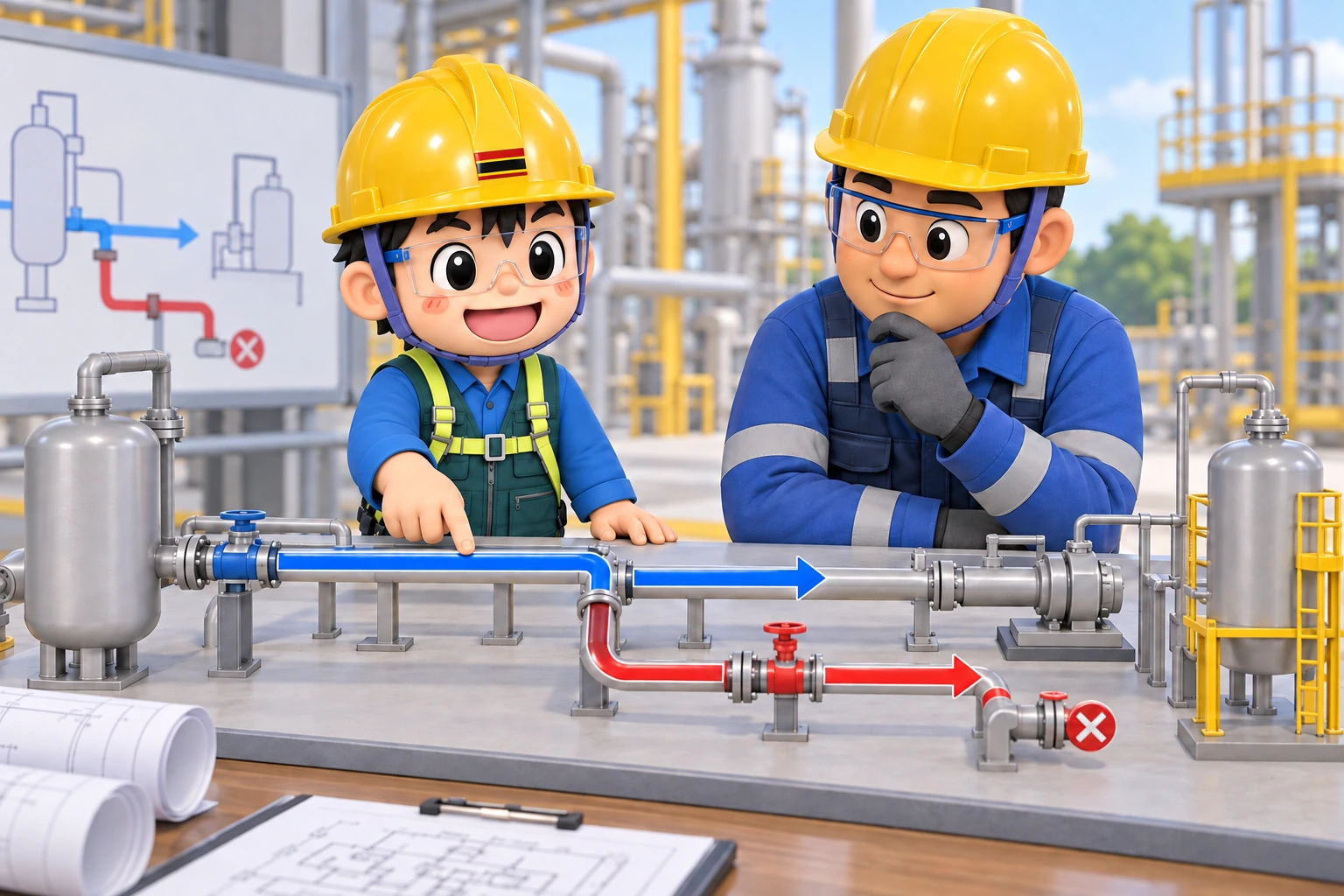
Questions for your site
| Question | How to check |
|---|---|
| Which header becomes connected during blockage recovery? | Overlay normal and temporary valve states and trace them to the discharge point. |
| May a pressure rise be treated as routine drainage? | Compare material and operating changes with the conditions covered by the procedure. |
| Who converts an alarm into an entry restriction? | Connect control-room recognition to field access control through assigned roles and communication. |
| How does ventilation failure affect permission to work? | Distinguish fan availability, performance and the tasks allowed during failure. |
| Does an assistance call trigger assessment for a toxic release? | Provide equipment, substance and alarm information before deciding on rescue entry. |
| Do other teams know the changed discharge path? | Compare permits and tasks in affected areas with the temporary-alignment register. |
Application at Korean workplaces
For Korean acute-toxic-substance equipment, compare Article 299 with the actual substance and plant conditions. Article 278 addresses direction, release prevention and concentration checks during chemical-plant disassembly/internal work; Article 279 addresses stopping and evacuation during imminent fire/explosion danger. Link KOSHA GUIDE C-C-2-2025 maintenance planning and permit/change controls to the task schedule.
The KOSHA confined-space safety guide covers permits on p.20, safety measures on p.24 and rescue on p.44. Use it for preparation and emergency planning; its legal references reflect the publication period.
Rules on Occupational Safety and Health Standards: MOEL Ordinance No. 450, amended 2025-09-01; effective 2026-03-02.
What the initial update and final investigation established
The 17 November 2014 update described the investigation beginning: meetings with company and union representatives, interviews and assessment of safe site access. It did not present a final causal account. The final report combined physical, interview and documentary evidence to explain release and escalation pathways.
How I would approach this incident at work
Before checking whether a drain valve has been opened, I check what will come out, where it will come from and where it will go.
I review the receiving destination’s capacity, backpressure in the common header, and people and ignition sources around the outlet.
References
- CSB — DuPont La Porte final-report release
- KOSHA · Safe work guide for preventing confined-space asphyxiation
- CSB No. 2015-01-I-TX · 2019-06
- HSE HSG253 · second edition, 2006
- KOSHA GUIDE C-C-2-2025 · 2025. 3. (Korean)
- Rules on Occupational Safety and Health Standards · MOEL Ordinance No. 450 (Korean)
- CSB investigation update · 2014-11-17
Related cases
The KET pigging case examines pressure and exit direction during blockage recovery; the confined-space checklist examines harmful atmospheres and rescue preparedness. Compare those mechanisms without classifying the DuPont building as a confined space.