Before confined-space entry
A reading alone is not entry authorisation. Korean MOEL emphasises pre-entry checks; UK HSE also addresses avoiding entry and preparing rescue.
Understand the situation
A normal reading at an opening does not describe an entire space. Define the purpose of entry, work location, connected equipment and substances the task may introduce.
Cleaning, coating or welding can change conditions after entry.
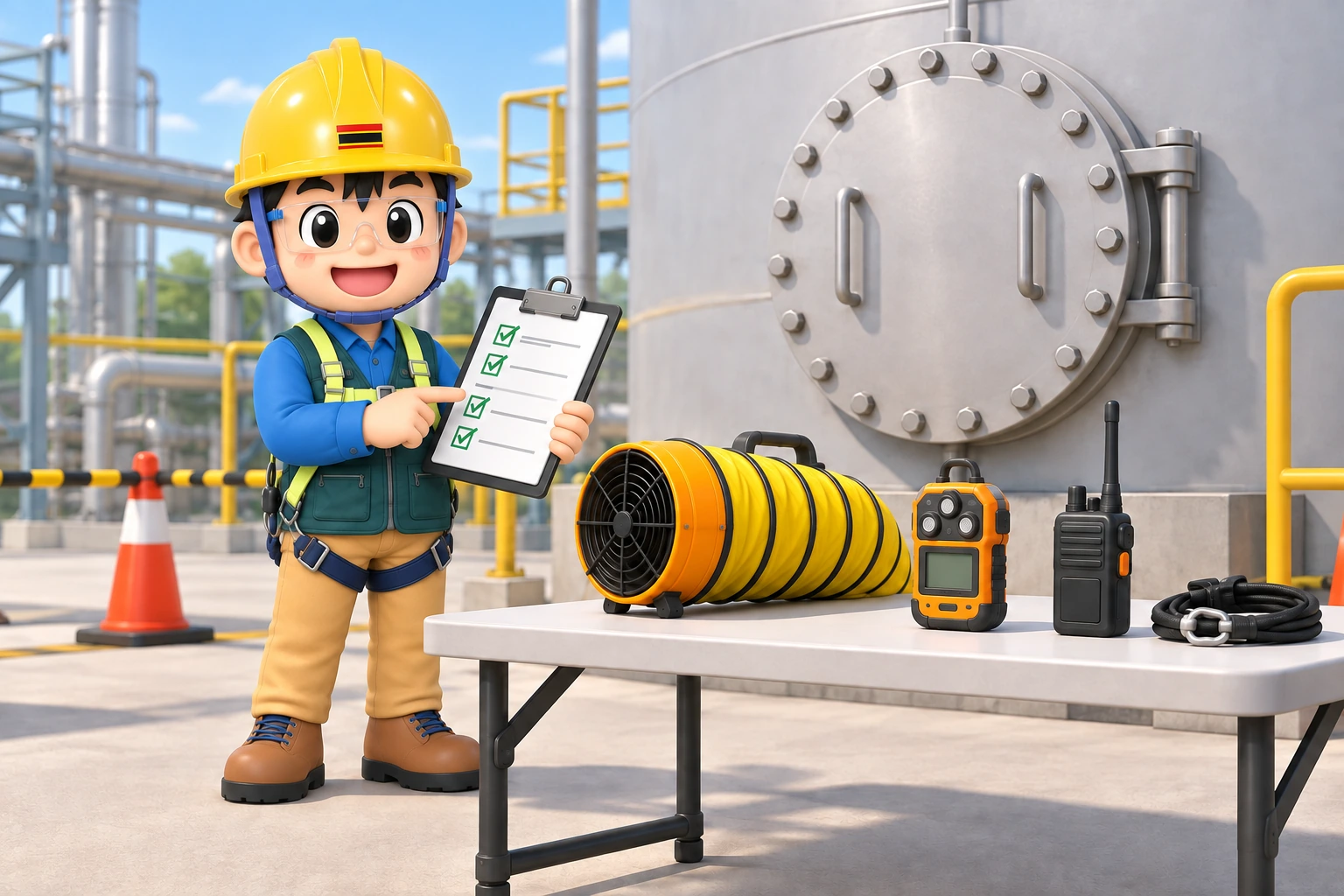
Review the task
Start by considering a method that avoids entry. Where entry is necessary, the responsible team brings isolation, ventilation, testing, attendance, communication and rescue arrangements into one plan.
Workers should understand which areas the sampling plan covers.
Check your workplace
- Can the task be performed from outside?
- Are isolation and ventilation verified?
- Are attendance, communication and rescue arrangements ready?
Apply the lesson
For example: a tank-cleaning crew receives only an opening measurement. Ask whether the planned work area and residues were assessed.
Mark unsampled locations explicitly rather than filling them in as safe. Keep the entry decision open until the responsible team resolves the gap.
Avoid a common mistake
Follow the agreed withdrawal procedure if alarms, ventilation failure or communication loss occur. An unprepared colleague entering after a casualty is not a rescue system.
Rescue needs task-specific planning, competent responders and suitable equipment.
Putting it into practice
Record measurement location, time, target gas, tester and reassessment triggers. Agree what happens if alarms, ventilation failure or communication loss occur.
Technical insight
Match the sampling plan to the task
Do not let the gases installed in a detector define the entire hazard assessment. Consider residues, cleaning agents, work inside and connected equipment before selecting measurement methods.
An entry plan should connect readings to actions when ventilation stops, work changes or an alarm activates. A single normal reading cannot replace management of changing conditions.
Site entry criteria, sampling plan and legal applicability need review.
Korean safety resources
- KOSHA · Safe work guide for preventing confined-space asphyxiation
Korean-language PDF: permits p.20, safety measures p.24, rescue p.44. Legal references reflect the edition’s publication period.
Sources
- HSE — Confined spaces INDG258영국 / UK
- 고용노동부 — 밀폐공간 질식사고 예방 집중 관리대한민국 / Korea