Before hot work: look beyond the work point
Ignition hazards extend beyond the weld
Clearing the visible welding point is not sufficient preparation. Sparks can fall through openings, heat can pass through metal to combustibles on the other side, and vapour entering a connected tank can ignite during work outside it. Assess these as separate paths: the work point, spark destinations, heat transfer and connected equipment interiors.
The actual cutting or heating matters more than the job label. If tools, location or method change, reassess the required controls rather than rely on the original check.
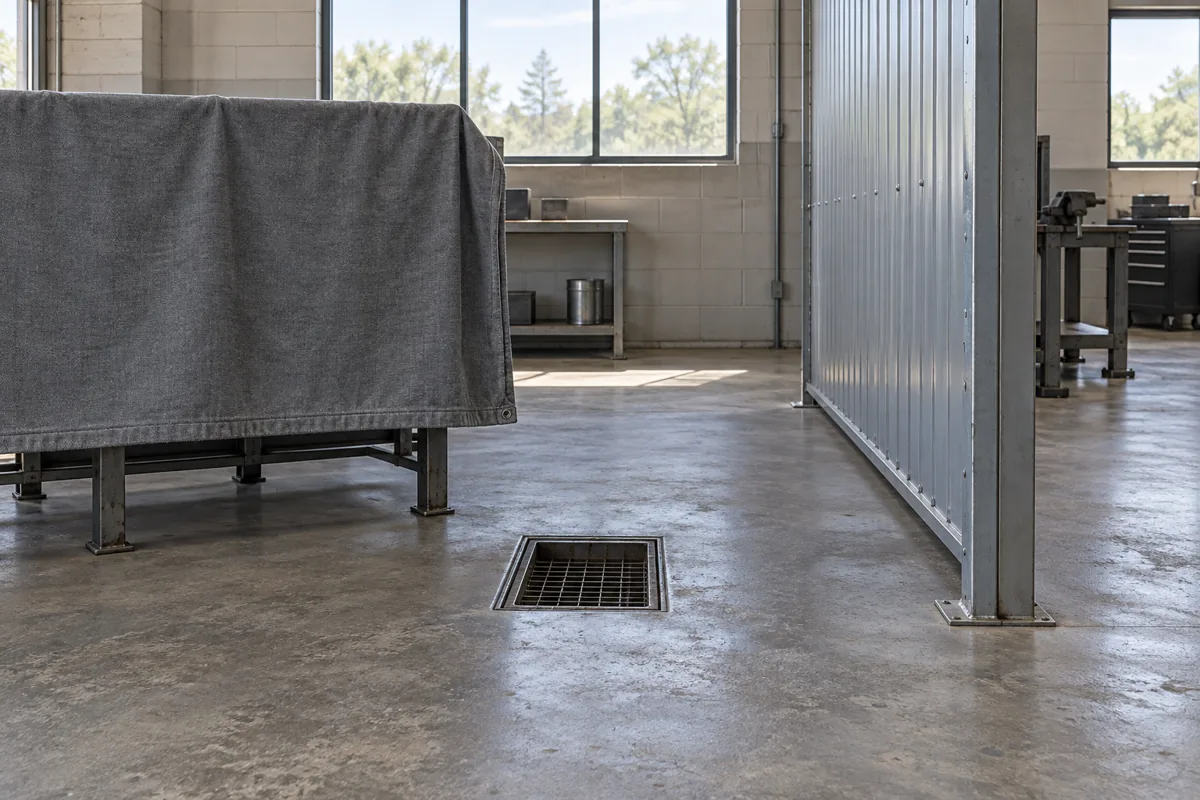
- Blanket edge: examine gaps and protective coverage.
- Floor penetration: trace the path to the space below.
- Beyond the partition: examine combustible exposure on the far side.
Sparks, heat and vapour follow different paths
Hot particles can pass around blanket edges, overlaps and pipe penetrations into a lower level. Covered area alone does not describe containment. Examine the direction of production and possible destinations, including whether protection remains effective when the tool angle changes.
Heat can reach the opposite face of a metal partition. A clean floor does not address combustibles attached behind it. Lack of visible sparks there does not remove the hazard. Korean fire-watch criteria expressly include combustibles near the opposite side of metal partitions that could ignite through conduction or radiation.
Flammable vapour can enter through process connections. A previous emptying operation does not eliminate the influence of connected operating equipment. Identify former contents as well as current connections and possible inflow. An initial reading cannot establish conditions after a connection or operating state changes.
Figure 2 highlights the checks described here.

- Downward path: inspect below the work point for exposed combustibles.
- Metal boundary: examine the far side where heat can transfer.
- Connected pipe: trace potential inflow beyond the vessel.
- Work tank: assess internal conditions separately from external protection.
A connection missing from the list, a space missing from the test
In the Buffalo report, the overflow line was more than a drainage accessory. Damage to its liquid-seal section allowed a vapour path between operating and maintenance tanks. The damage was found, but its flammable-vapour significance was missed and repair deferred until a later shutdown. Assessing a failed part only by its visible leakage can miss another path that it previously blocked.
The lockout card included valves and the agitator motor but omitted the overflow line, which had no valve. A complete list of lockable devices was not a complete isolation boundary. Trace connections into and out of the equipment before listing devices to lock. Overflow and equalisation lines can affect the atmosphere even when they do not carry the main operating flow.
Other connected tanks remained in operation. Material could therefore re-enter while the maintenance tank was being prepared. Treating maintenance authorisation and connected operating status as separate paperwork can leave this boundary unresolved. The interface between operating and maintenance equipment must be assessed.
There was measurement and continuous monitoring around the tank top, but not inside the tank. The problem was not simply test frequency: the tested space was different. Combining worker-surroundings monitoring with internal-explosion assessment obscures what was established. The record needs to identify the tested location.
CSB analysed accumulation of heavier-than-air vinyl fluoride low in the tank and the contribution of steam condensation after insulation removal to inflow and increasing concentration. A small continuing input can alter a retained atmosphere. A small apparent inflow does not establish a harmless internal concentration.
An unsealed gap around the agitator shaft could admit sparks or release vapour, while CSB also considered ignition through contact with heated metal. Covering one gap does not establish control of the internal atmosphere. Control formation of the atmosphere and the possible ignition paths separately.
The permit signatory did not adequately understand the process hazards and believed the contractor was still working on a steam line. The authorisation understanding had not followed the actual work. Field verification needs agreement on the actual location, not merely recitation of an equipment name.
What the Korean provisions require
Article 240 prohibits fire-risk work on piping, tanks or containers that may contain specified hazardous or flammable materials until explosion and fire-prevention measures, such as removal, have been taken. External work does not remove the need to assess the interior. The removal and isolation method must suit the equipment and task.
Article 241 covers preparation, procedures, hazardous-material use and storage, combustible protection, extinguishing equipment, spark containment, control of flammable vapours and emergency measures. Welding blankets used for this purpose must be performance-certified. Oxygen must not be used for ventilation in inadequately ventilated places.
The 11-metre conditions in Article 241-2 are not a universal boundary beyond which danger ends. Combustibles below the work and on the far side of metal partitions also matter. Apply the specified conditions and exceptions and identify the locations needing coverage. One person beside the operator cannot automatically cover several levels.
Checks at start, change and completion
During preparation, match the equipment identity and location and assess connections. Establish visibility above, below, behind partitions and through openings. An unseen space with unknown combustibles is not a completed check. Separate removal from shielding and align ventilation, monitoring and watch coverage with the actual work.
During work, watch for displaced shielding or combustibles introduced by another task. Stop and report from a safe position if ventilation or connected equipment changes, or unexpected odour, smoke or leakage develops. A repeated reading alone is not a sufficient restart decision when the changed hazard has not been assessed.
At completion, inspect possible spark destinations as well as the work point, including protected recesses, penetrations and hot surfaces. Watch termination and handover depend on the site procedure and remaining hazards; one universal waiting time is not appropriate for every job.
Figure 3 highlights the checks described here.
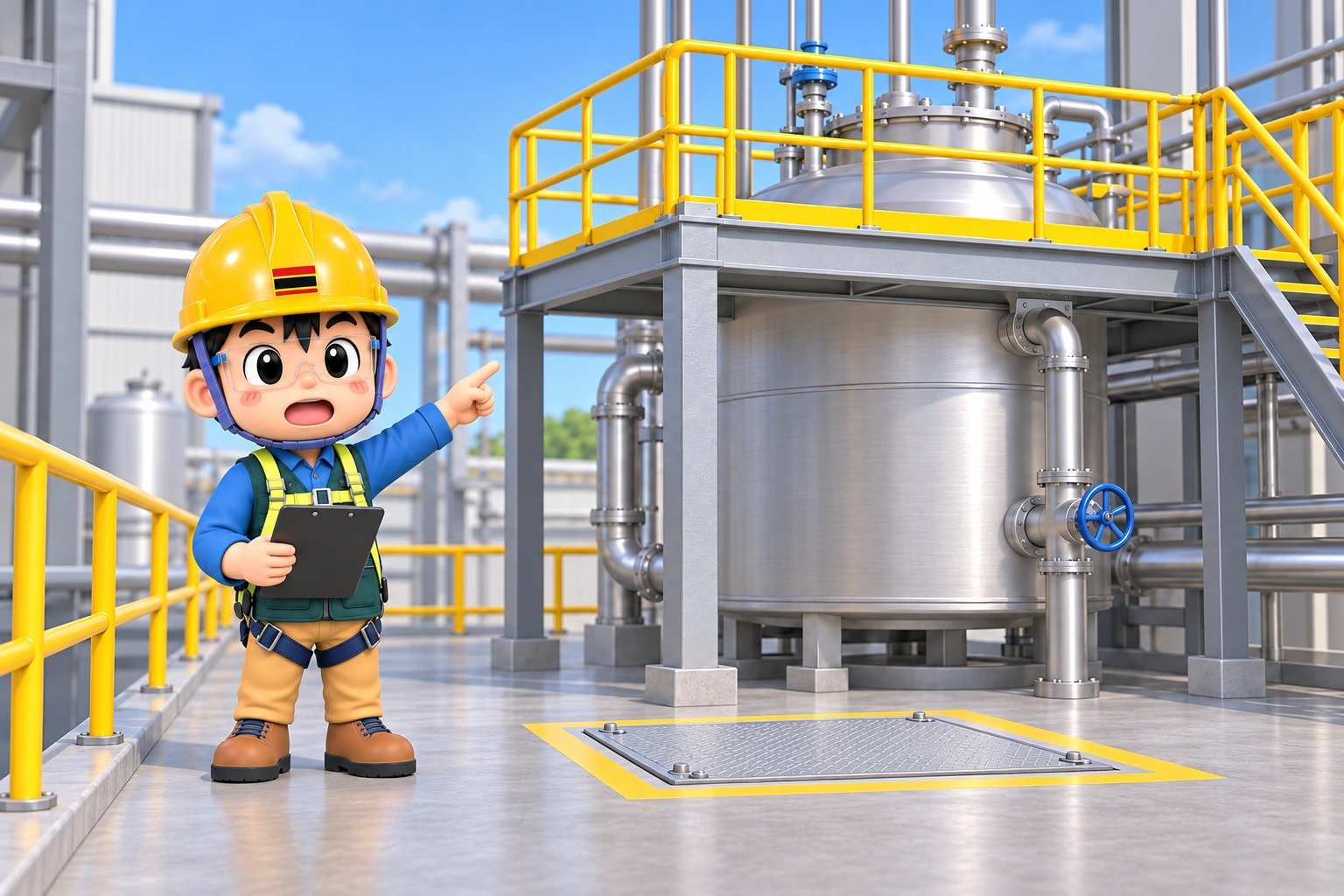
Look above, below and beside the work area with Safety Kim before starting work.
Questions that follow the hazard outward
The questions below follow the hazard from the work point to adjacent spaces, lower levels and connected equipment. They do not replace permit authorisation. An unresolved item needs an identified field check and a defined condition for restart.
| Point | Question | Follow-up |
|---|---|---|
| Spark path | Have openings, edges and lower destinations been checked? | Assess covered area and bypass paths separately |
| Heat transfer | Are combustibles on the far side of metal? | Define inspection and watch coverage |
| Interior | Could connected operating equipment feed the space? | Reconcile contents, connections and measurement locations |
Removal and monitoring remain task-specific
Tank cleaning and measurement locations or intervals require a procedure based on contents, geometry, connected operations and the job. Overseas investigation findings support comparison rather than determine a Korean legal violation. Detector selection and substance-specific criteria require the instrument and substance information together with applicable Korean provisions.