Hot work near a tank: The PCA DeRidder tank explosion (2017)
30-second summary
At about 11:05 on 8 February 2017, a foul condensate tank exploded at PCA’s DeRidder paper mill in Louisiana. Three contractors died and seven were injured. Their task involved water piping and its supports above the tank, rather than repair of the tank itself.
The CSB determined that air mixed with flammable vapor inside the tank and considered the overhead hot work a likely ignition source. It could not establish a definitive ignition source. A clear gas test at the work piping did not establish safety inside an adjacent vessel.
Work background and incident sequence
The annual outage began on 5 February. No work was planned directly on the foul condensate tank, and it was not emptied. Mill personnel believed that its vapor space mainly contained non-condensable gas and water vapor with insufficient air for combustion.
The water piping above the tank had shifted on its supports and cracked at a connection, causing a leak that had been temporarily repaired. Outage work would reposition the piping, repair the crack and weld guides to prevent further movement.
On 7 February, operations personnel closed and locked valves in the water system. Contractors disconnected flanges and repositioned the piping. No positive isolation, such as a blind flange, was installed on the open end at the tank-side valve. That day’s repositioning did not require welding.
On the morning of 8 February, testing found no flammable atmosphere in the water piping or around the platform. A hot-work permit was issued at about 08:00. Its review did not include the explosion hazard inside the nearby condensate tank.
Around the time of the incident, repositioning and crack repair were complete and guide welding was being finished. The CSB could not establish every activity at the precise moment, but the process-pressure spike and witness accounts supported an explosion at about 11:05.

The tank separated from its base and traveled about 375 ft, passing over a six-story structure before striking process equipment. The pipe rack and surrounding equipment were damaged. A fire watch at ground level was among those injured.
Equipment and work principles
The non-condensable gas, or NCG, system collects and treats process gases. Foul condensate can contain volatile material as well as water. Turpentine could form a separate layer on the water, and the CSB considered accumulation likely because it had not been removed for an extended period.
A fuel-rich, oxygen-poor atmosphere differs from a combustible fuel-air mixture. Conditions during normal operation cannot be assumed to persist after shutdown and cooling. Examine the paths that can change the ratio of fuel vapor to air.
The pressure-vacuum breaker could admit air to relieve low internal pressure. Both normal level cycling and cooling and condensation during shutdown can lower pressure. Isolation from process piping does not necessarily remove this air-entry path.
The CSB concluded that air ingress and cooling brought the tank atmosphere into the explosive range. Review remaining contents, temperature and pressure changes during shutdown, and what vacuum-protection devices admit. Calling it a water-containing tank does not exclude flammable hazards.
A gas reading describes its sampling location and time. A reading from water piping or a platform does not measure the tank’s vapor space. Adjacent or connected equipment can have different atmospheres because isolation, ventilation, temperature and residues differ. The assessment boundary may need to extend beyond the named task.
Opening a hatch arbitrarily to check inside is not the remedy. The CSB explained that potential flammable atmospheres require established safer methods such as purging and inerting. Sampling itself must not introduce added vapor exposure or ignition risk.
Closing a valve and disconnecting piping reduces possible paths but is not the same as positive closure of an open end. The tank-side valve was not recovered. The CSB documented the absence of a blind without establishing valve leakage as the sole ignition path.
Eliminating an explosive atmosphere and mitigating an explosion are different design tasks. The CSB discussed designs that reduce air entry, explosion-prevention systems and protection where prevention cannot be achieved. A plan to escape after an alarm does not adequately address a vessel becoming a projectile. Selected safeguards must work during both operation and shutdown.
Process review must consider possible states as well as inventory. A condensate tank can contain a separate flammable layer and vapor even when water is its main constituent. Cooling retained contents or stopping gas extraction can change the atmosphere. Include these changes in the turnaround hazard assessment.
The pressure-vacuum device described in the report vented at positive six inches of water and admitted air at negative six inches of water. Correct pressure protection can still introduce air into flammable vapor. Pressure protection and prevention of an explosive atmosphere therefore need to be assessed together.
Published chronology and investigation findings
The CSB found no process hazard analysis for the NCG system and unclear operating ownership of the tank. It concluded that limiting process safety management to regulated units could leave explosion hazards in connected equipment unaddressed.
Recommendations to PCA addressed process safety across NCG systems, explosion prevention and protection, functional safety and training. They sought risk reduction through equipment design and operating management rather than reliance on a hot-work permit alone.
The CSB also reiterated its recommendation to OSHA arising from the 2001 Motiva tank explosion concerning PSM coverage of atmospheric tanks. Both involved hot work above a tank containing flammable vapor, highlighting the danger of excluding vessel interiors from an external-work assessment.
Recommendations to PCA addressed explosion prevention and protection under the relevant standards and the functional-safety life cycle for safety instrumented systems. Periodic training was to include NCG hazards and conditions required for hot work. This extends beyond permit paperwork to understanding why an adjacent tank must be assessed.
Operations participation is needed from the work-request stage. Connect the requester’s knowledge of the leak with operating knowledge of residues, temperature and pressure. If tank hazards are not communicated, testing may cover only the named pipe. Joint review of equipment boundaries before permit issue helps close that gap.
| When | Established account | Source |
|---|---|---|
| 2017-02-05 | Annual outage began | CSB p.22 |
| 2017-02-07 | Water piping disconnected and moved | CSB p.25 |
| 2017-02-08 about 08:00 | Hot-work permit issued | CSB pp.25,30 |
| 2017-02-08 about 11:05 | Tank explosion; 3 killed, 7 injured | CSB pp.19–21 |
| 2018-04 | CSB investigation report | CSB cover |
Consequences and emergency response
The impact from the launched tank extended beyond the welding location. Damage to the pipe rack and nearby structures exposed people elsewhere. Defining a hot-work area requires consideration of adjacent-vessel explosion and projectiles, not only spark travel.
Evacuation also failed in important respects. The report cites OSHA findings that some employees were not evacuated for over an hour, contractors were not accounted for and some phones were inoperative. Turnaround contractors must be included in emergency arrangements.
An on-site roster differs from the permanent employee list. Before a turnaround, establish team locations, muster-accounting responsibilities and alternatives for failed communications. Connect permit close-out arrangements with emergency accountability.
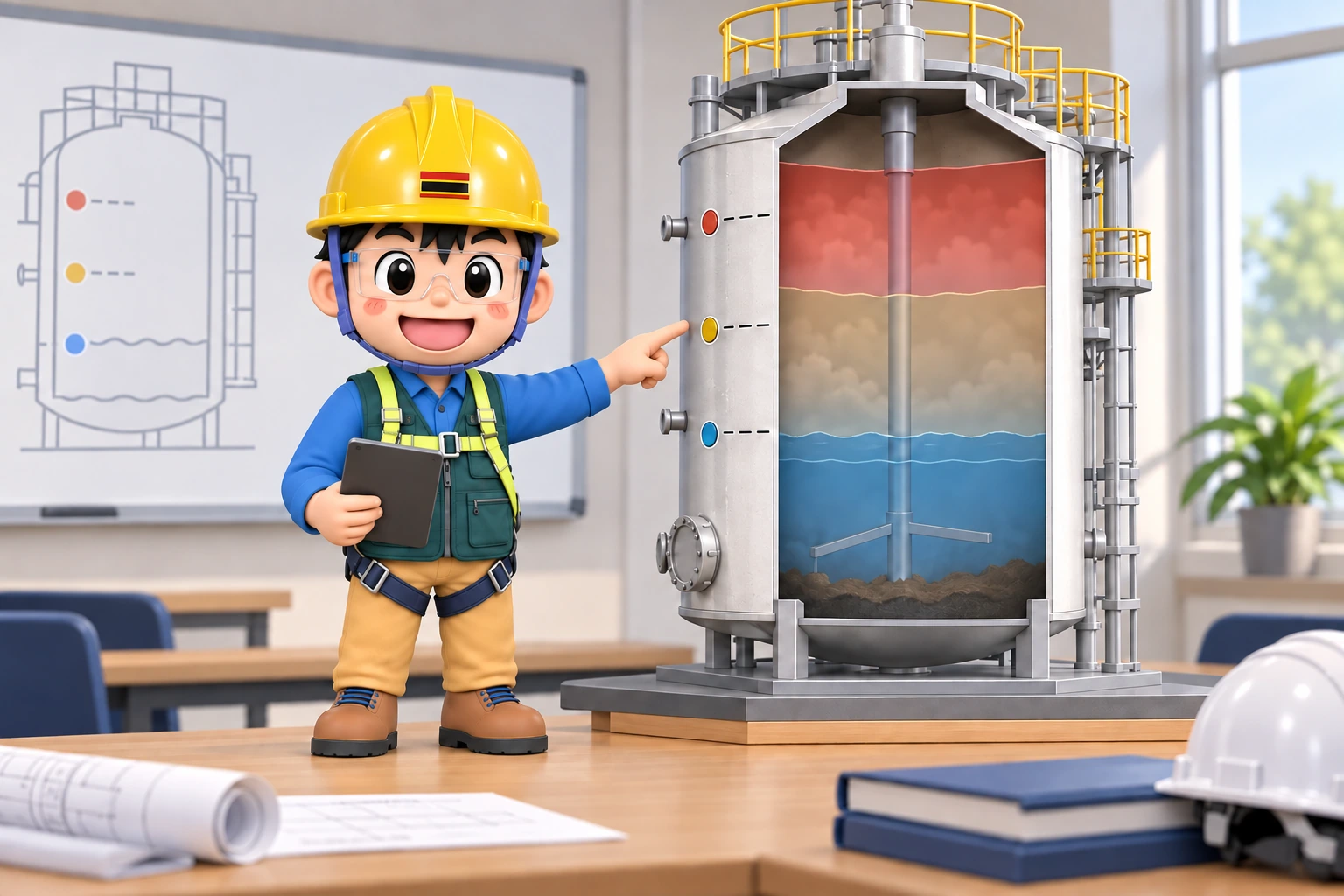
This does not depict the actual PCA layout, the moment of the accident or evidence of ignition.
Questions for your site
| Question | How to check |
|---|---|
| Has the vessel below been assessed even though the task is on water piping? | Map adjacent vessels, vents and residues using both connections and physical layout. |
| Where can air enter during shutdown and cooling? | Review pressure-vacuum devices and cooling. Do not use normal oxygen-poor operation as evidence of shutdown safety. |
| Do recorded sampling locations cover the actual hazardous space? | Record locations, methods and retest conditions, and separately control hazards in unmeasured spaces. |
| Have alternatives to welding and positive isolation been considered? | Assess cold-work options and suitable positive isolation; link de-isolation to restoration authorization. |
| How will contractors be accounted for after an incident? | Connect team rosters to muster accountability and test alternatives for failed communications. |
Application at Korean sites
Comparable work in Korea is subject to the Rules on Occupational Safety and Health Standards, MOEL Ordinance No. 450, effective 2026-03-02. The following concerns present work; findings about the incident depend on its investigation and proceedings.
Article 239 prohibits ignition-producing or potentially hot equipment at or above locations with specified fire or explosion hazards. A hot-work permit does not waive the prohibition.
Article 241 covers procedures, hazardous-material inventories, combustible protection, extinguishing equipment, spark control, ventilation and escape training. Its current text also addresses pre-work checks, posted information and certification of welding blankets.
Article 278 addresses task direction, prevention of hazardous material or hot-steam leakage, and flammable atmosphere testing during specified disassembly or internal work. First determine whether the proposed task falls within its scope.