Before going onto a tank: the UTK sampling explosion in Ulsan
What work conditions should be checked before sampling at the top of a tank?
30-second summary
At about 11:15 on 10 February 2025, an explosion and fire at a UTK storage tank in Ulsan killed one external inspection-company worker and injured another. They were performing chemical sampling work at the tank roof.
An injured worker told investigators that contact between the sampling tool and tank was followed by a spark and explosion. A final forensic conclusion has not been verified. Sampling preparation should address hatch-opening exposure, tool contact and tank operating conditions as well as the stored material.
Work background and incident sequence
The workers belonged to an external company that analyzed stored chemicals. Opening a roof hatch and taking a sample brought them into direct contact with the process. A quality-inspection purpose does not remove the tank’s atmosphere or ignition hazards.
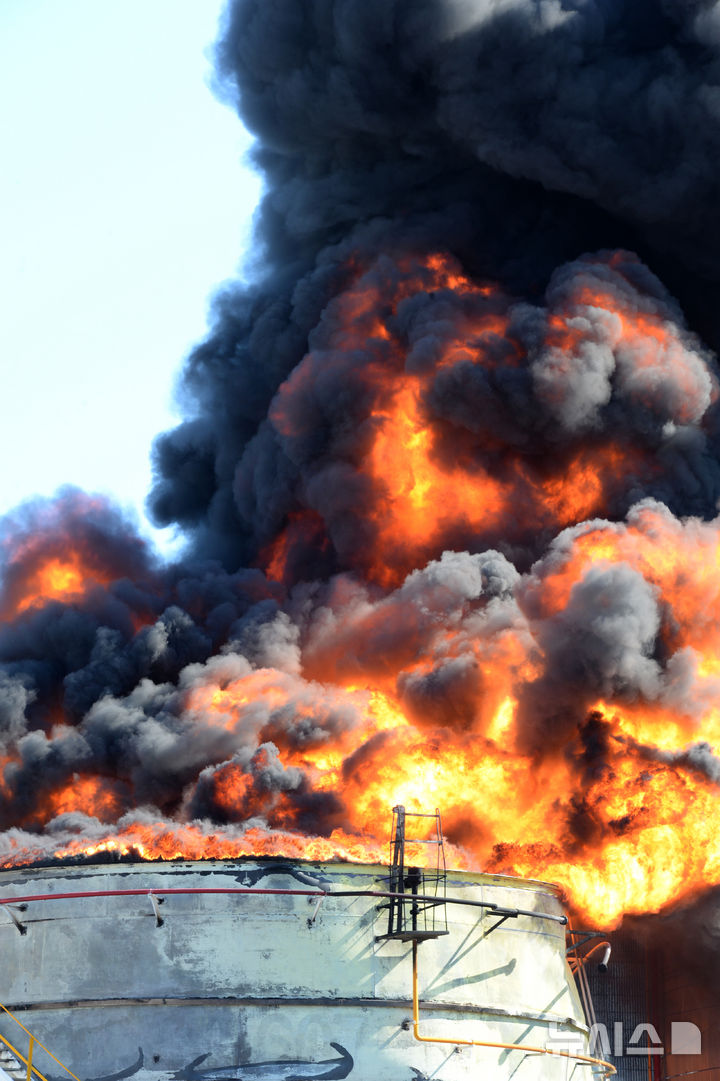
The explosion damaged the tank roof and caused a fire. Firefighters worked to prevent spread to nearby tanks while casualties were taken to hospital. The labor authority subsequently stopped roof work on storage tanks at the site.
On 11 February, the coast guard described plans to remove remaining contents and secure structural safety before forensic examination. The damaged tank also posed hazards to investigators, requiring safe access arrangements before examination.
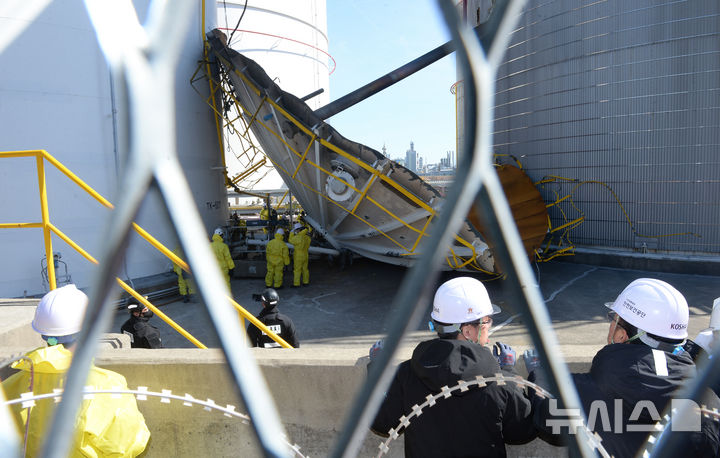
A joint examination by the coast guard, forensic service, labor authority and other agencies took place from 11:00 to 13:00 on 17 February. Investigators inspected the tank and detached roof and recovered the sampling tool, reported by Yonhap as brass.
The coast guard obtained the injured worker’s account of a spark after tool contact. It sought forensic examination of the tool and investigated sampling procedures and possible negligence by the operator, inspection company and cargo owner.
On 27 February, investigators searched UTK and the inspection company’s Seoul headquarters. News1 reported forensic examination of the tool and antistatic clothing and an investigation into possible Serious Accidents Punishment Act violations. These investigative steps were not findings of guilt.
Equipment and work principles
A roof opening provides access to liquid and a path for internal vapor to escape. A sampler remains nearby while inserting and withdrawing equipment. Planning should therefore consider vapor generation, pressure, ventilation, weather and transfers during sampling.
Reports named a petroleum-based product, but its composition and safety data sheet have not been verified. A particular chemical’s flash point or lower explosive limit should not be assigned to this tank. Actual work requires supplier data and consideration of mixing or contamination.
Static discharge and mechanical-contact ignition are distinct hazards. Tool material alone does not eliminate ignition potential. Equipment, clothing, bonding and grounding need to suit the material and sampling method; the ignition source in this incident remains a forensic question.
Closed sampling arrangements can reduce the need to open a hatch, but connections, pressure, valve line-up, residual liquid handling and container compatibility still require review. Reducing the need to stand at a vapor-release point takes priority over adding warnings to an exposed method.
At PCA DeRidder, a clear gas test around water piping and a platform did not reveal the explosive atmosphere inside a nearby tank. Although the work and material differed, it illustrates why an external reading cannot establish internal conditions. Check whether sampling locations represent the space people will encounter.
The PCA lesson is not an instruction to open every tank hatch for testing. The CSB emphasized safe hazard assessment and removal of potential flammable atmospheres. Roof sampling likewise requires the method to be selected before access.
Published chronology and investigation findings
The verified public sequence includes examination, recovery of the sampling tool, witness questioning and searches. Final forensic findings, referral, prosecution and judgment have not been verified. Neither tool material nor clothing condition is established here as the cause.
The operator holds information about contents and operating state, while the inspection company controls its method and tools. These need to meet in a task-specific review, including whether a transfer or product change invalidates an earlier sampling authorization.
| When | Established account | Source |
|---|---|---|
| 2025-02-10 11:15 | Explosion and fire; 1 killed, 1 injured | Newsis 02-10 |
| 2025-02-11 report | Plan to remove contents and secure structure before examination | Yonhap 02-11 |
| 2025-02-17 11:00–13:00 | Joint examination; sampling tool recovered | Yonhap 02-17 |
| 2025-02-17 report | Injured worker described a spark followed by explosion | Yonhap 02-17 |
| 2025-02-27 | Searches at operator and inspection company | News1 02-27 |
Consequences and emergency response
Roof workers face falls around damaged surfaces and openings as well as fire and explosion. Assess descent routes and what happens if heat or smoke blocks stairs or ladders before access.
Nearby tanks and connecting lines affect emergency response. Prepare material information and exclusion arrangements before approaching. Rescue re-entry also requires assessment of residual vapor and structural damage.
Questions for your site
| Question | How to check |
|---|---|
| Has receipt or withdrawal changed since sampling was authorized? | Match the operation log to the sampling time and reauthorize changed conditions. |
| Can sampling be performed without opening the roof hatch? | Review pressure, connections and residue handling for a closed system. |
| Are tool materials and static controls suitable for the actual contents? | Compare the SDS, procedure and equipment instructions; labels such as brass or antistatic are not sufficient. |
| Can roof work be stopped and evacuated promptly? | Establish access, communication and evacuation signals; do not reopen a hatch alone to investigate an abnormality. |
Application at Korean sites
Comparable work in Korea is subject to the Rules on Occupational Safety and Health Standards, MOEL Ordinance No. 450, effective 2026-03-02. The following concerns present work; findings about the incident depend on its investigation and proceedings.
Article 239 prohibits ignition-producing or potentially hot equipment at or above locations with specified fire or explosion hazards. A hot-work permit does not waive the prohibition.
For sampling work facing imminent danger of fire or explosion, Article 279 requires immediate cessation and evacuation to safety. Entry by unauthorized persons must be prohibited and clearly signposted until the danger has been confirmed absent.