MOEL Ordinance No. 450: verify performance certification for welding blankets (Partial amendment to the Rules on Occupational Safety and Health Standards)
Know the scope of the requirement
Article 241(2) addresses fire-risk work where combustible materials are present. The added sentence in item 4 requires welding blankets used in spark-containment measures to hold performance certification under Article 40(1) of the Firefighting Systems Installation and Management Act.
A generic flame-resistant or heat-resistant sales description does not establish that certification. Do not interpret the provision as covering every ordinary cloth or cover used for any purpose.
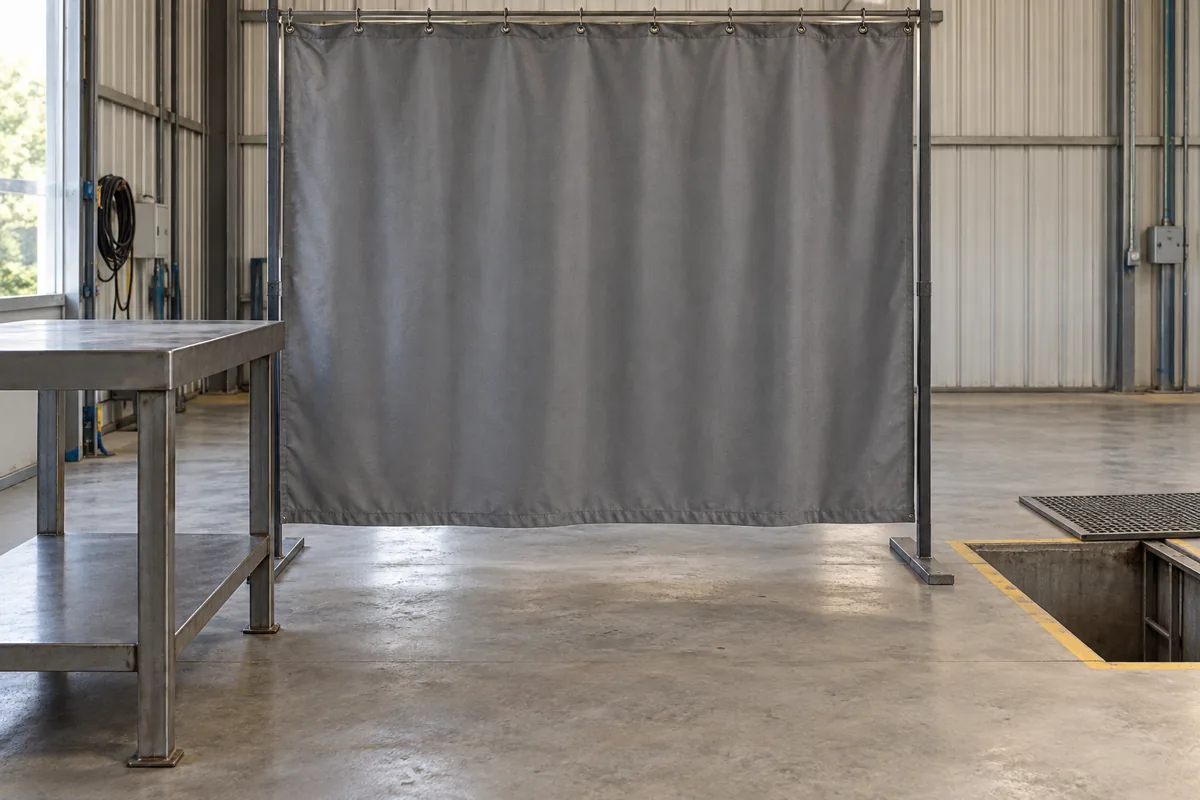
- Screen edge: examine gaps that may leave a spark path.
- Work table: relate protective coverage to the work location.
- Opening: Before work, trace the spark path into the space below and determine the protective coverage.
Amendment wording comparison
| 241②4 | Spark control retained + certification sentence added |
|---|
Based on the official promulgated amendment; English entries are explanatory translations.
- 1 Performance certificationCheck the type in official approval information separately from product advertising.
- 2 Product inspectionCheck inspection status and the pass marking separately from the performance certificate.
- 3 Delivered blanketMatch the delivered item’s markings and specification to its own official certification information.
- 4 InstallationIn addition to checking certification information, inspect damage, gaps and spark paths to establish coverage.
- 5 Other fire precautionsCheck contents, ventilation and watch arrangements as well as blanket coverage.
A product requirement was added to existing spark control
Order450 added the final sentence of Article241(2)(4). Spark and flame-spread prevention already appeared in the preceding text. When welding blankets are used for those measures in hot work at a location containing combustible material, they must have performance certification under Article40(1) of the Firefighting Facilities Act. This does not make every work cover the same certification category.
Product quality and installation are connected but distinct. A certified item may leave gaps in the path being protected; an apparently complete installation does not establish certification. Identify the product in purchase documents, then check the actual item and coverage before work.
For work beside an opening to a lower level, examine how the opening and nearby combustibles are protected rather than merely noting that a sheet is present. This applies the existing spark-control and combustible-protection requirements to the location.
Separate the commencement dates
Most corrections took effect on promulgation, 1 September 2025. The new Article 241(2)(4) sentence was delayed for six months; MOEL identifies 2 March 2026 as its start date.
Other changes replace ‘transport machinery, etc.’ (운반기계등) with ‘excavation machinery, etc.’ (굴착기계등) in Article 344(2), and ‘demolition of buildings, etc.’ (건물 등의 해체작업) with ‘demolition of structures, etc.’ (구축물등의 해체작업) in Annex 4. Annex 7 corrects bent to vent, and Annex 16 corrects the cited provision of the Enforcement Decree of the Weather Act. Not all of these terminology and citation changes took effect on 2 March 2026; check the supplementary provisions for their commencement dates.
The use date matters for previously purchased stock
Promulgation was2025-09-01, but the certification sentence takes effect six months after promulgation:2026-03-02. Other terminology changes in Order450 were not all postponed to that date.
Purchase date and requirements at the time of use are separate. This supplementary provision does not create a stock exemption for items purchased before commencement. Verify certification for items used in applicable work rather than treating an earlier purchase as proof of suitability.
Other controls remain: Article240 addresses substances in pipes and tanks, Article241 includes ventilation, extinguishing equipment and emergency instruction, and Article241-2 addresses fire watchers. A certified blanket does not replace them. The linked practical article addresses installation and damage checks.
Application conditions
| Condition | Provision to examine |
|---|---|
| Hot work with combustibles | Article241(2) controls |
| Welding blanket used | Performance certification |
| Contents / watcher | Separate provisions |
Match certification evidence to the supplied product
A useful site check compares manufacturer, model and specification on the supplied item against the certification evidence. Seek confirmation from the supplier if the evidence is missing.
Follow the manufacturer’s instructions and actual work conditions for installation and use. Damage, deterioration and gaps allowing sparks through still need physical inspection.
The educational illustration depicts a review process; it is not proof that any depicted product is certified.
Check your workplace
- Does certification evidence match the actual product?
- Are damage, gaps and nearby combustibles checked?
- Are all other hot-work precautions in place?
Compare certification and product-inspection identification
A heat-release-rate test report under KS F ISO 5660-1 records how the submitted specimen performed under specified radiant-heat conditions. That report alone does not establish that the product has welding-blanket performance certification. Since 2 March 2026, the performance-certification requirement in the final sentence of Article 241(2)(4) has applied to welding blankets used to contain flames and sparks during fire-risk work where combustible materials are present. A report stating the test method and measured results must be distinguished from statutory performance certification.
Article40(1) provides performance certification at the request of manufacturers or importers, while paragraph2 provides product inspection for certified firefighting products. Certification and product inspection are not interchangeable terms: approved-type information and the delivered item’s inspection identification need to remain connected.
KFI’s official guidance directs users to the fire-blanket category under flame-retardant products in approval information, showing company, approval number, date and type. Compare the item’s identification with that result. If a similarly named item’s certificate or a different specification is supplied, request evidence linking the delivered item to the approval.
The guidance separately addresses product-inspection status and inspection-pass identification. Do not stop at a statement that a certificate has no expiry period; approval may be cancelled following changes in standards. Performance certification, type approval and KFI certification should not be collapsed into one generic mark.
Article40’s restrictions on sale and marking apply to its specified conduct and parties. They should not be converted into an identical penalty for every purchaser or worker. A sanction requires a separate match to the applicable statutory conduct.
Correct delivery documents do not settle the protection path
Sparks may reach other spaces through openings and gaps rather than remaining on the floor. Review blanket coverage against that path. The illustrated lower gap identifies a checking location; it does not show the fabric’s heat resistance or certification. Colour and apparent thickness do not establish performance.
Consider removal of nearby combustibles, protection where removal is difficult, and access to extinguishing equipment. Those questions differ from certification. Approval information concerns a product type; pre-work verification concerns its actual use along the hazard path.
The distinction remains in repeated work. A posting exception does not exempt an applicable blanket from certification. Do not borrow an exception from another provision to remove the product requirement; assess watcher conditions separately too.
Sanctions
The provision-specific penalty and progressive fine amounts could not be verified; no amounts are stated here.
Do not substitute another quality label
Terms such as heat-resistant, flame-retardant or spark-resistant may describe a marketed use, but official evidence is needed to establish the particular certification required by the provision. Advertising text cannot replace an approval identifier linked to the delivered item. No brand or model is recommended here.
If the type found in an official search cannot be connected to the item, the manufacturer’s name alone is insufficient. Obtain the relevant documentation. Do not guess an unreadable number in a blurred certificate photograph.
Order450 aims to improve blanket quality for fire prevention, not to transfer all hot-work risk control to one product. Ventilation of residual gas, combustible protection and fire-prevention and evacuation instruction remain part of the overall measures.
Keep the other fire precautions
Existing Article 241 precautions also cover preparation and procedures, hazardous-material information, nearby combustibles and extinguishing equipment, ventilation and fire/evacuation instruction. A certified blanket does not replace checks of tank contents, connected equipment, lower levels or the opposite side of a partition.
Assess fire-watch requirements under Article 241-2 separately. These existing duties were not all introduced by Ordinance 450; the principal addition is blanket certification.
Primary sources
Related tools and guidance
Article 241(2)4, latter sentence — Korean statutory text
이 경우 용접방화포는 「소방시설 설치 및 관리에 관한 법률」 제40조제1항에 따라 성능인증을 받은 것을 사용해야 한다.