Recording and handing over damage to fireproofed pipe supports
Separate the damaged face and its location, and hand over access restrictions separately from the fireproofing assessment.
A fallen fragment and damage on the support
A grey fragment lies near the edge of a pipe-rack walkway, yet the visible front of the support directly above it has no obvious missing patch. Damage may be on the back of a column or underneath a beam, or the fragment may have come from another task. The maintenance crew first checks whether people pass beneath it and reports the location and visible condition from a safe position, leaving the cause for follow-up.
Fireproofing slows heat transfer to structural steel during a fire. When missing material exposes steel, asset management needs a location and extent it can verify. The crew separates the immediate risk to people and platforms from falling material from the follow-up assessment of the support's fire resistance. Clearing a walkway can otherwise remove the second issue from the handover record.
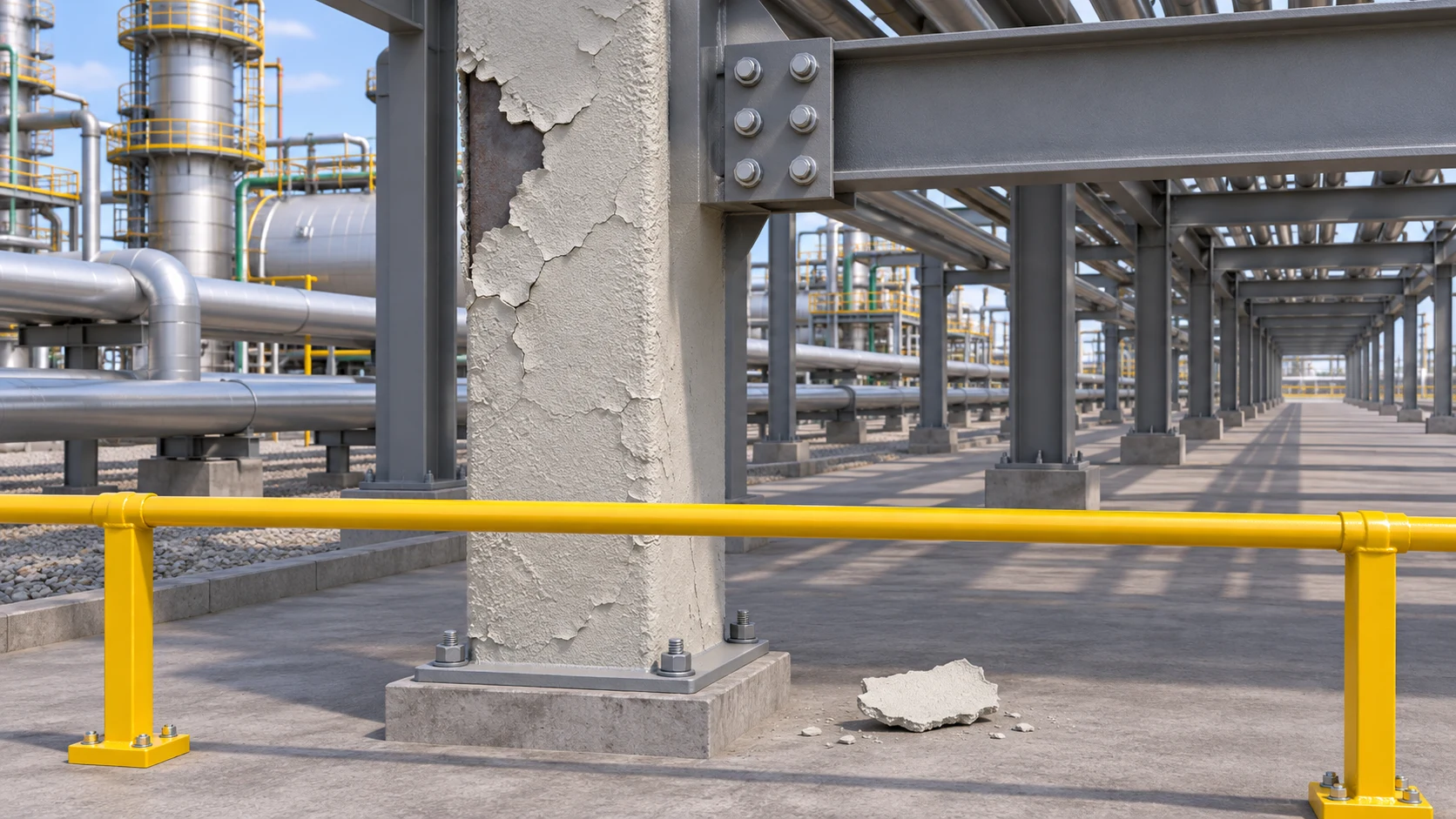
- Exposed steel face: Record the damaged face and the viewing direction.
- Bolted connection plate: Use the plate to describe the height of the damage.
- Fallen fireproofing fragment: Record where the fragment was found.
- Yellow guardrail post: Use the rail as a landmark when confirming the access restriction.
Check the approach before looking overhead
Walking closer to look up may place the worker directly beneath loose material. Even on a familiar route, stop traffic and use the designated reporting channel if more pieces may fall. Respect existing barriers. Check whether anyone is carrying material or working on a platform, and say plainly when a point could only be checked by walking underneath the hazard.
The point vertically below the damage is insufficient to define an access boundary. Fragments can strike nearby structures or bounce, and adjacent tasks can redirect foot traffic. Report the suspected overhead location separately from the doors, stairs and walkways people actually use. Establish barriers and alternate routes through site procedures. Hold material movements until the route is confirmed.
Which support and which face?
In a run of similar supports, “the column under the pipe” rarely identifies the spot. Record a readable support label or nearby fixed feature and add the direction of observation. If the label cannot be read safely, describe the walkway and fixed reference first. Resolve location ambiguity before the receiving team attempts to match the defect.
A single column has a walkway face, a pipe side and connection undersides. Pair “left” with the viewing position. If damage appears to wrap around a corner, record visible and hidden faces separately. Describe height using recognizable landmarks such as eye level or the upper beam connection. Keep estimates distinct from measurements. A sound handover lets the receiver locate the spot without approaching it unnecessarily.
Handover sequence
| Stage | Owner | Decision or check | Record |
|---|---|---|---|
| Discover | Crew | Observe from a safe point | Discovery point |
| Restrict | Area control | Identify affected routes | Access boundary |
| Locate | Crew | Pair the reference and face | Viewing direction |
| Record | Crew | Separate visible and hidden conditions | Defect and limits |
| Refer | Asset management | Review applicability and repair scope | Open checks |
| Release check | Work lead | Reconcile barriers and permit | Authorized scope |
How should the condition and limits be recorded?
Fine surface cracking, apparent lifting, missing chunks and visible steel are different observations. Record discoloration or wet staining separately. Mark a surface as unseen if lighting or pipework prevents observation. Recording a hidden face as sound can cause it to be left out of follow-up inspection.
Prodding loose material or pulling off a piece changes the condition and can expose the worker to falling debris. Record visible changes and limitations, and reserve detailed inspection for an authorized method under suitable controls. Appearance alone cannot establish material type, hidden corrosion, depth or fire performance. Put questions for assessment in a separate field from observations.

Pair context and detail photos
Where photography is permitted, first take a safe-position view showing the support and nearby fixed features. Connect a detail view to a marked location in the context image. A close-up may show a defect while losing its orientation and height. A wide shot alone can hide a small exposed edge. When photographs are unavailable, a written observation point and face preserve some of the same context.
A change of angle can make a defect look as though it is on a different face. Record the direction, time and whether multiple images show the same defect. Note differences in lighting or zoom when comparing images. Claims of further loss need supporting observations, such as a matched view or newly verified fragments. If views are not comparable, record them separately and leave the change unresolved.
Hand over work scope and access separately
Material movement, platform use or crew waiting points may be affected even when the planned maintenance does not concern the damaged support. Hand over the stopped work and permitted access separately. This helps avoid treating a single work hold as a whole-area closure or treating an open path as permission to restart the task. Tell area control about other crews and equipment routes already in use.
An initial report should carry the support location, face, visible condition, immediate access restriction and outstanding checks. At shift change, distinguish updates from restrictions still in effect. If another crew set a barrier, record its boundary and the department that can clear it. Read back the location and suspended activity against the handover record so crews do not prepare around the wrong support.
The fireproofing requirement and the repair decision
Article 270 of the Korean occupational safety and health standards addresses fire-resistant construction and maintenance for specified parts of structures in designated gas or dust explosion hazard areas. Applicability to pipe and conduit supports depends on the provision and the actual structure. The maintenance crew gives asset management the location and visible condition needed to check applicability and design, leaving performance assessment to the responsible function.
Covering a defect is a different action from controlling access or accepting a repair. Once covered, the condition that triggered the repair can become hard to trace. When work is planned, match the work order to the defect location and affected route, and establish whether the field action is repair or protection. The responsible function confirms performance or repair acceptance. Maintenance reports its own completed scope and remaining restrictions separately.
How far may the next crew proceed?
A cleared floor and a lifted access restriction are different states. Ask whether the overhead condition was checked even if the floor is clean. “Under review” alone does not identify who is checking what. Record barrier clearance, alternate access, permit revalidation and the department providing the next update separately.
If the arriving crew sees a barrier still posted while the record says access is open, it checks current conditions with the function controlling the barrier before entering. Even after receiving clearance, establish whether it applies only to passage or also to platform use and material handling. Brief the crew on remaining limits before work begins and stay within the confirmed boundary.
Recheck hidden faces and photographs
Distinguish a first observation made at night or against glare from one made in good light. Reflections can resemble exposed steel, and a single observation cannot establish when a stain appeared. Use portable lighting only under the applicable site procedure. If improving visibility would require crossing a barrier or bringing temporary access equipment, stop and request an authorized inspection method. Record which part could not be seen as well as the poor lighting.
Old coating marks and new fireproofing damage may appear on the same face. Locate each mark without assigning them a common cause. Record where a fragment was found as the discovery point. Mention possible movement by cleaning, wind or nearby work while leaving its origin unconfirmed. Do not approach beneath the suspected damage to match a fragment to the support.
Clarify whether the request covers a surface observation, reinstatement of access or preparations for a more detailed inspection. A single request may include tasks with different access conditions. Separate surfaces visible from ground level from those requiring a platform. If a platform is needed, ask whether its location conflicts with the falling-material zone. Keep staging equipment clear of alternate routes and tell the incoming crew where it is staged.
Check that the connection between context and detail photos survives transfer into the reporting system. Similar filenames can lead readers to a different support. Tie images to individual report items and keep enough written detail to find the support if a file cannot be opened. For photos added later, distinguish the time of addition and new observations from the original report.
When a task spans several supports, do not infer the condition of adjacent supports from the first defect. Identify nearby supports sharing the route so area control can define inspection scope. Separate a previously recorded defect from newly observed damage at another location. If it is unclear whether one clearance covers another point, reconcile the observation location, remaining barriers and work to be resumed.
The receiving crew should be able to locate the support and limits after the observer has left. A verbal explanation may make sense while the written record omits the face or viewing direction. Before leaving, have the receiver identify which route they would use to find it. If contact is unavailable, retain the restriction and record the function and confirmation still outstanding.
After reporting, verify that both the inspection request and the access restriction were received.