Contractor maintenance handover of a flare knockout drum level abnormality
On notice of an abnormal flare knockout drum level, confirm the equipment and access boundary and hand over the work hold.
Locate the work when an alarm is reported
A crew preparing work near a flare system receives an abnormal knockout drum level notice from operations. Its job may concern other equipment, but access and material staging can share the area. The work lead locates the people, tools and crews planning to enter. If conditions have changed since the permit was issued, check against the current authorization before starting or continuing.
A knockout drum separates liquid from flow headed to the flare. The possibility of liquid carrying through to downstream equipment is one reason operations needs to assess the condition. A report of an alarm alone does not establish actual level or cause. Operations assesses how the indication relates to the process and what action is required. The maintenance crew needs the applicable access and work restrictions and a route for confirmation.
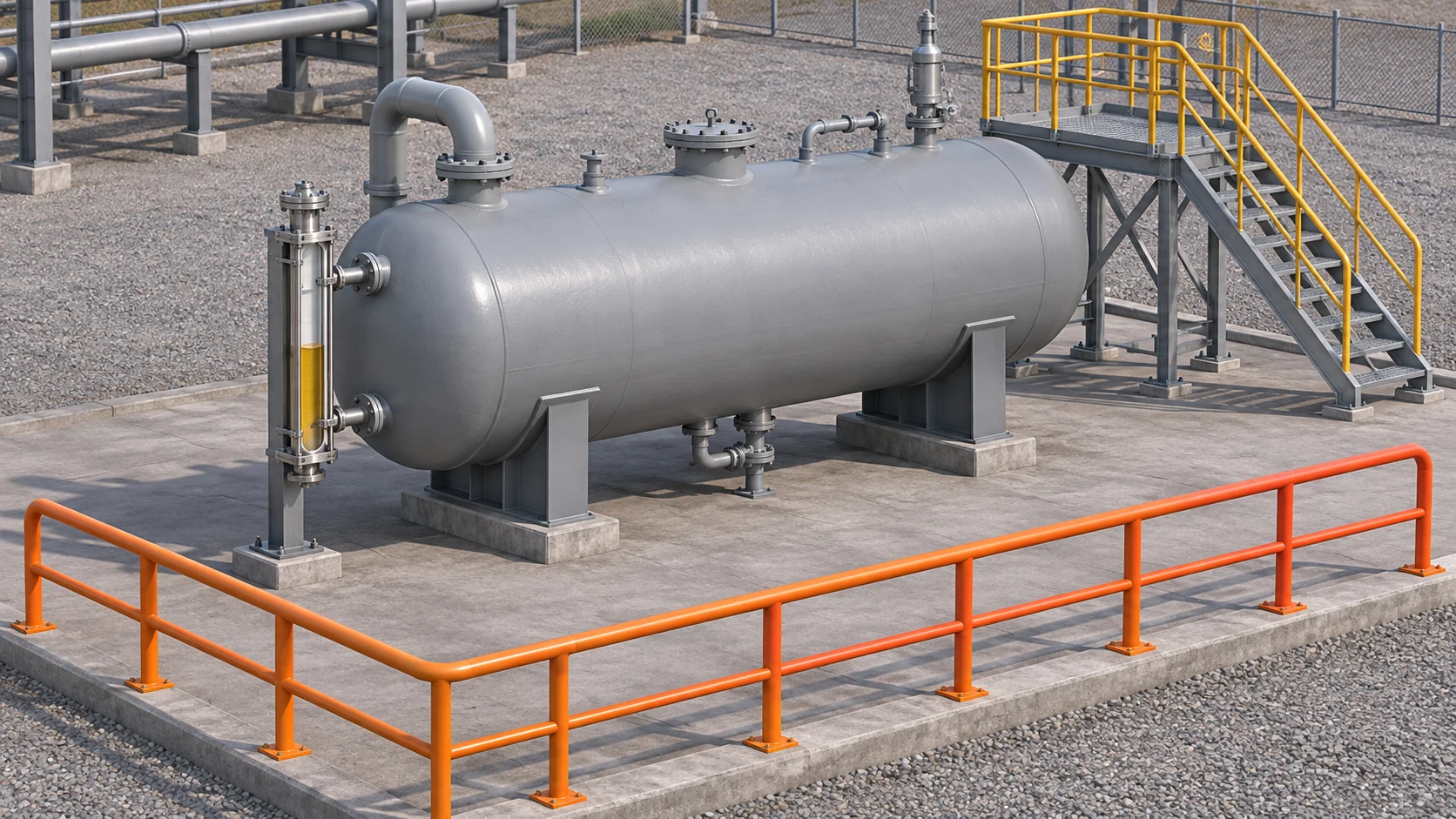
- Knockout drum shell: Confirm the equipment location with operations.
- Local level indicator: Record what was directly observed separately from the operations report.
- Front orange guardrail: Use the rail as a landmark when confirming the restricted area.
- Rear access stairs: Verify stair access separately from authorization to restart maintenance.
Distinguish a visible indication from a received report
An indication reported by a field worker and a condition confirmed by the control room have different sources. Record who reported it, through which channel, together with the equipment reference and time. Keep firsthand observations in a separate field. Note when no display was visible. Do not enter a controlled route to reread it. Refer uncertainties to operations.
An alarm notice and a confirmed level condition are not interchangeable. The incoming crew's plan may depend on who verified each point. Instead of an ambiguous note such as “looked high,” state which indication was visible from safety and what explanation came from operations. Record updates in order and preserve the basis of each.
How can similar equipment names be distinguished?
Shared and unit-specific systems can have similarly named drums or vessels. Read back the work area, readable equipment reference and affected access boundary to operations. Using only a crew nickname can produce directions for the wrong vessel. If a label cannot safely be seen, reconcile the permit location with operations and record how the identification was confirmed.
In a shared disposal system, following visible pipework is no basis for attributing the abnormality to a specific upstream unit. Lines can run in several directions, and neighboring sections may have different owners. Report whether the crew's own work and nearby access are affected. Leave process connections and causes to operations. If other crews may also be affected, ask area control to coordinate instructions.
Handover sequence
| Stage | Owner | Decision or check | Record |
|---|---|---|---|
| Receive | Crew | Separate operations notice from observations | Source and time |
| Identify | Operations | Confirm vessel and work location | Equipment reference |
| Hold | Work lead | Identify access and work impacts | Restricted boundary |
| Handover | Shift crews | Read back work and waiting point | Open items |
| Confirm response | Operations | Distinguish process and work updates | Response scope |
| Restart check | Work lead | Reconcile restrictions and permit | Authorized work |
Verify access and work authorization separately
If operations directs crews away from a route, account for who moved and who is still at the work location. Someone may stay behind to retrieve tools, or unrelated personnel may take the usual route. Identify the boundary established by area control for the whole crew. Keep passage and permission to resume maintenance in separate fields.
Moving materials or platforms by a different route changes the work scope. Confirm the alternate route and permitted staging point. Items moved in response to the abnormality may obstruct other work, so report their location and the waiting area to area control. If permitted housekeeping during the hold is unclear, confirm with the work lead before proceeding.

Facts and questions to hand to operations
The first report should briefly cover the work area, people who approached, the observed or reported condition and the maintenance affected. Do not open equipment or approach piping to verify liquid level or disposal status. Operations decides whether a process response is needed under its procedures. The maintenance crew asks how far access restrictions extend, what happens to its permit and who will provide the next update.
If operations says a check is in progress, record what is being checked. Reviewing instrumentation or the process differs from checking conditions for work restart. If several departments received the report, record their respective checks. If the restart time is unknown, record the hold and waiting location instead of promising an estimate. Update the specific items resolved by later responses.
What the incoming shift needs
Record location, the abnormality notice from operations, the reason for the hold, access boundaries and contact status. If restrictions remain at shift change, hand over tools left in place and the safe waiting point. Confirm that the receiving crew identifies the same vessel and task. Record completed work and work held before start on separate lines.
A response that the process is normal and a response that maintenance can restart are separate. An alarm no longer showing does not reactivate a permit by itself. If a field restriction remains posted or another restriction overlaps, report it to operations and the work lead. Establish what was cleared and when, and recheck the permit before resuming.
The limits of the legal and equipment references
The Korean safety rule on disposal of discharged substances addresses how hazardous material released from devices such as relief valves is handled. Applicability depends on the equipment and the provision. It does not establish alarm values or work boundaries for a particular knockout drum. The maintenance crew focuses on its work and access, leaving process-specific values to the responsible function.
The liquid separation role explains why reporting a level abnormality should not be delayed. Configurations and liquid paths can differ by installation. Generalizing when carryover will occur can conflict with actual safeguards. Leave equipment condition assessment to operations and keep work records tied to confirmed restrictions.
What remains just before restart
Before restart, check the work point and route again. Another crew may have moved access equipment or a boundary may have changed during the hold. Confirm the permitted scope and plan tool entry separately from work start. If field controls and the handover record disagree, wait and request confirmation. Even a permit issued earlier that day needs to reflect changed conditions.
In a verbal handover, name who confirmed which state rather than saying “all clear.” Clearance for one task may leave controls on another crew in place. Separate clearance responses, boundaries communicated to the crew and remaining open items. If another abnormality is reported, check the new condition instead of relying on the previous authorization.
When a radio message reaches several crews, ask the receiver to read back the equipment and boundary. A similar name can send the hold notice to an adjacent area while the affected crew continues preparation. If contact is lost, do not assume authorization or restrictions have changed. A handover should let the receiver name the same unit and outstanding check. The record preserves both the operations response and safe waiting conditions.
When several jobs are affected at once
A single alarm notice does not necessarily create identical restrictions for all crews. One crew may be near the vessel while another waits for materials outside the area. Reconcile each job location with area control and record where the crew was working, how far it can travel and what it is waiting for. Crews sharing the route need updated access information even when their work does not involve the affected equipment.
The restricted area may expand or some access may reopen while crews wait. Moving tools based on a remembered boundary can conflict with current controls. Confirm which routes and tasks an update covers and notify crew members who already moved. If the physical marking has not changed and conflicts with operations' guidance, hold the work and report the exact discrepancy.
If a response might refer to another drum, do not broadcast it as clearance. Match the equipment referred to by operations to the location and reference in the record. A response to one crew does not establish the status of the entire shared system. Identify who verifies each permit and communicates changes so that conflicting versions do not circulate.
Rain, wind or poor lighting can limit field observations of boundaries and indications. Record that an explanation came from the control room without marking it as personally observed. Establish how the crew will receive further messages from the waiting area. Leave instrument status that maintenance cannot verify with operations and check which changes affect the job location during permit revalidation.
If tools or parts were left behind, hand over their location. Anyone retrieving them should confirm that the particular location and route are authorized. Retrieval alone can require entering a controlled area. Update the crew's location and accountability if they change and check whether other crews share the alternate route.
A later review should look beyond when an alarm cleared and identify which conditions were confirmed after work stopped. Clearing barriers, revalidating the permit and briefing the crew are different events. Combining them obscures missing checks. Maintenance records confirmations needed to restart and refers process assessment and cause to operations records.