Reporting electric heat-tracing indications and insulation changes
Report heat-tracing indications separately from insulation changes and request separate process and electrical checks.
Notice the indication and the exterior from the work route
A maintenance crew locating its work beside a pipe receives a report of a heat-tracing abnormality and notices a gap at a nearby insulation jacket seam. Assuming a common cause can conflate an electrical check with assessment of the pipe. From a safe position, record the visible identifiers and jacket condition separately, together with the observation point and direction. Ask whether access or work boundaries are affected if other crews are using platforms or passing below.
Electric heat tracing can maintain temperature or reduce freezing risk depending on the installation. Jacket damage does not establish a broken heater or frozen contents, and a normal indication does not establish the expected pipe condition. Keep circuit status for electrical personnel separate from pipe condition for operations. Lead with what was directly observed so a field observation does not become a diagnosis in the record.
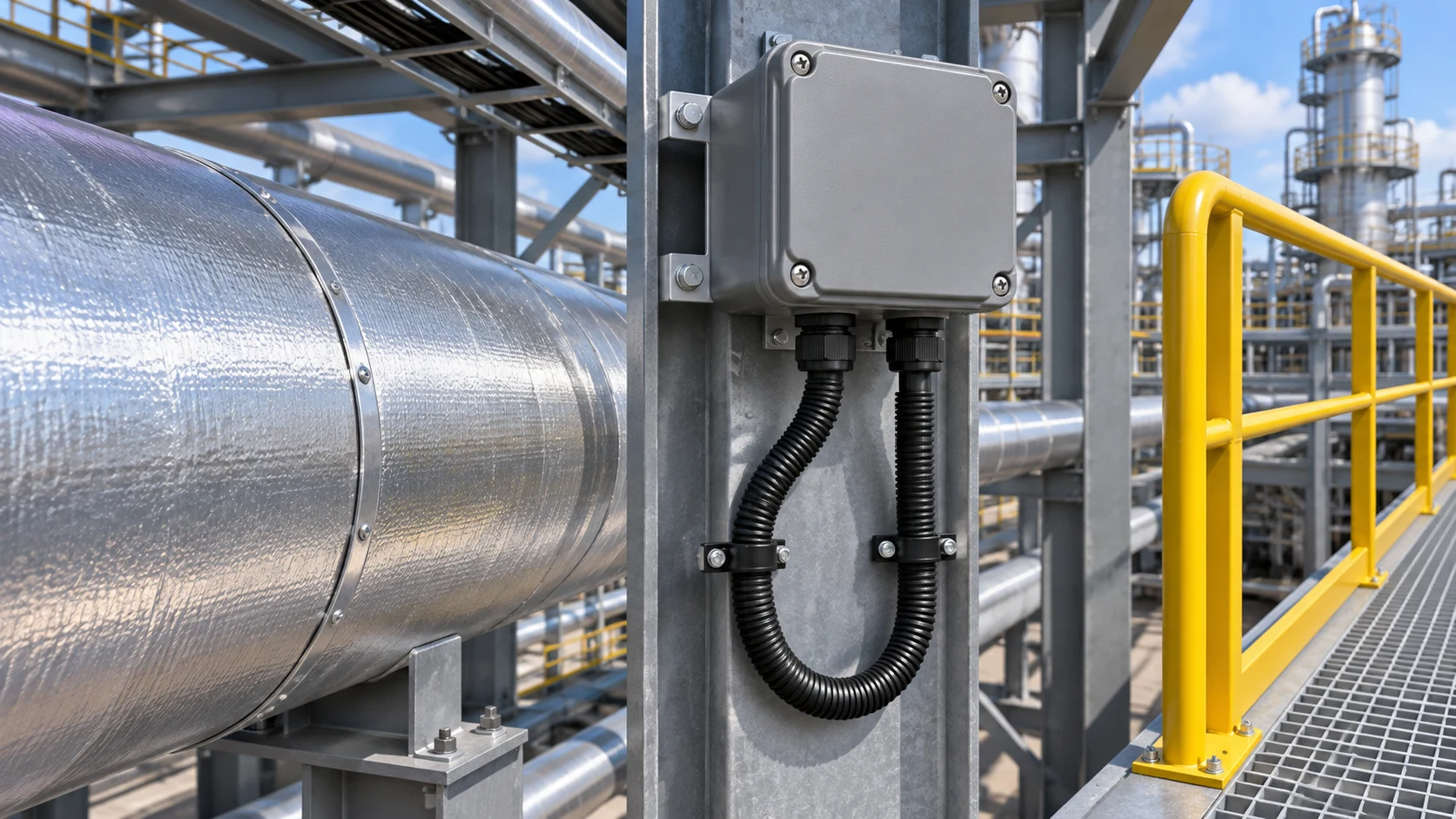
- Insulation jacket seam: Record the visible face and viewing direction.
- Closed junction box: Read only labels visible from a safe position.
- Protective conduit: Report the location of visible marks to electrical personnel.
- Yellow guardrail: Check authorized access and the work boundary separately.
Respect closed enclosures and insulation boundaries
A junction box may share a pipe route yet be treated as separate electrical equipment under the permit. Opening it or pulling a cable would exceed an exterior observation. Do not reach into a jacket gap to judge temperature or lift damaged cladding. If burning odor, smoke or unusual noise is suspected, stay clear and report under the site emergency procedure. Identify the suspected enclosure by location and viewing direction and leave details that require closer approach unresolved.
A heat-tracing conduit may be mistaken for nearby instrument wiring from appearance alone. Pair a safely readable identifier with a fixed reference on the pipe. Do not move the conduit or remove its cover to verify the connection. Tell the work lead if tools or access equipment encroach on the enclosure area and ask area control to coordinate overlapping electrical work. Do not assume that jacket work may start separately while electrical conditions remain unconfirmed.
Which pipe and which circuit are involved?
In parallel runs, “the second pipe” changes with the viewing direction. Describe the side of the walkway and a fixed reference first, then record any safely readable pipe and enclosure identifiers separately. The jacket seam and the reported indication may be in different places. Giving electrical personnel both locations helps distinguish confirmed correspondence from an unresolved relationship. Do not guess missing identifiers.
Insulation geometry changes around seams, branches and supports. Lifting or wet staining does not show how much insulation is affected. Separate visible faces from hidden ones and report if the top cannot be seen. Mark any apparent damage to the conduit as a separate location from jacket damage. Even when the two are close, leave electrical diagnosis and freezing assessment to the responsible departments after they verify the installation.
Handover sequence
| Stage | Owner | Decision or check | Record |
|---|---|---|---|
| Observe | Crew | Separate indications and exterior changes | Time and direction |
| Hold | Work lead | Check affected location and access | Affected area |
| Identify | Crew | Match pipe and enclosure references separately | Equipment references |
| Request | Operations and electrical | Separate pipe and circuit checks | Responding functions |
| Handover | Shift crews | Read back confirmations and holds | Remaining restrictions |
| Restart check | Work lead | Match access, isolation and permit | Restart conditions |
Distinguish a report from a firsthand observation
If electrical personnel report a signal, record who checked it, on which system and what it indicated. Put the crew's firsthand jacket observation, time and location in another field. If a radio message is interrupted or omits location, pass on only what is known and request identification. Do not enter a screen indication as a measured pipe temperature. The next shift needs to see what was directly verified and what remains open.
Weather or drips from nearby equipment can create new jacket marks. Check that lighting and viewing directions are comparable before interpreting photos from another shift. If spread cannot be confirmed, record observations in sequence. A dry exterior does not show that the insulation beneath it is dry. Leave checks requiring opening for separately authorized work after access and isolation are established. Report changing appearance without starting an unplanned task.

Route process and electrical checks separately
Tell operations the pipe location, affected route and job, and observed exterior. Tell electrical personnel where the enclosure and conduit are and distinguish the reported indication from visible traces. Read back the identifiers to make sure both departments refer to the same area. A request to assess the pipe does not confirm electrical isolation. Clearing an indication can still leave pipe condition and permit revalidation outstanding. Hand over the confirmation status for each department separately.
A frost-like mark is no reason for the contractor to tap the pipe or apply heat to test for freezing. Appropriate response depends on contents and operating conditions. Report visible appearance, affected access and tasks, and useful location references. Await separate responses from operations on the pipe and electrical personnel on the circuit. If confirmation takes time, the work lead should refresh the crew's understanding of restrictions and waiting points.
Check equipment applicability in hazardous areas
Article 311 of the Korean occupational safety and health standards addresses selection and management of electrical equipment in designated gas or dust explosion hazardous areas. The responsible department checks the heat tracing, junction box and associated parts against the area classification and design. Similar-looking boxes do not establish interchangeability across areas. Separate an exterior report from an authorized electrical inspection.
Even when jacket work is on the existing permit, verify whether it affects electrical equipment. If different crews share the pipe, reconcile sequence and boundaries with the work lead. Area control communicates changed access and work limits, while electrical personnel confirm circuit status and isolation within their scope. Carry unresolved requirements into the handover. At completion, verify jacket restoration and electrical checks separately.
How far can the crew go before restart?
When the incoming crew arrives, read back the work point and access boundary together. A valid permit does not restore an old route if staging or platform limits changed. Verify separately what operations and electrical personnel confirmed, what field notices remain and which task can restart. Ask area control which area a clearance covers if unclear. Record when and for which work clearance was confirmed.
Electrical enclosure or conduit checks can remain after jacket work is complete. Separate completed scope and open checks in the completion record. Match equipment identifiers to avoid applying a response about a different tracing circuit to this pipe. Brief the crew on where work can resume and where access remains on hold. Report any subsequent trace against the current condition.
Preserve the boundary between insulation and electrical work
On a shared pipe run, jacket work may finish at a different time from circuit verification. Closing the jacket does not establish completion of electrical checks. Record the two tasks separately and clarify which remaining restriction applies to which work. Do not promise a response time on behalf of electrical personnel. Check whether follow-on work reaches under the jacket or beyond the verified section and reconcile the scope with the work lead.
Several enclosures on one structure can lead a listener to point to the wrong box. From a safe position, pair readable labels with nearby fixed references. If electrical personnel name a different location, do not shorten the names and treat them as equivalent. Keep the task on hold until the relationship is confirmed. Brief early-arriving crews on waiting boundaries so they do not open an enclosure or remove cladding based on old records.
If photography is permitted, pair a context view of the jacket with a detail of the observed seam. A tight image can hide which branch and support bound the location. If cladding and conduit overlap in the photo, record the viewing direction to distinguish them. Do not describe hidden conditions as visible. If photos are added later, distinguish new findings from restrictions carried forward.
If weather affects observation, record the location and time together. Do not approach to read details in poor visibility or on slippery access equipment. Explain why a point was not checked and identify who will check it later. A view from one route does not establish the condition on the other side. The next crew confirms access first and observes from an authorized point, using earlier photos for location context.
Reporting the exterior does not close every electrical and process check. Record who confirmed restart for which task and keep outstanding responses separate. Work and access conditions do not automatically change while confirmation is missing. At shift change, communicate the waiting point and next contact as well as the status. After clearance, explain both where work may begin and what remains restricted.
The next crew should be able to compare the jacket and electrical locations after completion. Ambiguous descriptions can send it to another pipe. Keep the viewing direction and enclosure reference in distinct fields. Record responses about the circuit alongside the jacket work performed, with separate completion status. Check the previous permit boundary before assigning additional work.
An unreadable enclosure label belongs in the observation limits. This reduces the chance that the next crew checks a different circuit and treats it as the same job.