Before connecting lifting accessories: identification, damage, edges and connections
With slings and shackles beside the load, what should be matched before connecting them? Rigging involves both the condition of each accessory and how the components work together. Separating identification, damage, edge contact and hook seating while the load is stable on the ground makes completed checks and matters needing further review clear.
Establish the connection conditions with the load grounded
Start by matching the load's weight, shape, centre of gravity and attachment positions to the lifting plan. KOSHA's rigging material covers rope selection for the load's shape and type, attachment with regard to its centre of gravity, and checks for abnormalities before work. A useful starting point is to connect what the person handling the accessories has checked with the conditions understood by the person directing the lift. Uncertain weight or centre of gravity also leaves accessory selection open for review.
Lay out the accessories along the load path from the contact with the load to the hook. Distinguish the sling body, its end eyes, shackles, hook and edge protection. This is a way to avoid missing an actual connection, rather than a checklist of accessory names. Completing identification and inspection while the load is grounded reduces the need to reach in and correct connections after loading. Access limits and signalling arrangements are established separately in the lifting plan.
The scene separates inspection targets before connecting accessories, with the load resting on supports. For actual work, establish the designated lifting points, accessory combination and manufacturer's conditions in line with the lifting plan. This involves checking the positions intended to transmit the load instead of treating nearby bolts or pipes as convenient attachment points. Independently of the illustrated layout, finalise the connection method using the reviewed plan and the instructions for the actual accessories.
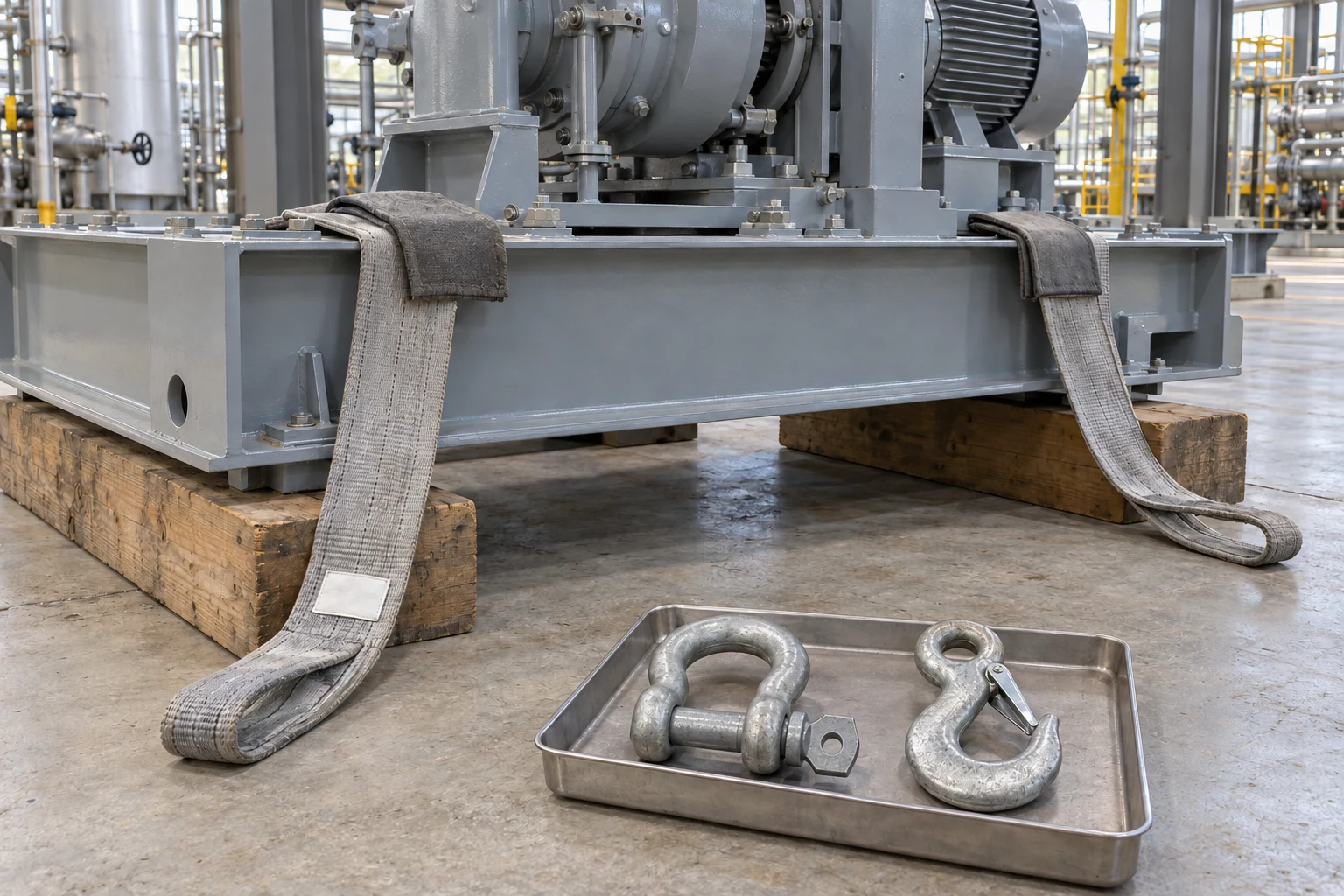
- Sling tag: Check the marking and use conditions for the actual accessory before connection.
- Edge protection: Follow the sling contact and check pad position and retention.
- Shackle: Check the body and pin for damage and confirm the specified fastening method before connection.
- Hook: Seat the connection in the load-bearing area and check latch operation.
Use markings and permitted loads to identify the accessory
Article 163(2) of the Rules on Occupational Safety and Health Standards requires lifting accessories with securely attached markings such as the maximum permissible load. Check the actual accessory together with its marking. Instead of transferring a loose tag to a similar item or assigning the same capacity from colour and thickness, find information that identifies that accessory. If damaged markings make necessary conditions unreadable, use an identifiable replacement or establish usability through the management procedure.
The safety factor and maximum permissible load serve different purposes. Under Article 163(1), the safety factor is the breaking load divided by the maximum load applied to the accessory, with requirements distinguished by use. Treating breaking load as the permitted working load changes the selection basis. Article 164 also sets a relationship for hooks and shackles integral with lifting wire rope or chain. Include the assembled accessory's conditions in the comparison rather than overlooking a small connection component.
After reading the marking, compare the information for the planned hitch and operating conditions, including the angle. KOSHA's material also discusses how rigging angle changes rope loading. Connect the actual product's conditions with the lifting plan and review whether a permitted value for one angle or combination can be applied to a different hitch. A changed hitch calls for review of whether previously checked conditions still apply. Confirming load weight alone and assuming equal distribution between sling legs is another assumption to avoid.
Different materials require different inspection targets
Inspect the full length of wire rope together with its ends. Article 166 applies Article 63(1)1, distinguishing joints, broken wires, diameter reduction, kinks, severe deformation or corrosion, and damage from heat or electric shock. Broken-wire counts and diameter reduction have specific criteria; identify the location and rope type and compare them with the legal text and accessory management criteria. Follow the contact areas and terminations instead of finishing after one conspicuous spot.
For chain, inspect elongation and section loss as well as deformed or cracked links. Article 167 applies Article 63(1)2, which compares length and section diameter with their values at manufacture. That comparison requires the chain's identification and records to remain connected. Measurements and management information for the actual accessory are more useful than an impression that it looks nearly new. KOSHA also advises freeing chain of twists and avoiding improvised welding or heat treatment of damaged parts.
For fibre rope, check the conditions applied by Article 169, including broken strands and severe damage or corrosion. Consult the legal and manufacturer's inspection criteria for the actual accessory rather than transferring another material's limits. If contamination obscures its condition, establish how to make inspection possible instead of storing it with the contamination hidden. A useful practical response to uncertain damage is to hold the accessory for assessment rather than assume the mark is harmless.
- IdentificationMatch the actual accessory to its use conditions
- BodyCompare material-specific damage with inspection criteria
- ContactCheck edges, protection and twists
- ConnectionCheck eyes, pins and latches
Follow the sling's contact across edges
An edge is a loaded contact point for a sling. KOSHA's material describes avoiding sharp bends over sharp edges and using protection. Place protection along the sling's actual contact rather than stopping at the fact that a pad is available. A pad on the load provides no protection to the intended contact if the sling runs over an adjacent edge. Align the path before connection and consider whether the protection could move as load is transmitted.
Distinguish edge protection from a patch intended to keep a damaged sling in service. First establish the accessory's usability, then manage its contact with the load. Twists or overlaps can change the planned contact arrangement, so spread out the sling before loading. KOSHA's guidance on avoiding twists and sharp bends is relevant at this preparation stage. If a pad must be held in place by hand throughout the lift, review how it will be retained.
Consider possible heat or chemical exposure along the same contact path. Article 165(2) prohibits wire rope affected by heat from an arc, flame or contact with a hot surface. Check the conditions for the actual material and product rather than extending one material's numerical limit to every sling. Accessories temporarily stored near planned welding also need a pre-use check for effects of that storage location. Combining appearance with use history reduces the conditions that can be missed by looking at shape alone.

Identify where the load bears in hooks and shackles
Distinguish the hook tip from its inner load-bearing area. KOSHA advises loading the hook centrally rather than at its tip. Article 137 requires a crane equipped with a device preventing the hooked wire rope or other rigging from escaping, and requires use of that device when carrying loads. Check both the connection's seating inside the hook and the operation of the latch. A closed latch alone does not make tip loading acceptable.
Inspect the connection between the shackle body and pin separately. Confirm the specified components and fastening method rather than assembling unrelated parts. Article 168(1) prohibits deformed or cracked hooks, shackles, clamps and rings as hooking accessories for cranes or mobile cranes. Surface damage and pin engagement are different inspection targets, so one check cannot stand in for the other. Match the detailed fastening method and permitted loading direction to the product instructions and lifting plan.
End eyes are also part of the accessory. Article 170 requires hooks, shackles, rings or eyes at both ends of non-endless wire rope or lifting chain and specifies how eyes are made. Select properly manufactured accessories instead of improvising an end that merely resembles one. Inspect connections and the areas around sleeves, and refer manufacturing or repair decisions through the responsible procedure. Reducing improvised changes to construction conditions is central to managing connections.
Separate suspect accessories from usable equipment
When pre-use inspection finds an abnormality, separate the item from usable accessories so the next person cannot simply pick it up. Distinguishing legally prohibited damage from a hold caused by insufficient identification or assessment information clarifies follow-up. Separation and recording are practical management recommendations. Decisions on prohibited use follow the legal and product criteria described above; placing the item back in a storage box does not complete its assessment.
After work, recheck areas compressed by the load or passed over edges and return accessories to their designated storage. KOSHA describes hanging chains and collecting small accessories and pads for orderly storage. This prepares the items for identification and inspection at the next job. Mixing items with different usability status makes identification difficult again, so connect end-of-job storage with the next pre-use check.
If conditions change during a lift, stabilise the load before reviewing the cause and connections. Rather than pulling one part of a sling to correct a tilt, return to conditions in which weight, centre of gravity, attachment points and accessory condition can be reviewed together. Markings, material-specific damage, contact areas and connections are distinct review targets; a sound condition in one cannot establish the others. Consult the separate lifting article for exclusion zones and signalling, and share accessory inspection findings with those coordinating the lifting plan.