Plan a lifting exclusion zone
HSE connects lift planning, supervision and safe execution. The exclusion zone is not just the landing point.
Understand the situation
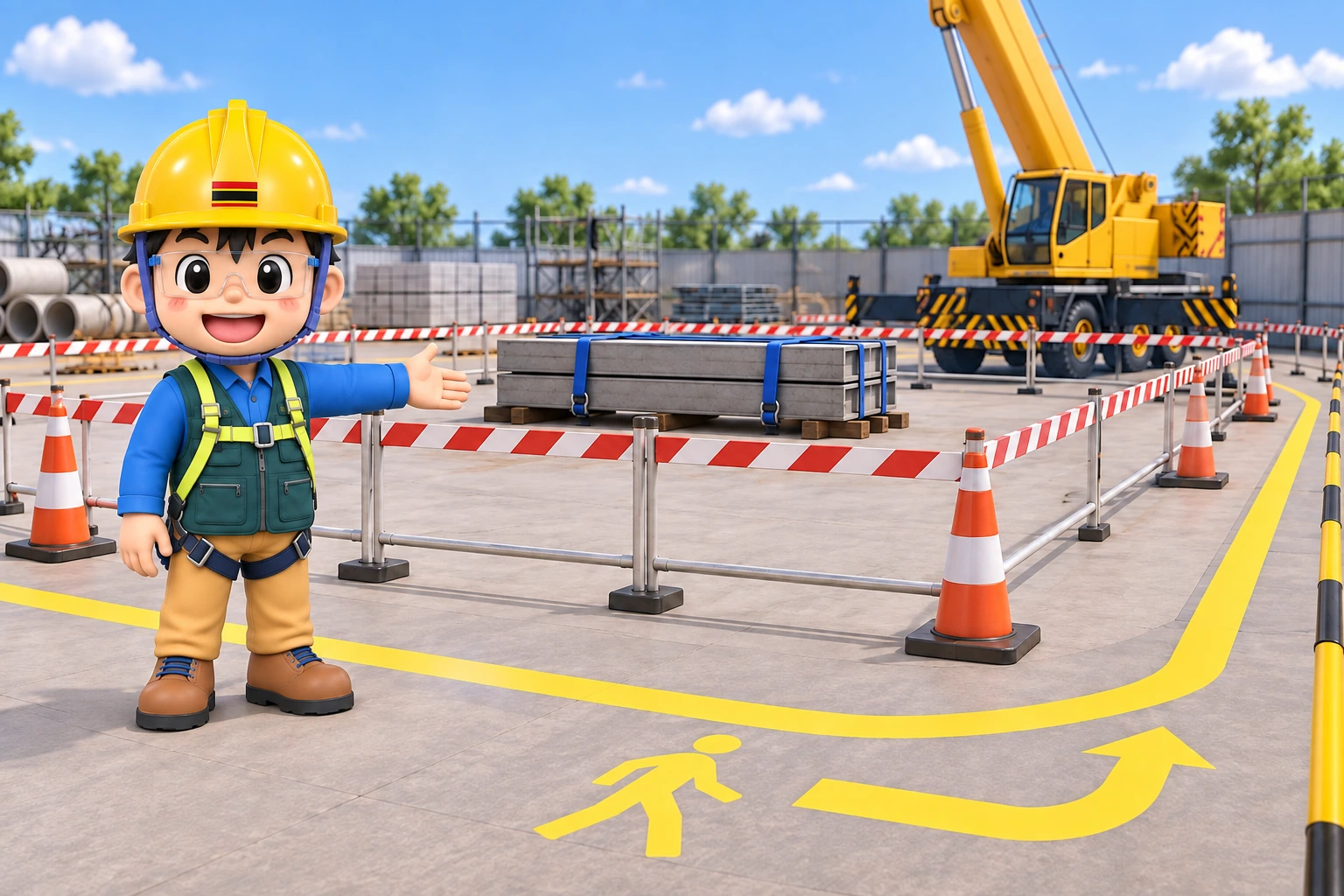
An exclusion zone includes more than the landing point. Consider the load route, potential movement, equipment motion and pedestrian paths.
The illustration is a planning scene, not a distance specification.
Review the task
Define load, equipment, route, signals and responsibilities in the lift plan, then match the physical boundary and alternative access. Coordinate overlapping tasks before work.
Check your workplace
- What is the load travel and slew path?
- Are pedestrians and adjacent work separated?
- Are signals and stop authority clear?
Apply the lesson
If a delivery route crosses the zone, agree a real separation method rather than relying only on a sign. Notify the operator, signal person and affected crews of timing changes.
Avoid a common mistake
Agree stop conditions for lost visibility, communication failure or entry into the controlled area. Determine boundaries from the actual lift; no generic radius in this article fits every operation.
Putting it into practice
Mark pick/landing points, access control and signalling positions. Apply the planned stop procedure if visibility or exclusion is lost.
Technical insight
Control the load’s travel envelope
Keeping people out from directly beneath a load does not address every trapping or movement hazard. Review the full journey from pickup to landing.
Consider centre of gravity, rigging, travel route and landing space as well as weight. Agree what happens if the operator and signaller lose visibility or communication.
Capacity, radius and ground conditions require a site-specific lift plan.
Korean safety resources
- KOSHA · Practical safety handbook 53: Automobile manufacturing (2020)
Korean handbook: forklifts p.143, rigging p.164, conveyor hazards p.195 and non-routine work incidents p.225.
Sources
- HSE — Lifting operations영국 / UK