English names and summaries of Korean laws are unofficial translations. The Korean text on the Korean Law Information Center (law.go.kr) prevails.
Check the connection before lifting: a falling heat-shield panel
At a glance
A heat-shield panel fell during a maintenance lift and killed 1 worker.
The sling used to turn the panel broke, allowing the suspended load to fall.
The case calls for checking sling condition, edge contact and connecting components together before lifting.
From preparation to the aftermath
On 2022-03-16, a subcontractor’s worker repaired an electric-furnace heat-shield panel inside a steel works. The panel shielded against sparks around molten metal and required maintenance to remove surface deposits. The worker ground one face that morning.
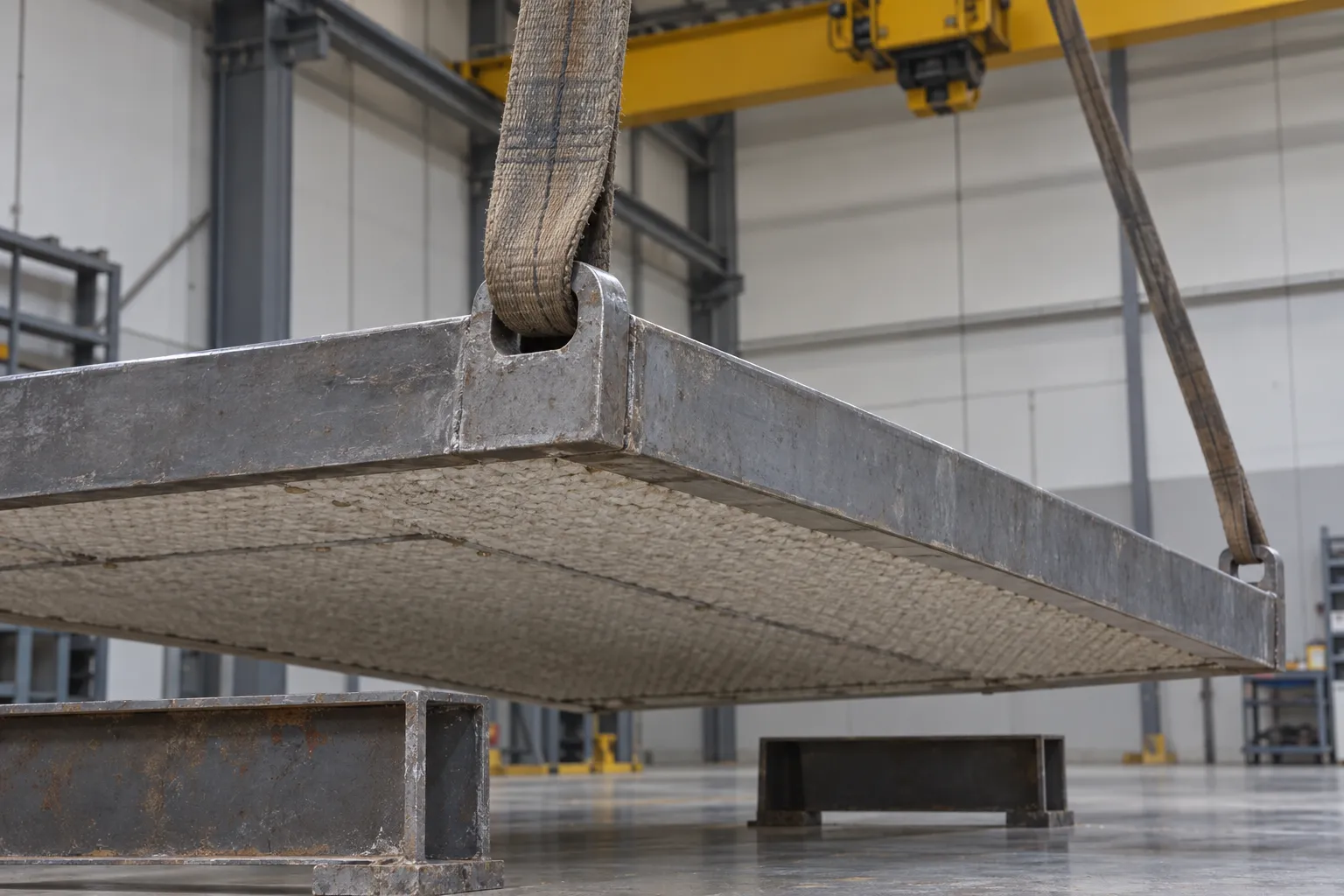
The panel measured about 3m×1.4m and weighed about 1.2t. At around 14:00, the worker used a gantry crane to turn it for work on the other face. While operating the lift by remote control, the textile sling connecting the panel to the crane broke and the panel fell toward the worker.
The worker was taken to hospital but died that evening. Investigation found that the sling was attached directly to the lifting lug without a shackle and contacted a sharp inner edge. A shackle was available nearby but had not been used in this connection.
The sling itself showed spark damage and contamination, and its load-rating label was missing. The missing connecting component and use of an already deteriorated sling were present in the same lift.
Sling contact changes as a panel is turned
Repair required turning the panel. As it moves from flat to upright and onto the other face, the relationship between its centre of gravity and supports changes. Checking sling contact only in the initial position does not cover contact and movement during rotation.
A textile sling can experience concentrated loading where it contacts a sharp metal edge. The lifting lug in this case had a sharp inner edge. Checking only the panel weight misses the surface through which the force is transferred and where damage can begin.
Check both the load-rating label and the current condition when selecting a sling. Heat, sparks and wear can degrade fibres, so a new-product rating cannot simply be applied. Identification and condition checks are separate, and a sling with unverified suitability must not be used.
The whitepaper notes that dressing an edge alone is not a complete remedy. The lug, connecting components, sling, crane and landing position must form a coherent plan. Adding one component does not resolve a damaged sling or inadequate space for people to stand clear.
Even a low lift for turning can expose a person’s legs to the panel. A small lifting height is not a reason to reduce exclusion arrangements. Plan possible tipping or sliding directions together with the operator’s position.
Crane capacity and sling conditions at the contact point require separate checks. A crane may lift the load while textile fibres remain exposed to a sharp edge. A load indicator or overload device does not remove that damage path. Inspect the lug edge and the surface bearing on the sling before connecting it.
Turning a heat-shield panel changes its support from the floor to suspended and tilted positions. The sling contact can shift as an edge lifts or touches a support. Initial clearance from an edge does not establish clearance throughout the turn. Plan the sequence and verify the connectors and edge protection through every stage.
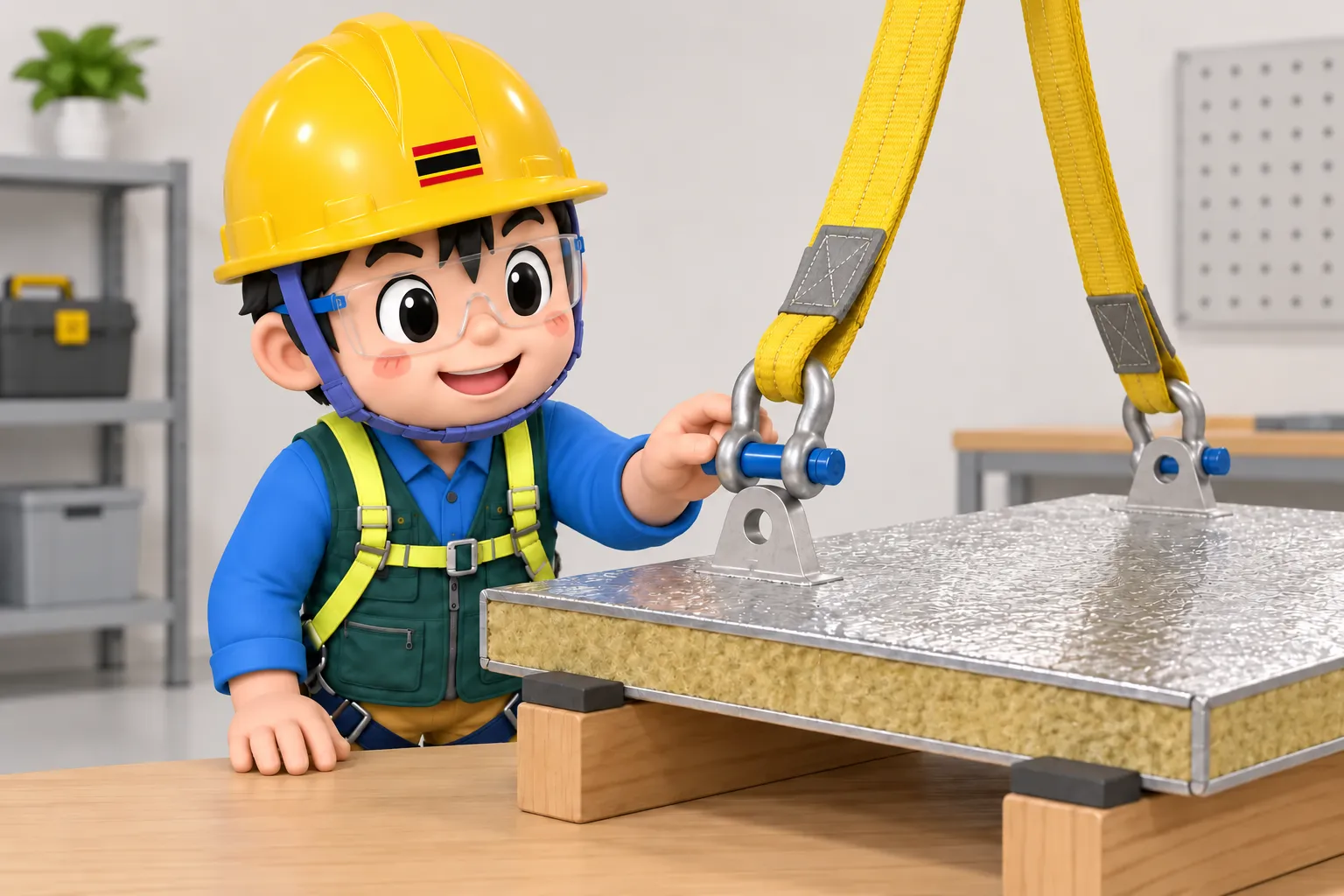
Obtaining the specified connector is a small task compared with handling an inadequately connected suspended panel. Have suitable connectors at the lifting position and do not start when they are unavailable. Compare the physical arrangement with the lifting plan so that a makeshift connection does not become accepted merely because it once lifted the load.
Other lifting accidents in the chapter involved detached clamps and failed lifting lugs as well as broken textile slings. Trace the complete load path rather than checking only one component. Position people outside the possible movement of a released load. If the arrangement requires someone to steady it by hand, revise the support and sequence first.
What the comparison shows
Another case in the 2023 edition changed long steel materials to a single sling attachment because they struck the wall during lifting. The angled load moved and a worker receiving it at an opening fell. This was not the same sling-failure mechanism, but it illustrates the risks of choosing a connection for convenience without controlling the receiving position.
Edge contact and sling condition are central to the panel; attachment position and rotation are central to the steel load. A generic heavy-lifting checklist misses those differences. The plan needs the actual load shape and changing orientation.
Causes and protective layers
| Layer | At the time | Workplace action |
|---|---|---|
| Lifting equipment | Heat and spark damage; missing label | Quarantine and replace with a suitable sling; check identity and condition separately |
| Connection | Direct contact with a sharp lug without a shackle | Review lug geometry, connecting components and load transfer |
| Turning | The load movement area overlapped the work position | Plan rotation, landing sequence and operator position |
Investigation and proceedings
In April 2023, the first-instance court sentenced the responsible management officer to 1 year's imprisonment (custodial), taken into custody in court immediately after sentencing. The corporation received a criminal fine of KRW 100 million. The appeal court upheld those sentences.
Why the consequences were severe
Colleagues were nearby when the panel fell, but could not reverse its movement. At receiving and turning positions, keeping people clear of the load before lifting matters more than how quickly others can approach afterwards.
Maintenance includes grinding and welding that can damage textile lifting equipment. Slings left near the work can be exposed to sparks or heat, so storage, retrieval and reuse decisions belong in lifting-equipment control.
Questions at the work position
| Question | What to examine |
|---|---|
| Where does the sling touch during turning? | Check edge contact from the initial lift to landing on the other face |
| Is condition checked even when labelled? | Examine heat damage, wear, contamination and damaged fibres separately |
| Where does the operator stand? | Choose a position outside falling, turning and sliding paths |
Korean legal references
Rules Article 38 addresses planning for heavy-load handling, while Article 163 addresses lifting-accessory safety factors and markings. Connect the actual weight, shape, route, equipment and work positions to the plan.
Occupational Safety and Health Act (Korean) · Rules on Occupational Safety and Health Standards (Korean)
Field practitioner note
Sources
MOEL and KOSHA, 2023 Serious Accident White Paper, 218–243, 327–328 pages. Official publication (Korean)