English names and summaries of Korean laws are unofficial translations. The Korean text on the Korean Law Information Center (law.go.kr) prevails.
Was the balance of the modified lifting attachment checked?: A coil-handling fatality
Key terms in Korean and English
- Serious Accidents Punishment Act (중대재해 처벌 등에 관한 법률)
- Enforcement Decree of the Serious Accidents Punishment Act (같은 법 시행령)
- serious accident (중대재해, OSH Act)
- supervisor (관리감독자)
- suspended sentence (집행유예)
- supervisor (관리감독자)
- C-hook (C형 후크)
- coil bundle (코일 묶음)
- lifting attachment (인양구)
- rated capacity (정격하중)
- overload protection (과부하 방지)
At a glance
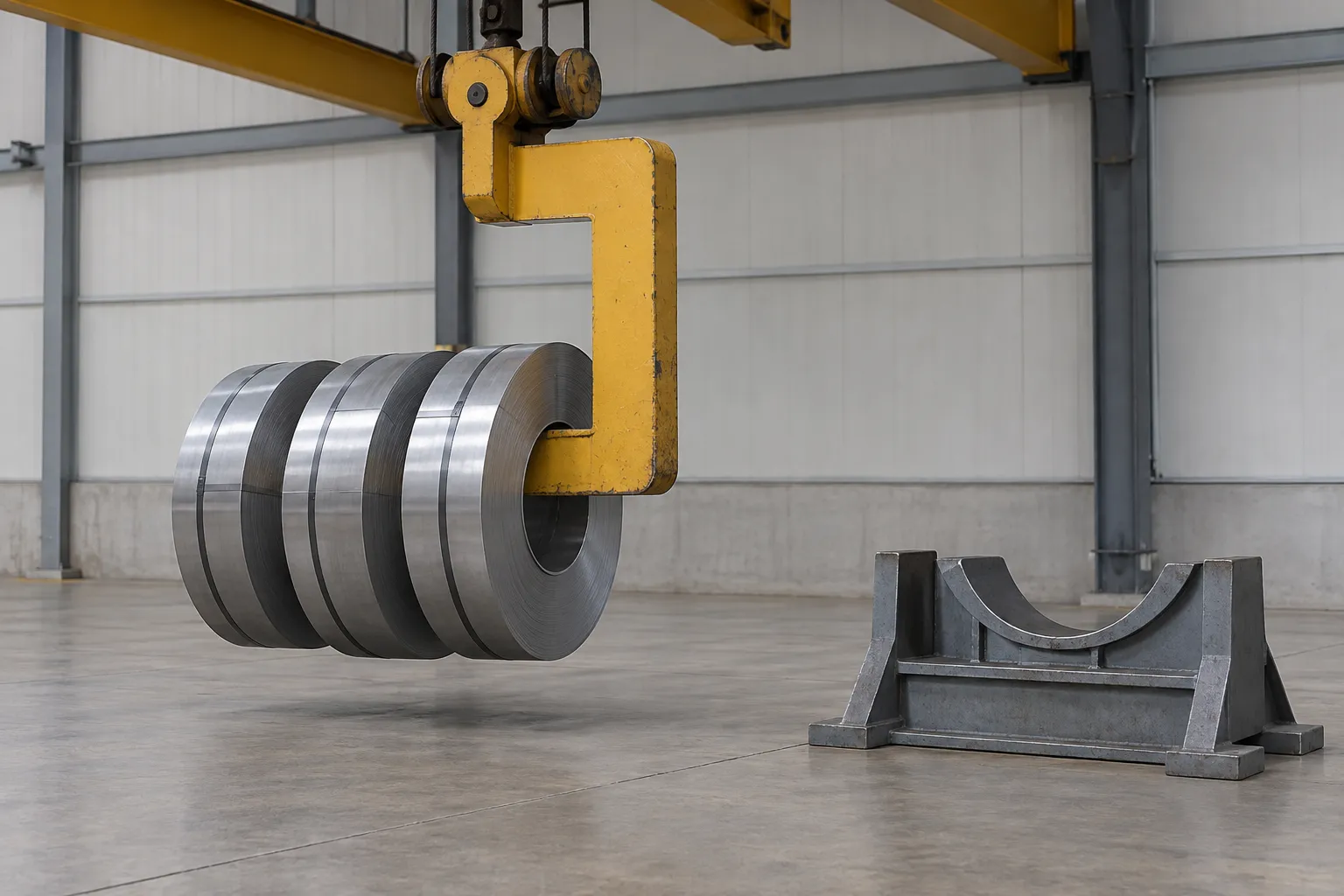
On 1 February 2024, 1 worker moving a bundle of coils at a steel-pipe factory in Gyeonggi Province was crushed by a falling coil.
The connection on the C-hook used for handling had been modified.
From preparation to the aftermath
On 1 February 2024, coils arrived at a pipe-making factory. Production involved forming the coil into pipe, cutting it, then coating and assembling the product. Receiving material supplied the following processes, and the worker prepared to move coils to storage with an overhead crane.
Coils arrived in bundles. The lifted bundle weighed about 3t, while the crane was marked with a 2.8t rated capacity. One person handled the coils while other workers carried out cutting.
The worker lifted a coil bundle on a C-hook, travelled briefly and stopped. After turning the coil by hand to align it for storage, the worker pressed the travel control again. The coil slipped off the hook and fell onto the nearby worker, who died.
The investigator found an altered upper connection. Holes intended for a pinned connection had been separated and welded in a fixed arrangement. The changed connection position and movement altered the attachment’s balance. Overload protection also failed to prevent lifting the accident load.
The plant manager was designated as supervisor but lacked the necessary authority, budget and performance evaluation. The representative initially pointed to the equipment’s second-hand purchase, but later replaced the modified hook with a normal product. The white paper records prosecution followed by a suspended sentence.
The incoming coils were handled in separate bundles. The crane was marked for 2.8t, while the accident bundle was about 3t. Bundle weight needed to be reconciled with capacity before arrival, rather than testing suitability by attempting the lift.
How a C-hook connection carries its load
A C-hook supports a coil through an arm inserted into its central opening. Simply seeing the coil on the arm does not establish stability. The suspension point, the hook’s own centre of gravity, coil width and position must work together. The same weight located near the arm tip can create different conditions for tilting and slipping.
The pin connection permits movement within its designed arrangement. Welding it rigid may appear to reduce movement while changing how the assembly takes load. Investigators identified an outward shift of the centre-of-gravity line after the upper suspension point changed. A weld that looks strong does not establish that the complete attachment functions correctly.
Getting a load just off the floor is different from completing a transfer. Starting, stopping and turning alter how the coil bears on the hook; contact with another object can add force in an unexpected direction. Verify the designed engagement position and permitted handling method before proceeding.
Capacity requires a separate check. The approximately 3t bundle exceeded the 2.8t marking. Correcting attachment balance would not justify leaving an overloaded lift unchanged. If incoming bundle sizes do not suit the crane, arrange a suitable splitting method or equipment before delivery and unloading.
Overload protection does not replace checking weight beforehand. It is a protective function that must operate when the limit is exceeded and must be checked against the marked capacity and actual configuration. Previous successful lifts of the same bundle are not evidence that the device works correctly.
Turning the coil by hand requires entering close to a suspended load. A person using the remote while manually aligning the load combines control operation with close approach. Review delivery and rack alignment, suitable turning or guiding equipment and the sequence to reduce manual repositioning beside the load.
When buying used equipment, examine the attachment’s identity and alterations as well as whether the crane runs. Do not put it into service when pins, welds and capacity markings cannot be reconciled with drawings or instructions. Seek manufacturer information or competent technical assessment rather than treating absent records as proof of original condition.
Supervisory authority matters when it permits stopping unsafe unloading or requesting another method. Pressure to unload on schedule without authority to change equipment or sequence can perpetuate the method. Evaluate actual withdrawal of unsuitable attachments and completed action, rather than relying on signed logs.
The process formed steel coil into pipe before cutting, coating and assembly. Incoming handling is upstream of production but still needs separate planning. If a supplier’s bundles do not match on-site lifting capacity, separation becomes an improvised task on arrival. Agree handling units and attachments when arranging purchase and delivery.
Movement at a pinned connection is not automatically unwanted looseness. Here the connection position and permitted movement were part of the load-supporting arrangement. Welding it rigid can change suspension and force transmission as well as local stiffness. Check the specification and use conditions before eliminating inconvenient movement.
The handling sequence called for separating the bundle from adjacent bundles and positioning it appropriately on the lifting arm. Skipping separation and alignment can leave it near the arm’s end. Approaching to correct it by hand substitutes personal effort for attachment stability. Provide a sequence for safely setting down and correcting the attachment.
What the comparison shows
In the 2023 white paper’s lifting fall case (2022-11), slinging was changed when a long load interfered with a wall, after which the load rotated and escaped. The coil case instead involved an attachment already modified and used routinely. Both show the gap between lifting a load and managing balance and people’s positions during travel.
Long material calls for attention to sling position and swept movement, while a coil calls for correct support position and hook balance. A shared crane checklist cannot make attachment conditions identical. The plan needs the actual coil-bundle and hook combination.
Causes and protective layers
| Layer | At the time | Workplace action |
|---|---|---|
| Attachment geometry | Pinned connection changed to welding | Check specification and alteration history |
| Capacity | Bundle exceeded rated capacity | Match incoming units to equipment capacity |
| Protective function | Overloaded lift was not prevented | Test protection and stop unsuitable equipment |
| Position | Suspended coil turned by hand | Provide a method of alignment without close approach |
Investigation and proceedings
A suspended sentence was imposed following prosecution. The prison term and suspension period are not recorded in the white paper.
Why the consequences were severe
The escaping coil fell towards the worker’s position. Helmet provision and use were also deficient, but keeping people outside the load’s fall zone comes first. Protective equipment cannot be treated as protection against a multi-tonne falling load. Stability, capacity and segregation are separate safeguards.
Questions at the work position
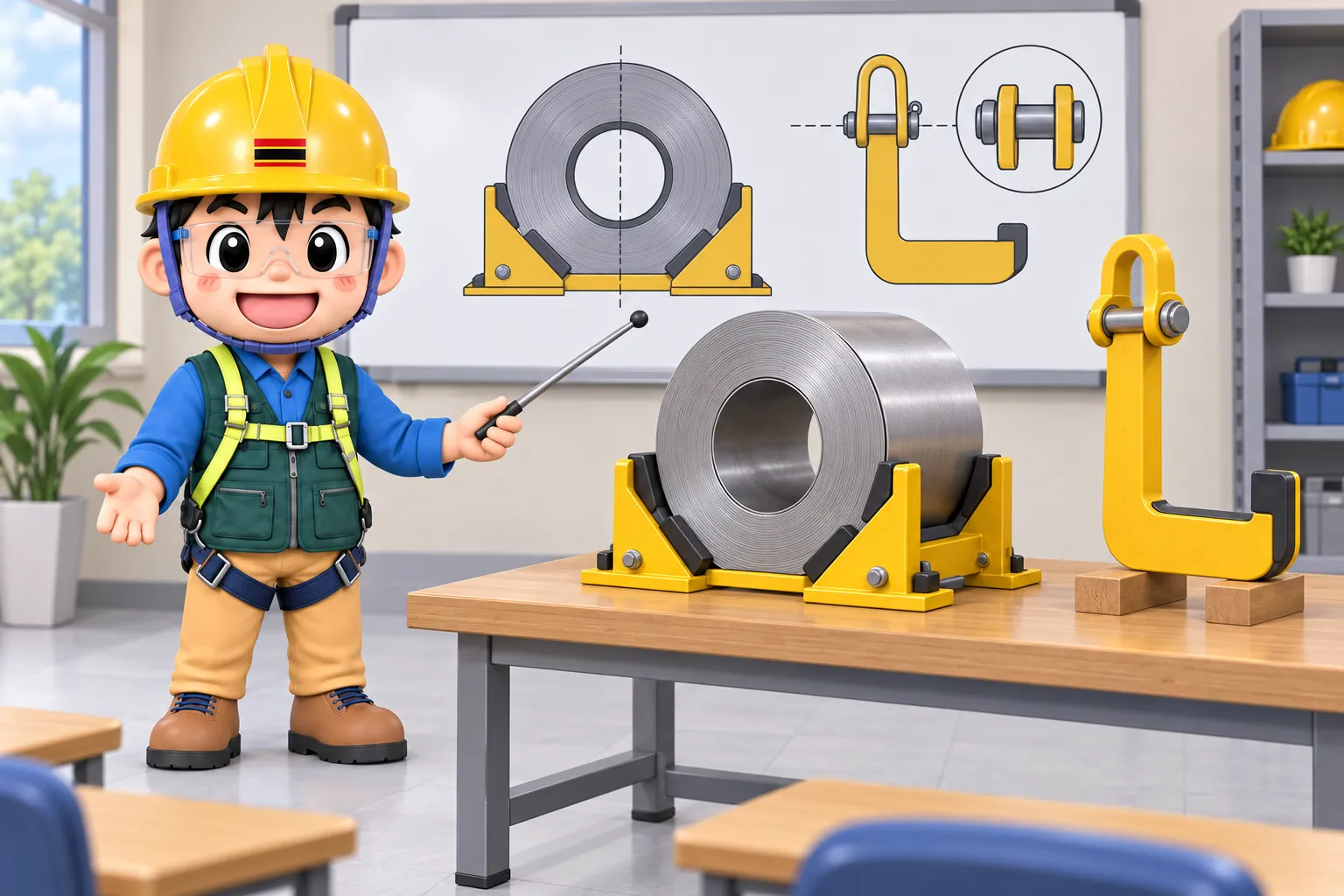
| Question | What to examine |
|---|---|
| Is the connection original? | Pins, welds, suspension position and manufacturer information |
| What does the bundle weigh? | Crane and attachment capacity versus delivery unit |
| Is it stable when travel resumes? | Position on the arm, interference and approved method |
| Why must someone approach? | Layout, equipment and sequence to remove manual turning |
Korean legal references
Safety-rule Articles 133, 134 and 135 address capacity markings, normal operation of lifting protection and rated-capacity limits. Review heavy-load planning under Article 38 as well. Relate the marking to the actual incoming bundle and operating conditions.
The white paper records 24 regular workers and an accident in February 2024, after coverage expanded. SAPA Enforcement Decree Article 4(5) concerns the authority, budget and evaluation needed for supervisory duties. Use it to examine whether supervisors can actually stop unsafe receiving work and replace unsuitable attachments.
Occupational Safety and Health Act (Korean) · Rules on Occupational Safety and Health Standards (Korean) · SAPA Enforcement Decree (Korean)
Sources
MOEL and KOSHA, 2025 Serious Accident White Paper, Part 2, 31–53 pages. Official publication (Korean)