English names and summaries of Korean laws are unofficial translations. The Korean text on the Korean Law Information Center (law.go.kr) prevails.
Protect the receiving edge before lifting: steel materials at an opening
Key terms in Korean and English
- serious accident (중대재해, OSH Act)
- responsible management officer (경영책임자등)
- safety and health manager-in-chief (안전보건관리책임자)
- supervisor (관리감독자)
- safety and health manager (안전보건관리담당자)
- fall from height (떨어짐)
- guardrail (안전난간 / 난간)
- safety net (추락방호망)
- supervisor (관리감독자)
- slinging (줄걸이)
At a glance
On 14 May 2022, 1 worker receiving lifted materials at an extension project in Gyeonggi Province fell and died.
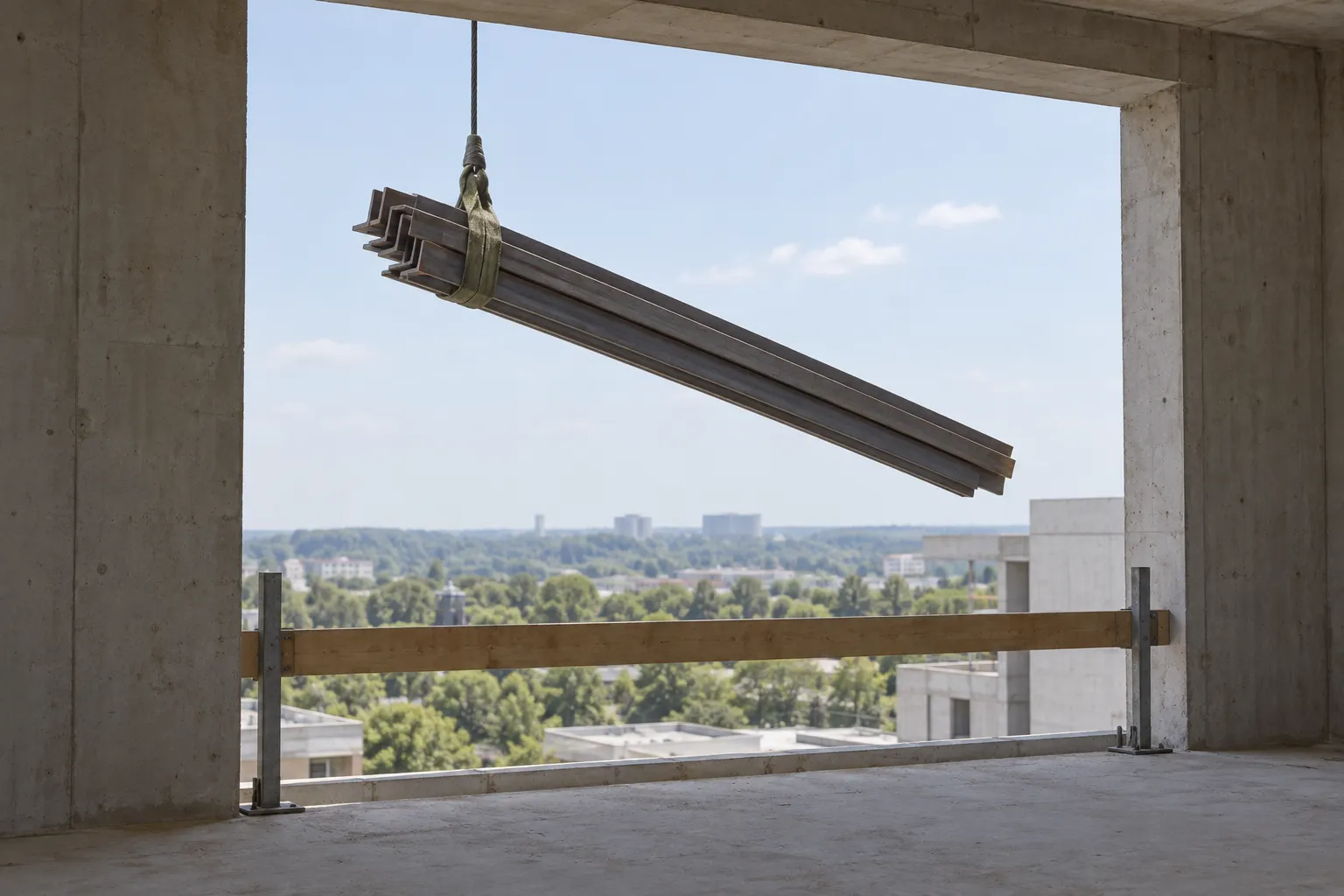
The upper guardrail at the fifth-floor opening had been removed to bring materials inside.
From preparation to the aftermath
On 14 May 2022, a building-extension crew in Gyeonggi Province decided to lift materials ahead of the following week’s steelwork. Structural reinforcement took place in the morning; the afternoon was used to prepare angles for fixing deck plates. Materials raised from the 1st floor were to be received by two workers at an opening on the 5th floor.
The upper guardrail was removed to make room for the material. When the long steel was attached at multiple points, it fouled the wall during lifting. Instead of revising the route or delivery method, the crew changed to a single attachment point.
The bundle of 5 m steel rose at an angle and began rotating. The other receiving worker suggested lowering it to re-sling, but the lift did not stop. As it came within reach, the receiver extended a hand; the material slipped from the sling and the worker fell through the opening.
The worker was taken to hospital but died. There was no safety net replacing the removed rail and no connected harness. PPE being available in an office was not the same as effective fall protection at the receiving position.
The site manager learnt of the day’s work only after the accident. The appointed safety officer was not carrying out safety duties, and no effective supervision corrected the hazardous change. Despite a project value of about KRW 8 billion, delivery, removal of opening protection and changed slinging were not managed together.
Sentences concerning the responsible management officer, company and site safety and health manager-in-chief followed in April 2023. The worker’s immediate action cannot be isolated from the absence of effective arrangements for both receiving-edge protection and the lift method.
Load access and a protected receiving position are different needs
A long load tilts according to the relationship between attachment and centre of gravity. Movement within a bundle or rotation while inclined changes how it bears on the sling. Successful initial lifting does not establish stability through final delivery. The method needs to include passage through the opening.
If a two-point attachment fouls the wall, the delivery arrangement does not fit the route. Reducing attachment points to pass the obstruction changes the stability conditions. Lower the load and reassess its length, mass, bundling, opening dimensions and equipment position. An improvised change of attachment during the lift requires a revised plan.
This case concerns a particular long load that rotated and escaped from a single-point attachment. It does not imply that the same number of sling legs suits every load. Select equipment and attachment for the load geometry and manufacturer requirements, and check stability during a trial lift. If the appropriate method cannot fit the space, change the access arrangement or delivery sequence.
Removing an opening guardrail creates both access for material and a route for a person to fall. Guard removal is therefore not a minor preparatory task. Alternative protection, the receiver’s position and reach need to be established before removal.
Wearing a harness alone does not prevent a fall. A suitable anchorage and a workable connected position are required. If the incoming load conflicts with the lanyard, redesign the arrangement rather than disconnecting during the task. Plan the load route and the protected worker position together.
Reaching for material that is slipping moves the body toward the opening. The receiving worker must not become the means of controlling rotation. Agree signals between the winch operator and receiver so the lift can stop and return to a stable position, and exclude people below.
Lifting material in advance is a hazardous task in its own right. Treating it as mere preparation because the main activity starts later can leave it without planning or supervision. Confirm who lifts what, where it is received and who removes and restores protection as part of that day’s work.
The lift plan is not only for the person attaching the load below. The receiver above, winch operator and nearby workers face different hazards. Establish a common stop when the load fouls a wall, a place to lower it and a receiving laydown area so the intermediate stages do not force hazardous decisions.
A decision to pre-lift materials also needs a laydown position. Without space above, a receiver may hold suspended material longer or turn it at the opening. Clear internal storage and movement space before delivery so the person can place the load and withdraw to a protected position.
Those changing an attachment below and receiving above may not share the same understanding. Stop the lift and review the new method together. Check not just wall clearance but potential bundle escape and where the receiver’s hands would be placed.
Appointing a safety officer does not replace directing the task. Identify who directs the day’s lift and reviews changes. A qualified name on a list does not provide control if an unstable attachment is still used. Work brought forward as preparation for the next activity also belongs within that supervision.
Restoration of opening protection should not depend on remembering after all lifts finish. Other people may approach the edge during a break or while another load is prepared. Plan control during deliveries and protection during interruptions, then verify the guardrail’s function after completion.
The exclusion zone is not necessarily limited to directly beneath the opening. Long materials can tilt or rotate into a wider area. Set boundaries from load geometry and route and provide an alternative passage. Separate people from potential dropped-load areas instead of leaving the receiver to reach dangerously to save a load.
What the comparison shows
In the ship-painting case in the 2025 white paper, a worker fell where a truck-mounted platform entrance was open. The location differs from this building opening, but both involved a break in protection at the edge supporting the person. A removed rail for deliveries and an open platform entrance both create an actual fall path.
The differences matter: the ship case concerns entrance closing and securing and platform inspection; this case concerns replacement protection for an intentionally removed rail and delivery of an unstable load. Confirmation that harnesses were issued does not resolve either site’s specific mechanism.
Causes and protective layers
| Layer | At the time | Workplace action |
|---|---|---|
| Delivery plan | Attachment improvised after wall interference | Lower and reassess route, attachment and space |
| Fall protection | No alternative after upper-rail removal | Provide replacement measures before removal |
| Rotation control | Receiver reached toward the moving load | Stop signal and a stable lowering position |
| Supervision | Managers unaware of the day’s lift | Review changes and supervise on site |
| Completion | Opening remains hazardous after delivery | Restore guarding and check residual hazards |
Investigation and proceedings
In April 2023, the responsible management officer received 1 year and 6 months’ imprisonment, suspended for 3 years. The company’s criminal fine was KRW 30 million, and the site safety and health manager-in-chief’s fine was KRW 5 million.
Why the consequences were severe
Load escape and the worker’s fall occurred together. There was neither a protected margin for the receiving action nor fall protection to arrest the fall. Protect the receiving position so that trying to prevent a dropped load does not create another casualty.
A colleague proposed lowering and re-slinging. Supervision and working arrangements did not turn that proposal into an actual stop. An unstable suspended load calls for stopping and restoring safe conditions, rather than an experienced worker trying to control it by hand.
Questions at the work position
| Question | What to examine |
|---|---|
| What if the load touches the wall? | Lowering position and signals before attachment changes |
| What is installed before the rail is opened? | Alternative protection and a protected receiving position |
| Can people stay clear of rotation? | Rotation envelope, reach and the opening |
| Does harness connection remain effective? | Anchorage, load interference and movement range |
| Who checks restoration? | Guardrail and access-control restoration after delivery |
Korean legal references
Safety-rule Article 43 addresses opening protection and replacement measures when guarding is temporarily removed for work. Article 38 on heavy-load handling plans is also relevant. Planning must cover fall risks and methods at the receiving floor, not merely the attachment method.
The approximate KRW 8 billion project value and 2022 accident date place it within the SAPA construction coverage then in force. Current Enforcement Decree Article 4(3) is linked as a preventive hazard-identification and correction measure. Historical appointment thresholds are not presented as current requirements.
Occupational Safety and Health Act (Korean) · Rules on Occupational Safety and Health Standards (Korean) · SAPA Enforcement Decree (Korean)
Field practitioner note
Sources
MOEL and KOSHA, 2023 Serious Accident White Paper, 106–133 pages. Official publication (Korean)