English names and summaries of Korean laws are unofficial translations. The Korean text on the Korean Law Information Center (law.go.kr) prevails.
Can anyone take the forklift key?: a collision during material changeover
Key terms in Korean and English
- serious accident (중대재해, OSH Act)
- responsible management officer (경영책임자등)
- supervisor (관리감독자)
- supervisor (관리감독자)
At a glance
On 9 January 2023, a forklift struck a worker during a material changeover at a factory in Gwangju.
The 1 worker trapped between the rack and the vehicle died early the next morning.
From preparation to the aftermath
On 9 January 2023, an electronic-component factory was changing products. Both the press mould and raw material had to be replaced. People entered the rack area during the changeover, while a forklift also had to approach it with material.
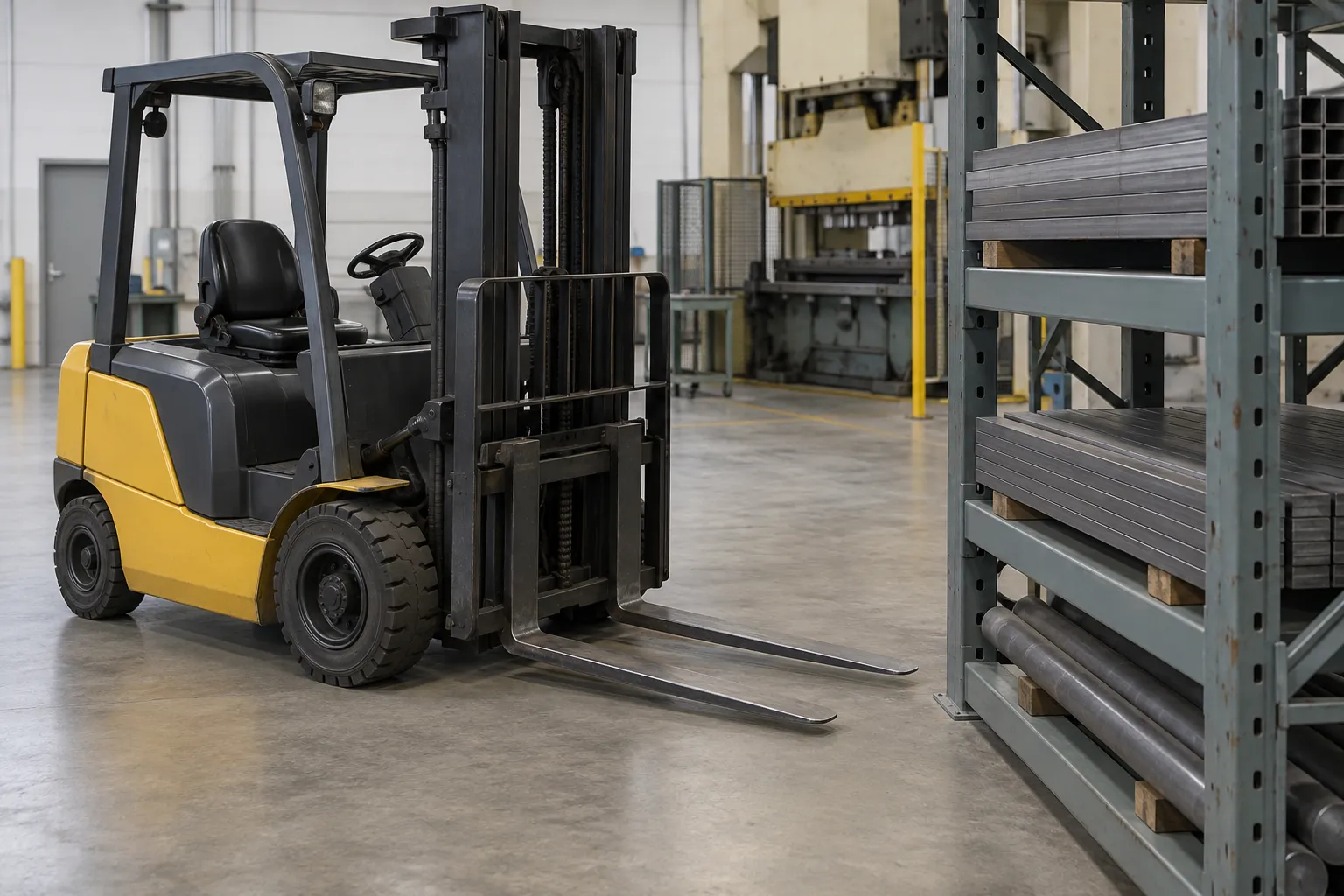
At about 14:00, one worker arranged the material rack while a colleague fetched the forklift. The key had been left in the machine, allowing a worker to drive it immediately. The colleague had no licence and had learnt the controls from another worker.
The forklift turned a corner towards the rack. The driver saw the worker, but braked too late; steering away did not prevent the collision. The worker was trapped between the rack and forklift. A colleague called for help and the worker was taken to hospital, but died early the following morning.
The person responsible for supervision was working on another floor. Workers with different languages remained on the production line. The investigation found that an executive had prepared the risk assessment without workers or the floor supervisor, and that the work plan omitted forklift routes and measures against trapping.
An external safety service had already warned about forklift hazards. The responsible management officer received the warning, but it did not lead to improvements. A worker’s statement that no training had been received also conflicted with the training signature record. MOEL examined the management arrangements that allowed the task, not only the person at the controls.
Changing positions during material changeover
Material changeover involves more than briefly stopping a press. The person clearing old stock, the receiver and the vehicle may converge in a confined area. Assessing only normal production can miss this collision route. A changeover layout should show both people’s positions and the forklift approach.
A rack can obstruct the driver’s view and become a rigid surface that prevents escape during a collision. Knowing that someone is beside it does not preserve escape space as the truck approaches. Separate the sequence so that the person finishes arranging material and leaves the zone before vehicle entry.
Leaving the key in place equates convenience with authority. Access to the key does not establish training, qualification or assignment. Moving the key alone is insufficient: decide who may operate that machine and whether work waits or another qualified operator is called when that person is absent.
Where a guide is used, consider a position visible to the driver from which pedestrian entry can also be controlled. Signalling between the load and rack can put the guide in the trapping zone. Driver and guide need the same rule for stopping when the signal or a person’s position cannot be seen.
A signed training sheet gives little evidence of understanding across languages. Demonstrate the stop signal, the safe position away from the rack and when material may be set down, then ask workers to explain them at the location. Learning machine controls from a colleague is different from learning the hazards of the handling area.
Check whether normal route markings remain effective during changeover. Removed moulds and leftover stock can narrow the aisle, while the person tidying may step into it. Allocate temporary storage positions and restore the route before calling the vehicle.
Repeated external findings call for inspection of the changed route, rather than only a written response. Completion should be based on actual separation of rack work and truck entry, worker understanding and compliance when the usual supervisor is absent.
Knowing how to operate the controls is separate from being qualified and assigned to the task. Informal instruction may enable someone to start and move a truck without establishing understanding of load-obscured visibility and turning space. Control access against authorized operators and equipment, including at shift changes, instead of leaving the key available.
The discrepancy between a training signature and the worker’s account cannot be explained solely as a language issue. First establish whether training occurred, then whether the worker can explain or demonstrate withdrawal and whose signals to follow at that rack. General forklift information must connect to the actual changeover area.
After an external safety adviser raises a finding, someone needs to check the changed operation: whether vehicles wait during rack work, temporary stock obscures the corner again, and the sequence holds while the supervisor is on another floor. Record completion after segregation and sequence are implemented.
What the comparison shows
In the same 2024 white paper’s steel-pipe handling case (2022-10), a worker also died during forklift handling. A pipe rolled and trapped a worker in the rack, with chocking and guidance assigned to the same person. Here, a worker remained by the rack as the truck approached to collect material. The approach before loading therefore belongs in the handling plan.
Both are recurring production tasks, but material shape and people’s positions produce different hazards. Preventing pipe rolling alone does not prevent collision at a rack. This layout needs separation based on corner visibility and withdrawal of changeover workers. In both cases, avoid positioning a guide inside the hazardous work space while signalling to the vehicle.
Causes and protective layers
| Layer | At the time | Workplace action |
|---|---|---|
| Operating authority | An unlicensed worker used a truck with its key left in place | Link qualification and assignment checks to key issue |
| Segregation | Rack work coincided with vehicle approach | Vehicle entry after people leave |
| Supervision | The supervisor was on another floor | Assign actual direction during changeover |
| Corrective action | An external warning did not remove the hazard | Verify the revised route on site |
Investigation and proceedings
At the first trial, the responsible management officer received a criminal fine of KRW 50 million for violating the SAPA.
Why the consequences were severe
The worker was between a moving vehicle and a fixed rack. The trapping space itself created severe risk beyond the initial impact. Being conscious during transfer did not reveal the seriousness of internal injury. An injured person’s ability to speak or move is not a reason to delay medical attention.
Questions at the work position
| Question | What to examine |
|---|---|
| Where are changeover workers? | Confirm rack work is finished and people have left |
| Who may receive the key? | Machine-specific qualification, training and assignment |
| What blocks the corner view? | Racks, moulds, temporary stock and the driver’s sight line |
| Did corrective action reach the floor? | Compare segregation and sequence with real work |
Korean legal references
Safety-rule Article 38 addresses investigation and planning for vehicle-based handling work. Article 172 addresses entry restrictions and guidance where contact is hazardous. Include the timing of worker withdrawal and forklift entry and communicate it understandably.
The white paper records about 145 regular workers and a 2023 accident. That falls within the coverage then in force, making SAPA Enforcement Decree Article 4(3) relevant to hazard identification and correction. Use that procedure to check whether external warnings led to completed action.
Occupational Safety and Health Act (Korean) · Rules on Occupational Safety and Health Standards (Korean) · SAPA Enforcement Decree (Korean)
Field practitioner note
Sources
MOEL and KOSHA, 2024 Serious Accident White Paper, 64–87 pages. Official publication (Korean)