English names and summaries of Korean laws are unofficial translations. The Korean text on the Korean Law Information Center (law.go.kr) prevails.
Control rolling pipes and worker access together: forklift transport accident
At a glance
A worker died after becoming caught between steel pipes during forklift transport.
Inside the pipe storage rack, the worker placed chocks and guided the forklift task.
Plan both a means to restrain rolling loads and an area that workers must remain outside.
From preparation to the aftermath
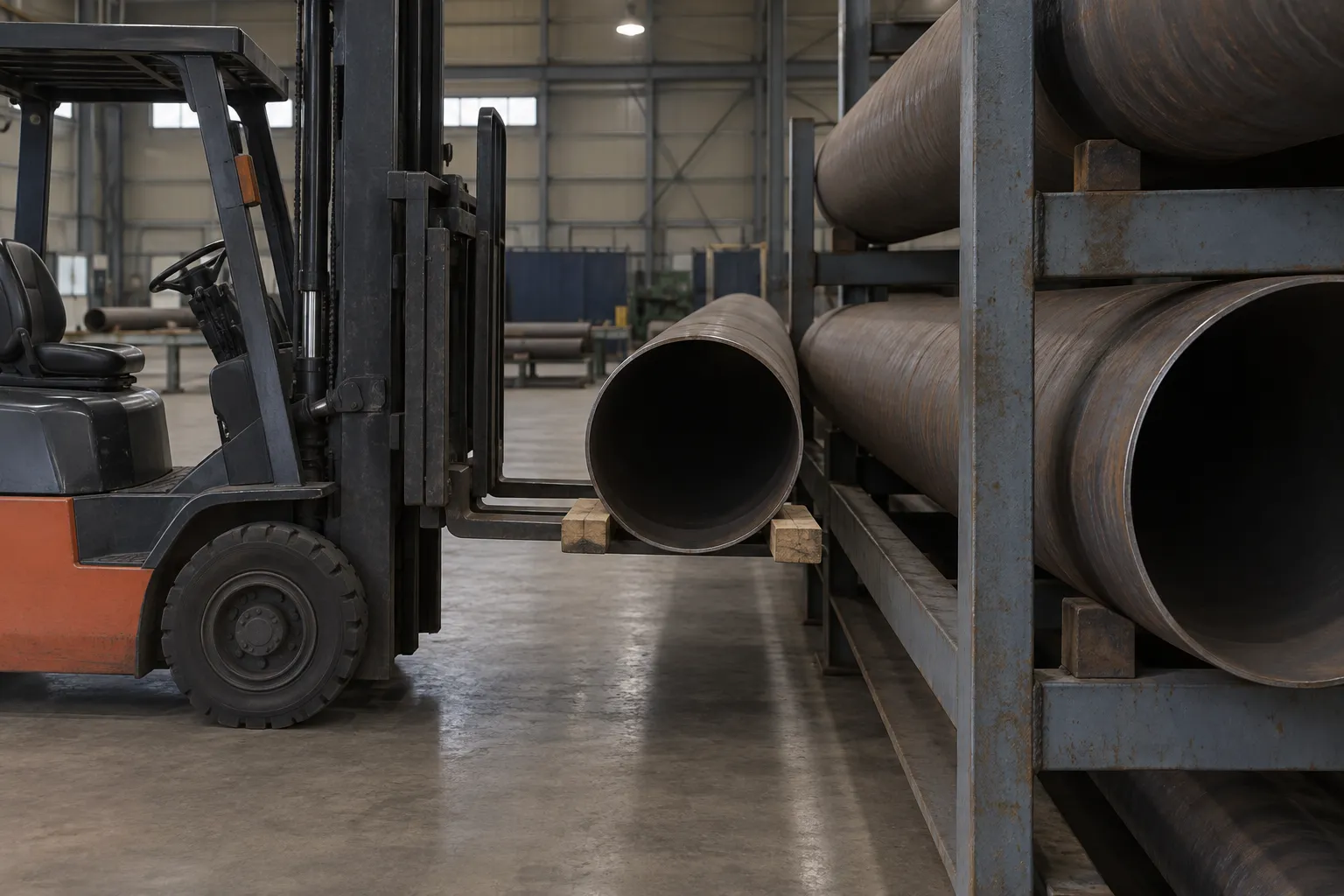
On 2022-04-20, 1 worker died after being trapped between pipes during transfer from a shot-blasting area to a coating area. The worker placed chocks between the forklift and storage rack while also guiding the driver. Load restraint and vehicle guidance were combined in one person inside the danger area.
There were 10 pipes to transfer. Each weighed about 4.3t and measured 12m long and 60cm in diameter; a 7t forklift was used. The worker stood where a chock was added after a pipe came onto the forks. Another worker removed surface debris in the noisy indoor area.
The first transfer was completed at about 09:50. At about 09:59, the assistant was heading towards the break room when a loud noise prompted a look back. A pipe near the forklift had rolled and trapped the worker inside the rack. The victim was taken to hospital but died about 1 hour after the incident.
The principal contractor claimed the worker entered to stop a rolling pipe. Colleagues, however, described routine chock placement from inside the rack. The whitepaper identifies that working practice and the lack of a separate guide as problems.
There were 3 fixed wooden chocks on the forks, with 1 further chock added after loading. Experts proposed that rebound from contact with an existing chock may have initiated rolling.
Round pipe can roll during loading
A round pipe is supported differently from a flat-sided box. It can roll sideways on forks, and a change in contact with its support can initiate movement. A transfer method for long, heavy pipe must address both stability and when people approach. Being able to lift the mass does not establish safety of the entire operation.
A chock works only when correctly positioned. If a person must enter between pipes to place the final chock, that person occupies the rolling path before restraint is complete. Checking wood quality or shape alone does not remove this sequence hazard. Review how the load can be supported and restrained before approach.
Forklift capacity must be assessed with the actual operation. Getting a long pipe onto the forks may require moving neighbouring pipes or rolling a pipe towards the rack edge. That changes contact positions, centre of gravity and clearance. Evaluate the capacity chart, attachment, load centre and route together.
A rack must control pipe movement during retrieval and placement as well as storage. Shaped supports or suitable clamps are possible alternatives, but an arbitrary attachment is not a solution. Verify compatibility with pipe dimensions, contact surfaces and machinery, and keep people outside pinch zones during trials.
Separating guidance from manual load handling allows the guide to observe the whole movement. A worker looking down and placing chocks cannot continuously watch the driver and approaching people. In noisy areas, define signals and stop conditions, including stopping when the guide is no longer visible.
What the comparison shows
Another whitepaper case concerns a reversing forklift striking a worker in a yard, where blind spots overlapped pedestrian movement. The pipe event instead involved a method requiring close approach to the load. Alongside an exclusion area, review a restraint method that does not require entry.
This factory reused an assessment from a plant making different products. It mainly covered crane work and omitted forklift pipe transfer. A shared company form cannot substitute for assessment of the actual load shape, equipment and worker position.
Causes and protective layers
| Layer | At the time | Workplace action |
|---|---|---|
| Load restraint | Worker added a chock after placement | Restrain rolling before approach |
| Worker position | Work between pipes inside rack | Design a method outside the pinch zone |
| Guidance | Chocking and guidance combined | Separate guidance with clear stop signals |
| Assessment | Another factory's document reused | Assess the actual pipe-transfer steps |
Investigation and proceedings
The subcontractor corporation and its representative were indicted for OSH Act violations. In May 2023, the principal contractor corporation and its representative were indicted for SAPA violations. At the hearing on 2023-11-14, the principal contractor side denied the allegations; proceedings were ongoing when the white paper was published.
Why the consequences were severe
Escape space between the pipes was limited. Catching or bracing a rolling pipe by hand cannot reliably control such a load. Prevention lies in removing the need to enter the path of an unrestrained pipe, not in teaching faster chock placement.
Questions at the work position
| Question | What to examine |
|---|---|
| Where is the body during final chocking? | Check the position against possible pipe movement. |
| Is rolling controlled during retrieval? | Review storage and transfer states separately. |
| Does the guide also handle the load? | Check for conflicting manual and signalling tasks. |
| Does the assessment match the equipment? | Compare load shape, machinery and route with the document. |
Korean legal references
Review Rules Articles 38 and 39 on work planning and supervision against the transfer method. Article 172 on preventing contact also relates to worker approach. Defining signals alone is insufficient if the chock installer remains inside the danger area.
OSH Act Article 36 risk assessment requires consideration of the actual work rather than unmodified reuse of another site's assessment.
Occupational Safety and Health Act (Korean) · Rules on Occupational Safety and Health Standards (Korean)
Field practitioner note
Sources
MOEL and KOSHA, 2024 Serious Accident White Paper, 114–133 pages. Official publication (Korean)