English names and summaries of Korean laws are unofficial translations. The Korean text on the Korean Law Information Center (law.go.kr) prevails.
Does container inspection overlap forklift travel?: a reversing collision in a yard
Key terms in Korean and English
- serious accident (중대재해, OSH Act)
At a glance
At a port yard in South Jeolla Province, 1 employee inspecting containers was struck by a reversing forklift.
The employee was taken to hospital but died two days later.
From preparation to the aftermath
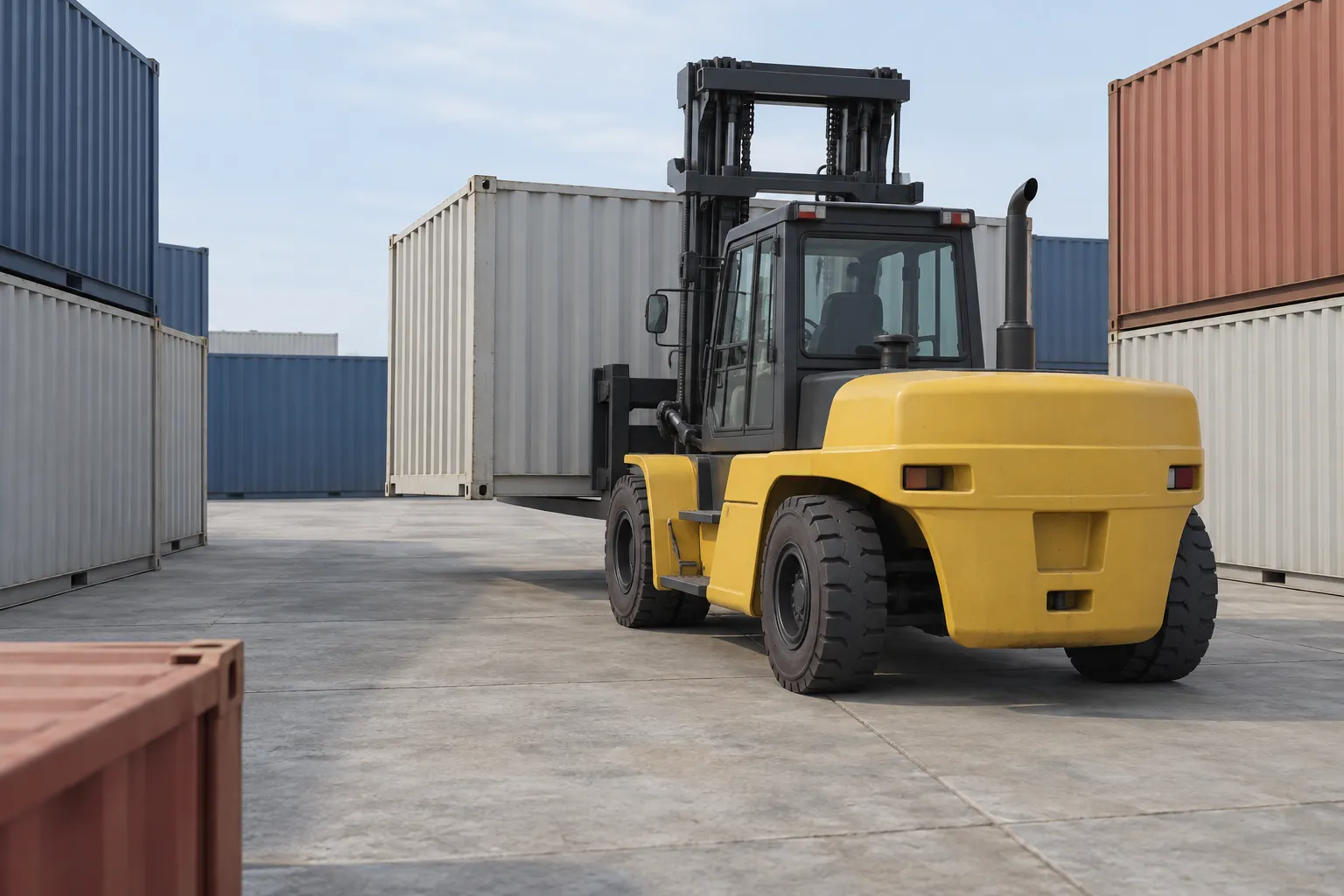
At the port yard, cargo was transferred into containers, inspected and then moved into storage. An employee walked between containers to complete the checks needed for administrative work while forklifts continued loading and transporting. Inspection was supposed to precede transport, but pedestrian and vehicle routes were not separated.
A forklift lifted an inspected container weighing 8.4 t and began reversing. Behind it, the employee was walking towards another container. The vehicle struck and ran over the employee, who was taken to hospital by emergency responders and died two days later.
MOEL reconstructed visibility using the 16 t forklift involved. A person of similar height could not readily be seen in the interior mirror close behind the vehicle. Under the reconstruction conditions, identification required at least 40 cm of separation from the rear. That finding belongs to those particular conditions; it is not a permitted approach distance for other forklifts.
There was no dedicated route for the inspector and no guide for reversing. The driver said the employee had not been seen. The layout required inspection within the vehicle work area, without an arrangement to clear that area before reversing.
The inspector’s path outside the driver’s view
Blind areas are not caused only by distant obstructions. The frame or body can hide a person close to a large vehicle even when the driver checks a mirror. When a pedestrian emerges between containers directly behind the vehicle, little time remains for recognition. The view from the seat and the actual walking route therefore need to be considered on the same plan.
A stationary vehicle does not by itself establish a protected inspection area. If the driver is free to start the next move, pedestrian access can coincide with departure. Stop movement before inspection, confirm that the person has left and only then resume transport. A general instruction to take care does not establish those start conditions.
Horns and reversing alarms do not replace separation. Several vehicles may sound at once in a yard while an inspector concentrates on cargo marks and condition. The first task is to keep the vehicle work area clear, rather than depend on a person hearing and escaping. A guide also needs a position outside the vehicle path and an agreed means of communicating with the driver.
Moving containers changes the original view. As transport progresses, the corners from which pedestrians appear and the available gaps also change. Check whether stored cargo blocks the designated route and forces people into a reversing area. The decision to continue inspection with a blocked route should not be left to the individual employee.
Separation begins with deciding where inspection takes place. Match the physical arrangement to whether transport precedes inspection or follows it. Sending an employee between available containers while vehicles depart whenever ready creates conflicting start conditions. Identify containers under inspection and a waiting position for vehicles to reduce reasons for entering an occupied area.
The inspector is performing a different task from the driver. Attention may be directed at markings and cargo condition before moving immediately to the next container. From the cab, that movement may look like a sudden appearance. It is more practical to protect the space needed for inspection than to rely solely on the driver predicting the inspector’s next action.
Interpret the reconstruction distance with the mirror position and vehicle shape in mind. A point at which a particular person becomes visible demonstrates the hidden area; it does not turn the ground just beyond it into a safe walkway. Distance changes as the vehicle moves, and mirror checks are not continuous. Route separation must account for movement independently of visibility around a stationary vehicle.
Agree the stopping response as carefully as the departure signal. Control breaks down if people interpret entry by an inspector or loss of sight of the guide differently. Identify who signals for the duration of the move. Where several vehicles operate together, make the intended vehicle and signalling position clear so that a gesture to another driver is not mistaken for permission to start.
A painted line does not by itself preserve a route as storage changes. Opening a container or temporarily unloading cargo can reduce walking space. If an inspector must detour through the vehicle area, the separation has already failed. Define when transport stops for route restoration so that completing the inspection does not depend on taking a dangerous path.
The chapter also covers falling loads and overturns. Mirrors and pedestrian routes do not address every transport hazard. For this particular collision, however, the central question is how the inspector came to remain behind the vehicle, rather than a long account of capacity or overturning theory. Walking the inspection route and checking the same positions from the seat can expose interfaces omitted from the plan.
Moving the vehicle or container during rescue can create further hazards. Stop surrounding traffic, secure responder access and follow rescue instructions for heavy-object movement. Uncontrolled entry between vehicles can recreate the shared-space hazard. Emergency stopping, communication and access-control roles therefore belong alongside the normal inspection arrangement.
The reconstruction gives a frame height of 1.63 m and the victim’s height as 1.57 m. A structure taller than the person can make someone close to the vehicle especially difficult to see. Absence from the mirror is therefore not proof that nobody is nearby. Visibility assessment should be carried out with the vehicle safely stationary and coordinated observation from inside and outside.
The white paper also records operating noise measured at 78.5 dB. This helps describe the vehicle conditions but is not by itself a criterion for alarm adequacy. Hearing a warning and having time to reach safety are different questions. Do not base shared work on the expectation that an inspector will recognise an alarm in that environment.
At handover, the next transport team must distinguish containers awaiting inspection from those ready for storage. A change of driver can lose knowledge held only verbally. Maintain the pre-departure clearance check regardless of handover, and accept a request for new inspection only after vehicle movement has stopped.
What the comparison shows
The same chapter describes another incident in which a forklift wheel became caught on steel in a yard and reversing was attempted to free it. In the inspection case, the pedestrian route intersected the rear of the vehicle; in the other case, an obstruction changed the vehicle’s movement. Familiarity with a location is insufficient grounds for starting the next move.
Inspection requires controlling pedestrian access first; a trapped wheel requires stopping transport and planning recovery around the obstruction and load. The same reversing motion has different prerequisites in each situation. Examine the inspection sequence and travel surface separately rather than treating both solely as driver training issues.
Causes and protective layers
| Layer | At the time | Workplace action |
|---|---|---|
| Inspection sequence | Inspection overlapped container movement | Start transport only after the inspection area is clear |
| Routes | No dedicated pedestrian route | Maintain the walking route as cargo positions change |
| Rear visibility | A person close to the body was hidden | Define exclusion areas and driver verification |
| Guidance | Shared work without a guide | Agree safe signalling positions and stop signals |
Investigation and proceedings
MOEL’s reconstruction examined visibility from the driving position and the shared working arrangements; the white paper does not describe subsequent enforcement or court proceedings.
Why the consequences were severe
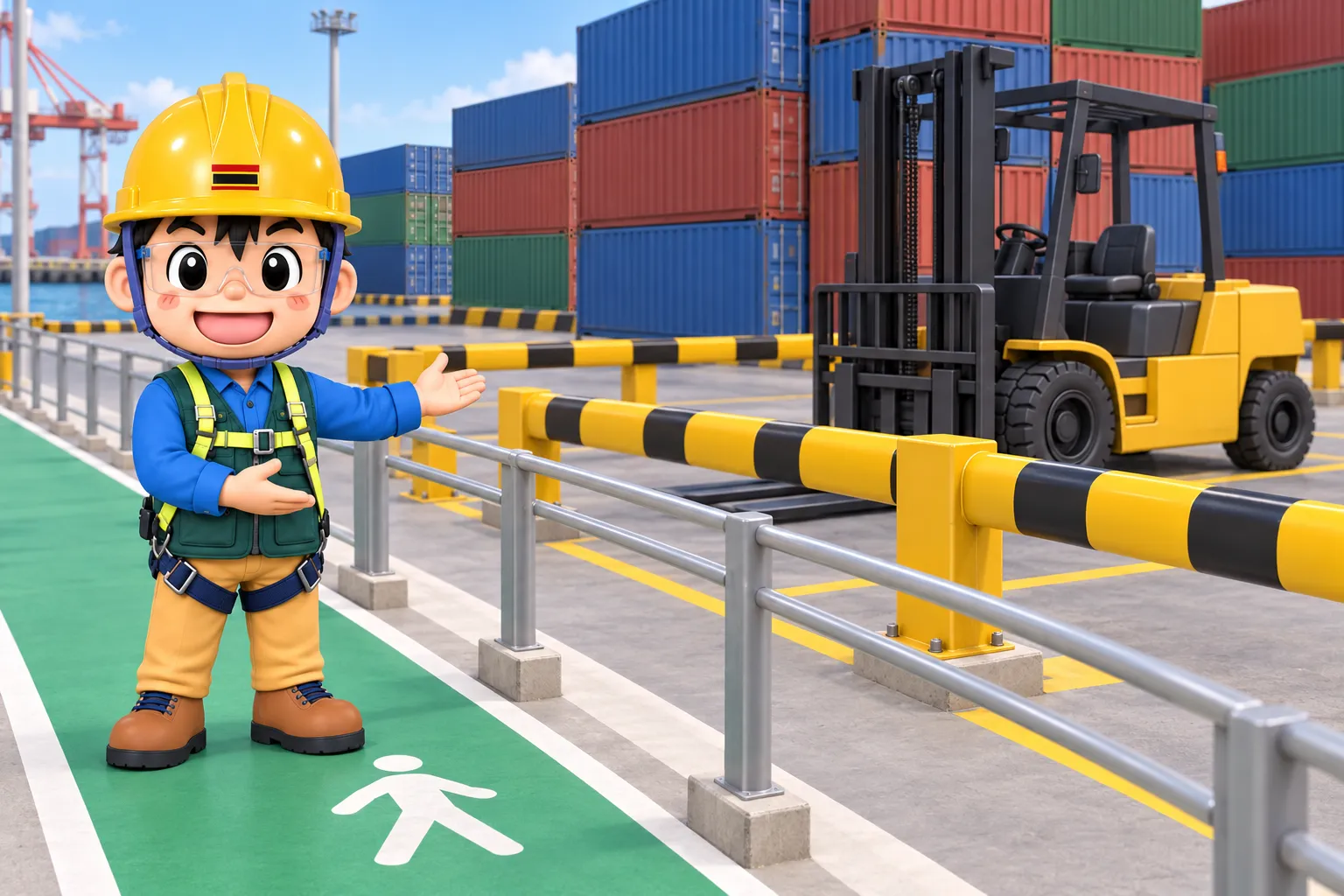
The consequences worsened when the employee was run over after the initial impact. The loaded vehicle and pedestrian shared a space with little room to avoid contact. Slow movement does not make that arrangement safe. Prevention needs to keep people out of the movement area rather than rely on action after contact.
Questions at the work position
| Question | What to examine |
|---|---|
| Where does the inspector walk? | Check the actual route from the seat and mark access behind containers |
| Who confirms inspection is complete? | Make departure conditional on the person leaving the area |
| What happens if cargo blocks the path? | Stop movement and restore the route rather than improvise a detour |
| Where does the guide stand? | Choose a visible signalling position outside vehicle and container paths |
Korean legal references
Article 172 of the Rules on Occupational Safety and Health Standards addresses access to places where contact with materials-handling vehicles is possible and compliance with a guide’s directions where one is used. The preliminary investigation and work plan under Article 38 need to reflect the actual routes and method. A plan omitting the inspector’s access points cannot adequately control shared work.
Occupational Safety and Health Act (Korean) · Rules on Occupational Safety and Health Standards (Korean)
Sources
MOEL and KOSHA, 2024 Serious Accident White Paper, 260–295 pages. Official publication (Korean)