Map interacting jobs in a risk review
Assess interactions as well as individual task hazards. Review overlapping work and coordinate timing, areas and equipment use.
Understand the situation
Separate assessments can miss the point where jobs interact. Sparks from above or a lifting boundary across another crew’s route are examples.
Look at time and location together.
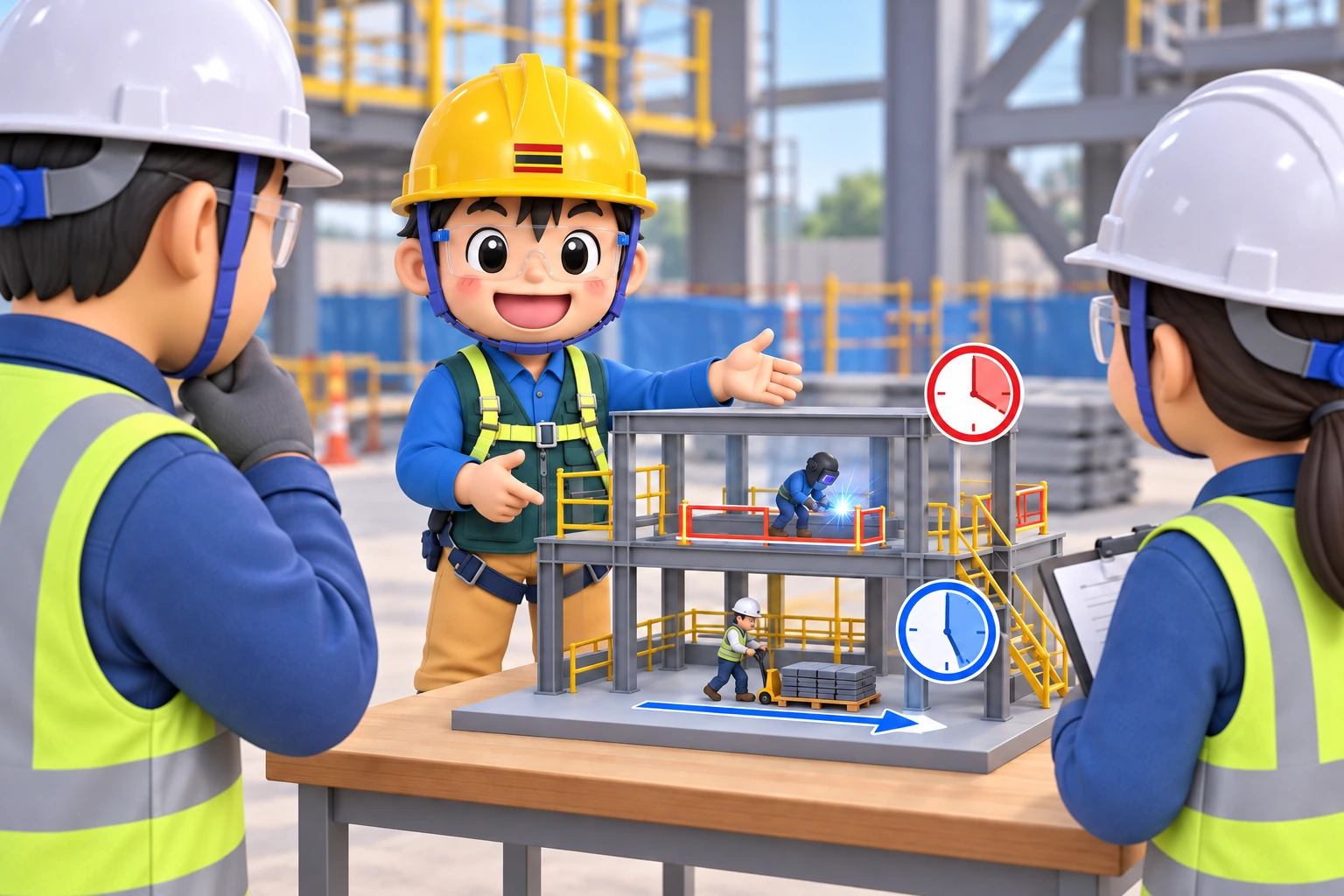
Review the task
Place crews on a map and overlay the timetable. Record how a hazard can travel across each overlap.
Where practicable, separate work in time or space and assign control of the boundary.
Check your workplace
- Who works where and when?
- Can sparks, loads, gas or power affect another job?
- Who coordinates separation?
Apply the lesson
If a delivery is moved until overhead work ends, verify that both teams received the new timing. A change known by only one team does not provide coordination.
Avoid a common mistake
Revisit the map when plans change. This discussion tool does not replace the full risk-assessment process or certify compliance with a particular legal method.
Putting it into practice
Plot location against time. For each overlap, record the hazard, separation measure, owner and recheck time; compare across crews.
Technical insight
Assess interfaces between tasks
Separate task assessments can miss conflicts between lifting and work below, or painting and hot work. Look for shared time, space and equipment.
A simultaneous-work review should record the conflicting condition and the coordination decision: sequencing, separation or controlled use of shared systems.
Korean safety resources
- KOSHA · Risk assessment and safety training handbook (2021)
Korean educational resource: risk assessment p.130 and safety training p.93.
Sources
- 고용노동부 — 위험성평가 개편 시행대한민국 / Korea