Can another trade ignite your work area?: The 2020 Icheon warehouse construction fire
A fire at an Icheon warehouse construction site in South Korea on 29 April 2020 killed 38 people and injured ten. The case highlights coordination across trades and the whole building.
Incident sequence and circumstances
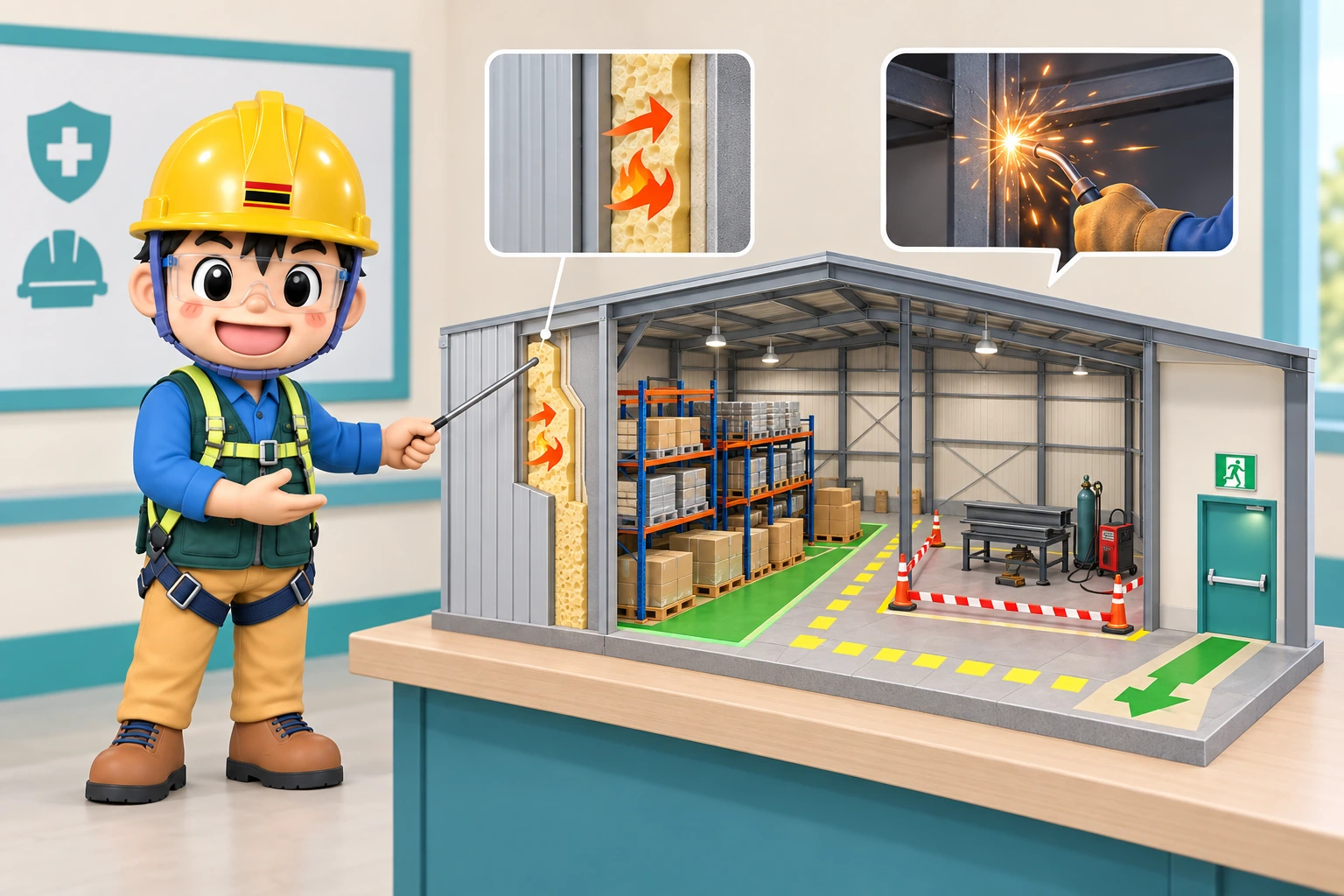
Thirty-eight people died in the Icheon warehouse construction fire on 29 April 2020. Reporting of the police interim findings on 15 June described welding sparks igniting polyurethane foam on basement level 2.
That later account differs from early speculation about a vapour explosion. The relevant setting includes combustible insulation, hot work and escape conditions across the unfinished building. Interim findings must also be distinguished from final judicial decisions.
Original reporting and investigation records
Yonhap’s report of 15 June 2020 covers the police interim findings. The OSHRI research provides further material on coordinating simultaneous work.
Distinguish early reporting from subsequent investigation findings. These sources are in Korean.
Yonhap: Police interim findings on the Icheon fire · OSHRI: Hazards and prevention in simultaneous work (2021)
Check your workplace
- Have concealed insulation and penetrations been assessed?
- Are hot work, coating and insulation schedules reviewed together?
- Are the present escape routes physically available?
Distinguish investigation findings from early reports
Reporting of the police interim findings on 15 June 2020 described sparks from oxygen-fuel welding of unit-cooler piping igniting polyurethane foam concealed in the basement ceiling and walls. Early reports of a vapor explosion should not be presented as the settled explanation.
Check concealed fuel and heat paths
A metal facing does not prove that the material behind it is non-combustible. Examine concealed insulation, penetrations and openings through which sparks or heat can travel.
Compare drawings with the actual stage of construction. Where exposure cannot be controlled, change the work method or sequence rather than relying on a quick visual check of the immediate work point.
Coordinate simultaneous operations
Korean OSH research addresses the interaction of painting, insulation and hot work. Separate contractors can each consider their own task controlled while their combined operations create an ignition path.
A coordination plan should identify location, timing and responsibility. Scope changes and additional hot work must trigger communication and reconsideration of existing permits. These are practical planning lessons, not a substitute for local requirements.
Recheck evacuation as construction changes
Temporary partitions, stored materials and unfinished access routes can change during a shift. Verify the route that exists now.
Review alarm communication, emergency lighting, access and head counts against the current layout. Fire watches and extinguishing equipment supplement elimination and separation of hazards; they do not replace them.
Putting it into practice
Combine trade schedules on one floor plan. Remove hazardous overlap through sequencing, then walk down the area before releasing work.
Communicate changed escape routes to everyone entering the floor, including short-duration contractors.
Technical insight
Match the permit boundary to the potential fire path
The influence of hot work extends beyond the worker’s immediate area. The reported Icheon investigation described ignition of insulation within the construction. Removing visible combustibles alone cannot establish that concealed spaces are safe.
Review routes for heat and sparks through openings, adjacent levels and concealed assemblies. Reassess permit assumptions when insulation, painting or deliveries change conditions. The management question is whether interacting activities are coordinated, not simply whether each contractor holds a separate permit.
Sources
- Yonhap: Police interim findings on the Icheon fire대한민국 / South Korea
- OSHRI: Hazards and prevention in simultaneous work (2021)대한민국 연구자료 / Korean research