Coordinate the whole building: the Banyan Tree construction-site fire
Six people died in the 14 February 2025 fire at a resort construction site in Gijang, Busan. Hot work, combustible materials and escape arrangements need to be managed together across contractors.
30-second summary
Six people died in the fire at the Banyan Tree construction site in Busan.
The Busan police interim briefing identified 10:51 on February 14, 2025 as the 119 emergency-call time.
Indictments of six individuals and three corporations were reported on April 29, 2025.
Check spark containment alongside other work and escape arrangements in the building.
Work background, incident and investigation
Six workers died in a fire at a resort construction site in Gijang-gun, Busan on February 14, 2025. Yonhap’s report of the April 7 joint police and labour-office interim briefing identifies 10:51 as the 119 emergency-call time. Distinguish that time from ignition when reading the sequence.

Police said their investigation traced the fire from pipe cutting and welding in the first-floor PT room of Block B to insulation on pipework below. Openings connecting the hot-work surface to combustible material on the lower level were central to that account. The briefing also identified absent fire-watch and spark-containment measures.
On March 13, Newsis reported police findings that the site manager was at another site and that a vacancy followed the safety manager’s departure. The investigation therefore extended beyond the welder’s actions to staffing and work control near construction completion. Individual criminal responsibility remains separate from that investigative account.
On April 29, Kyunghyang Shinmun reported indictments involving six contractor and subcontractor personnel and three corporations. Alleged failures of safety measures are the prosecution account; the roles and duties of the parties are matters for the trial. Distinguish the indictment report from a final judicial finding.
After reporting of the first hearing on August 28, Newsis reported on February 14, 2026 that the accident and permit-related cases were before separate benches. A first hearing is not a conviction. Responsibility contested in court and the fire route described by police are different kinds of information.
Lawissue’s account of the police briefing describes cutting out part of a pipe and replacing it with a section carrying a valve. Police considered that sparks reaching insulation below accumulated heat and smouldered before ignition. The place where flames became visible therefore need not be where combustible material first received heat.

The Busan labour office said inspections covered the contractors’ head offices and other sites, as well as the accident. Lawissue’s briefing account includes deficiencies in spark containment and exit signs at other sites. Do not combine every inspection finding into an account of this fire; distinguish the workplace to which each finding applies.
Equipment and work principles — site checks
Hot-work checks extend beyond the surface touched by the electrode. HSE HSG168 addresses ignition and fuel control together with alarm and escape arrangements. Check whether sparks from an upper work area can reach another area through gaps or penetrations.
Insulation delivery, packaging storage and welding can belong to different contractors. In addition to permit approval, align the timing, floors and shared areas. If deliveries change conditions below welding, reconsider material relocation or work timing.
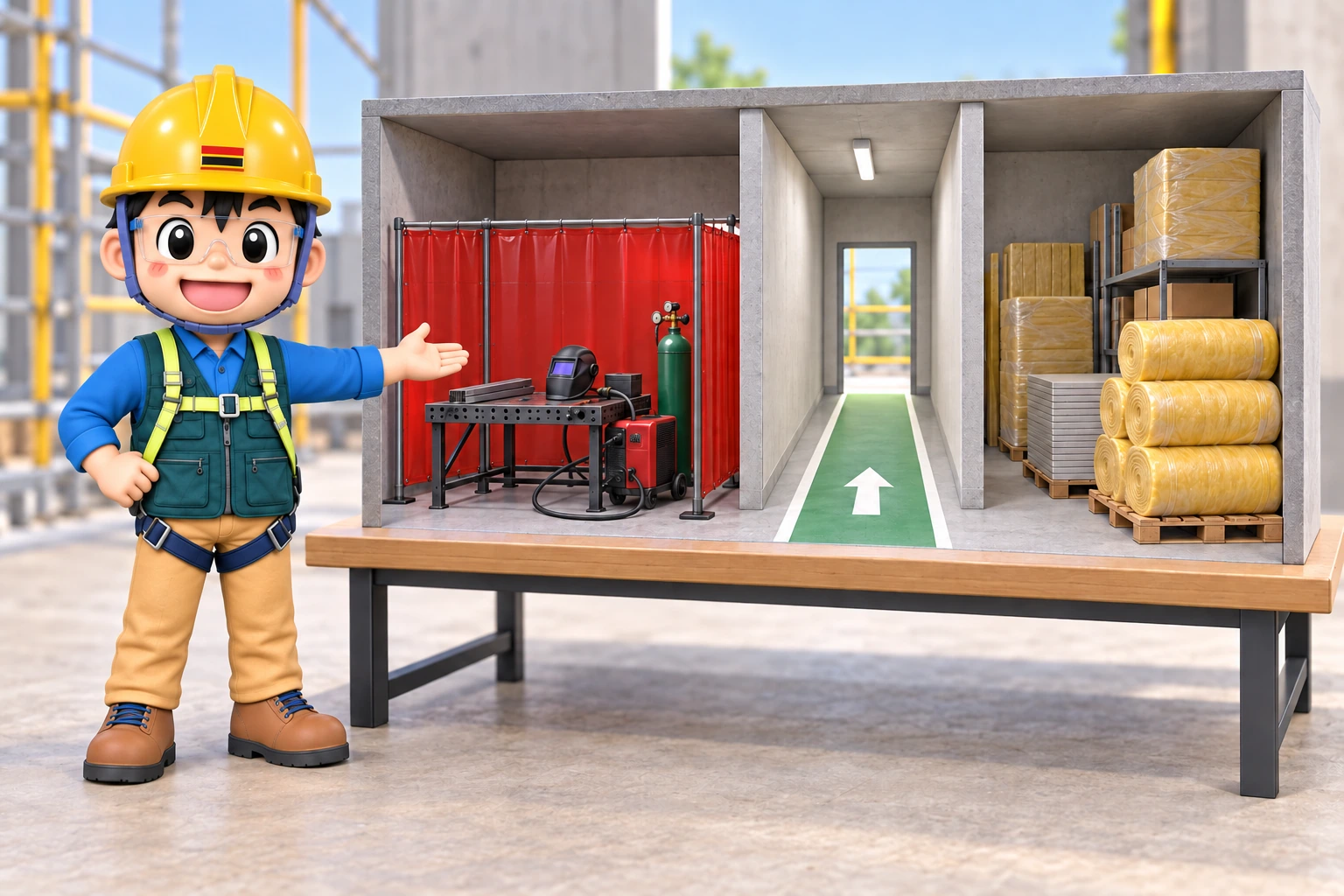
Partitions and stored materials can change escape routes during construction. Walk the route from today’s work position to the outside, and identify alarm and firefighting arrangements where permanent systems are not yet available. Completion documents and current operating condition require separate checks.
Hot-work checks extend beyond the floor around the welder. Where openings allow sparks to reach another level, inspect below and on the opposite side for combustibles. Coordinate access even where the lower space belongs to another trade, and check blanket attachment and remaining gaps at the actual location.
Fire may not become visibly obvious immediately after a spark reaches insulation. HSE construction fire-safety guidance calls for checks after hot work for signs of fire. Do not treat the end of welding as the end of fire risk: identify the spaces to inspect and assign the completion checks in the permit.
Near completion, paperwork and the actual installation can differ. Presence, connection and readiness of alarms and suppression systems are separate checks. Mark the location and duration of closed valves or unfinished connections and reassess the work that can proceed under those conditions.
A hot-work permit needs a defined place and task. Moving to another room or starting insulation work beneath the pipe changes what sparks can reach. Recheck combustibles, openings and escape at the changed location rather than carrying the original permit to new work. Record which spaces the issuer and closer actually inspected.
If the lower space cannot be observed, do not rely only on a watch above. Establish safe access and an observation point below and test communication between levels. Avoid assigning welding assistance or material handling that takes the watch away, and reassess permit conditions when other work changes the inspected area.
Staff changes near completion are changes in work conditions. If safety staff leave or a manager covers another area, an old name on a document is not confirmation of coverage. Reassign work authorisation and site-check responsibilities, define work to stop during gaps, and pass on unfinished fire installations and usable escape routes to incoming trades.
HSE HSG168, third edition, page 26 recommends maintaining the watch during breaks, continuous watching for at least 1 hour after hot work and another check 2 hours after completion. These durations are UK guidance. Check the current Korean provisions linked below for domestic duties. Record completion, watch-end and follow-up times separately so lower-level checks continue after the welder leaves.
Published chronology and investigation status
| When | Established account | Source |
|---|---|---|
| 2025-02-14 10:51 | 119 emergency-call time; six deaths in the fire | Yonhap, 2025-04-07, reporting the police interim briefing |
| Report 2025-03-13 | Police inquiry into absent manager and safety-staff vacancy | Newsis, 2025-03-13 |
| Briefing 2025-04-07 | Pipe-work sparks, insulation below, fire-watch and installation issues | Police and labour-office interim briefing |
| Report 2025-04-29 | Six personnel and three corporations indicted | Kyunghyang Shinmun; prosecution allegations |
| 2025-08-28 | First trial hearing | News1, 2025-08-28 |
| Report 2026-02-14 | Accident and permit cases before separate benches | Newsis, 2026-02-14 |
Consequences and emergency arrangements
Fire response needs both timely discovery and a usable way out. With contractor personnel spread across areas, assembly alone may not identify who remains inside. Link work-area attendance and movement to accountability, and pass last-known locations to responders.
Do not return for tools or personal belongings once smoke spreads. Fire-watch arrangements should connect detection, alarm and evacuation rather than focusing only on extinguishment. The article does not provide individual escape routes or smoke-exposure durations for this incident.
The April interim briefing identified fire-protection installations that were not ready to function. For comparable sites, this supports checking warning, exits and suppression together. Testing an alarm without checking escape routes, or assuming an outlet is usable without checking its connection, leaves separate gaps.
Construction evacuation differs from escape in an occupied finished building. Work locations and temporary routes change, and materials can obstruct passage. Walk the currently usable exit route, tell each trade which stairs and assembly point to use, and change the layout if hot work crosses the escape route.
Keep unprotected personnel out of smoke-filled interiors and give firefighters the last known location and access route. Account for workers at the assembly point; report missing people and locations rather than sending others back inside. Link each trade’s attendance information to whole-site accounting.
Questions for your site
| Question | How to check |
|---|---|
| Have openings and lower areas in the spark path been checked? | Mark penetrations, gaps and lower storage in relation to welding. |
| Who checks combustibles behind the welding position? | Inspect the opposite side from a safe, accessible position. |
| Is the permit reviewed when another contractor brings in materials? | Compare delivery and hot-work times in the shared work schedule. |
| Are the currently functioning alarm arrangements known? | Check fire-system availability and temporary alarm communication. |
| Has today’s escape route been walked all the way out? | Clear blocked routes before work and communicate changes. |
| Can assembled personnel be distinguished from those potentially remaining? | Reconcile contractor attendance at assembly and provide locations to responders. |
Application at Korean sites
For comparable work in Korea today, the reference is the Rules on Occupational Safety and Health Standards, Ministry of Employment and Labor Ordinance No. 450, effective 2026-03-02. These provisions guide current work; they are not findings of a breach at the time of the incident.
Article 241 covers procedures, hazardous materials, combustible protection, spark control, ventilation, escape training and checks before work. Check the current welding-blanket certification requirement when selecting products.
Article 241-2 distinguishes placement conditions and exceptions, checks on combustibles and gas alarms, evacuation duties and equipment. Link the appointment to who actually checks the opposite side and lower areas.
References
- Incident and follow-up report · www.khan.co.kr
- Source photograph
- HSE — General fire safety
- Source photograph
- KOSHA · Practical safety handbook 57: Inorganic chemical manufacturing (2021)
- Incident and follow-up report · www.yna.co.kr
- Incident and follow-up report · www.newsis.com
- Incident and follow-up report · www.news1.kr
- Incident and follow-up report · www.newsis.com
- Incident and follow-up report · www.lawissue.co.kr
- HSE HSG168 · Fire safety in construction · third edition 2022
- Rules on Occupational Safety and Health Standards (Korean)