Fire watch: coverage before assignment
Korean rule 241-2 distinguishes location triggers, fire-watch duties and equipment. A named person does not by itself provide coverage.
Understand the situation
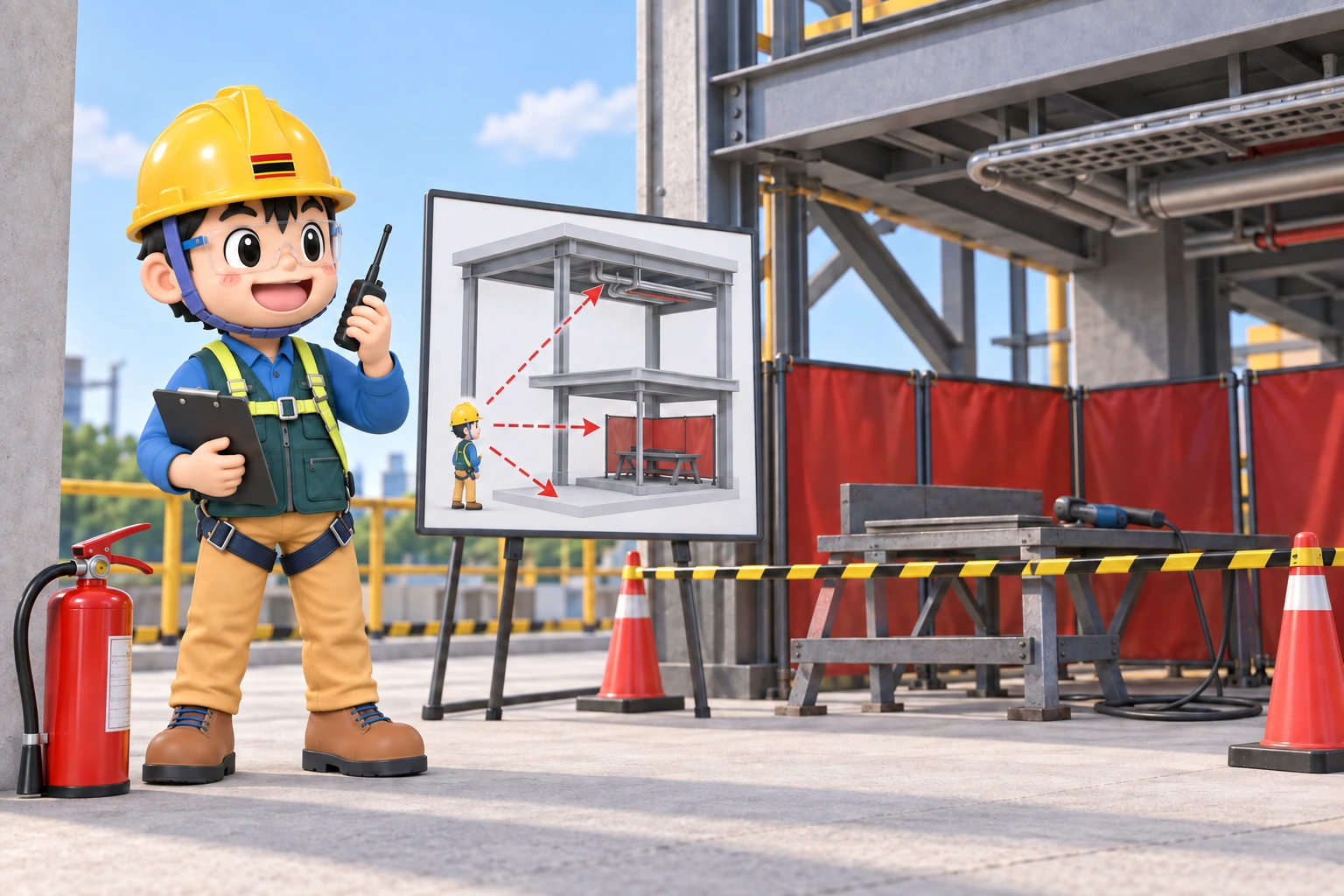
Fire-watch assessment should consider hidden combustible locations and heat transfer, not distance alone. Korean article 241-2 has specific triggers involving nearby materials, lower spaces and the opposite side of metal partitions.
Review the task
The Korean provision includes an 11-metre work radius, but also addresses materials farther below that can be ignited and materials adjacent to an opposite metal surface. The number is not a universal safe-distance rule and is not imported here as international law.
Check your workplace
- Can hidden or opposite-side areas be observed?
- Do other duties interrupt the watch?
- Is evacuation communication ready?
Apply the lesson
Its duties include checking for combustibles, checking relevant gas-detection and alarm operation, and guiding evacuation. It also specifies equipment for the assigned watch.
Read the full Korean provision for its precise scope.
Avoid a common mistake
A conditional exception exists for repeated work at the same place with specified arrangements. For international practice, determine local rules and the site’s watch plan.
Our exercise is to map blind spots and agree what happens when observation is interrupted.
Putting it into practice
Mark visible and hidden areas on a plan; agree supplementary observation and communication. Check the full legal triggers and exceptions.
Technical insight
Match the fire watch to the exposure
Seeing the person welding is not the same as observing every area exposed to sparks. Concealed gaps, lower levels and the opposite side of a partition deserve attention.
Use the work layout to identify blind spots and communication arrangements. Other duties must not interrupt the watch. Apply the relevant national rules when deciding statutory staffing requirements.
Check fire-watch triggers and exceptions for each work location under Article 241-2 of South Korea’s Rules on Occupational Safety and Health Standards.
Korean safety resources
- KOSHA GUIDE C-C-2-2025 · Chemical plant maintenance planning
Korean-language PDF on maintenance planning and preparation; technical recommendations.
Sources
- 국가법령정보센터 — 제241조의2대한민국 / Korea