Welding blankets: spark containment, certification and limitations
A blanket does not complete hot-work preparation
A welding fire blanket interrupts the path of hot metal particles to combustibles. It does not remove a flammable atmosphere inside a nearby tank or residues in a pipe. Covering the area directly below the work leaves separate questions about sideways sparks, heat through a partition and openings leading to lower levels.
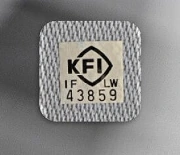
Compare the marking on the actual product with its documentation, and ask the supplier if identification is unclear. Separately check the blanket for damage and inspect its installation before work.
Distinguish product certification from installation. Certification assesses performance under specified conditions; size, overlap, restraint, damage and surrounding combustibles vary on site. A certification number does not justify continued use of a damaged blanket or an open gap.
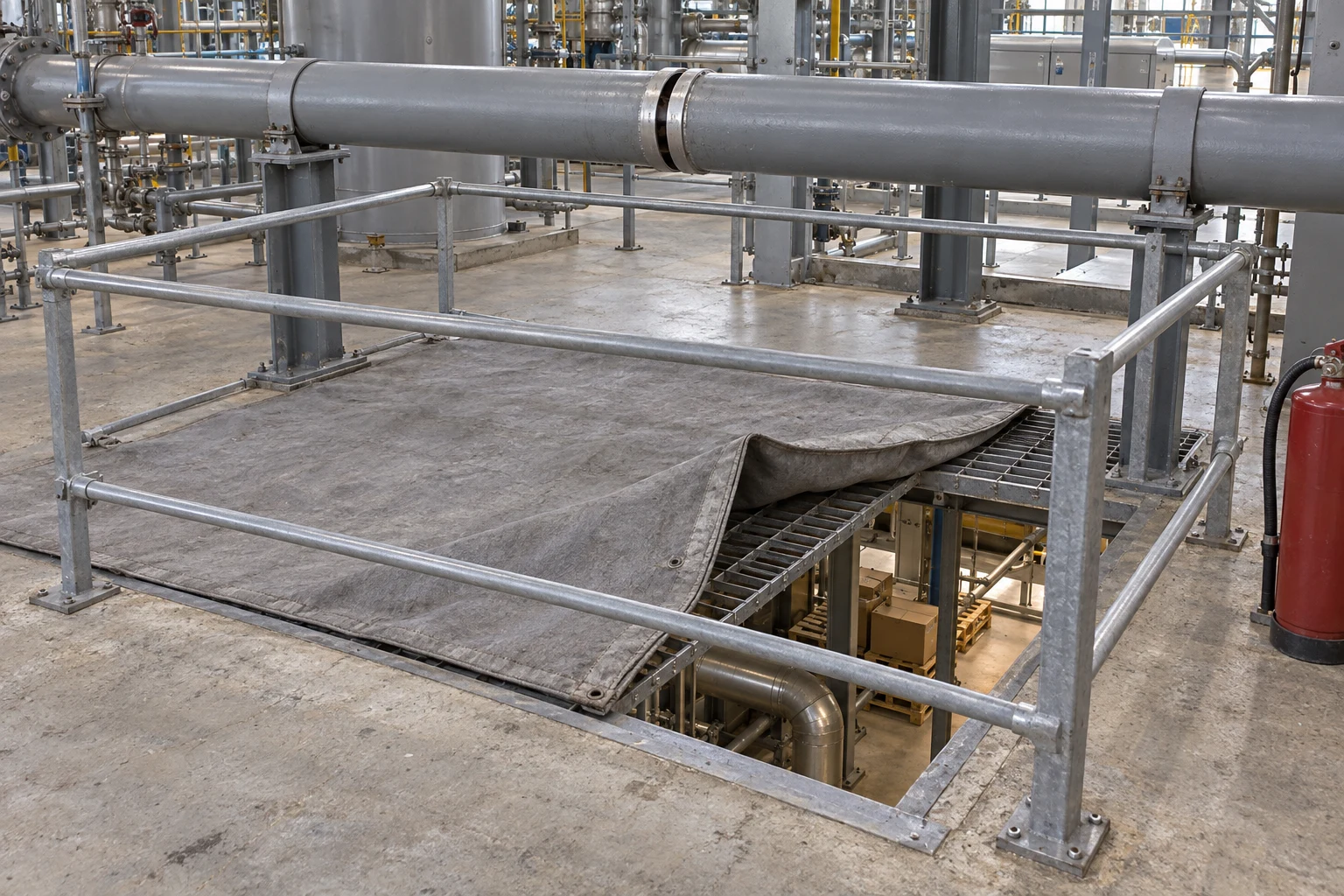
- Pipe awaiting welding: Before work, trace the spaces beneath and connected to the pipe to check where sparks and heat could reach.
- Blanket edge: Before work, find lifted edges and gaps, then overlap and secure the covering again.
- Gap to the lower floor: Follow the path of falling sparks to check lower-floor combustibles and watch positions.
- Lower-floor combustibles: Before work, move boxes and timber out of the spark path and decide how to protect items that cannot be moved.
- Extinguisher: Before work, locate it, check the access route and verify readiness under site procedures.
Exposed and concealed surfaces
Sparks do not travel only where the operator is looking. Cutting direction, elevation, airflow and surrounding structures affect their path. Lifted edges and gaps around penetrations can bypass a barrier. Inspect edges, penetrations and the underside from another viewing position after installation.
Metal surfaces can transmit heat to the opposite side without particles crossing the barrier. A blanket on the working side does not establish protection for hidden combustibles. For work against walls, ceilings or partitions, establish what is on the far side; inaccessible hazards may require a different method or location.
A blanket is not extinguishing equipment. Covering accumulated combustibles leaves different residual hazards from removing them. Consider removal first where possible, then assess protection and observation of what remains. A tidy covering does not reveal the nature of the material underneath.
Figure 2 highlights the checks described here.

- Identify the covered surface to check the extent of spark protection.
- Inspect open edges for paths that let sparks pass beyond the blanket.
- Check gaps at penetrations for sparks travelling below.
- Check nearby combustibles for hazards that the blanket does not cover.
Distinctions in the 2026 technical standard
Article 241 requires measures including spark containment for fire-risk work where combustibles are present, and performance-certified welding fire blankets when blankets are used. Other measures concerning combustibles, extinguishing equipment, ventilation and emergencies also apply. Providing the blanket does not close the entire preparation process.
The technical standard under National Fire Agency Notice 2026-26 took effect on 1 June 2026. Its basic and enhanced flexing categories concern durability under repeated bending. The enhanced designation alone does not establish a higher temperature limit or successful containment in every installation.
Article 5 tests flaming and spark penetration using specified specimens, steel, geometry and cutting conditions. Its 500±50 mm separation is a test configuration. It is not a prescribed on-site clearance or a safe standing distance for workers.
The flexing test examines damage such as cracks and holes after repeated bending. It addresses a relevant use condition but is not a guarantee of a field service life counted in uses. Follow the product’s handling instructions when assessing contamination, abrasive edges, storage and damage history.
Article 7 covers product name and category, certification number, manufacture date and identifying number, manufacturer, dimensions and handling precautions. Inspect the delivered product’s markings, not just a sales image. Check the certified configuration and manufacturer’s conditions before cutting or modifying it.
The transitional provision treats products certified under the previous standard as certified in the enhanced flexing category. An older marking alone does not make certification invalid. Verify the certification history and product identity, while separately assessing damage and suitability.
Follow the spark path from selection to removal
Preparation starts by locating combustibles relative to the work, including other levels. Identify stairs, penetrations, ducts and platform openings leading to other spaces. Check whether areas below or behind equipment are accessible for protection and observation.
Select coverage and restraint together. Where blankets overlap, examine whether movement can open the joint. If people or materials will displace the blanket, alter access or the installation. Initial coverage and maintained coverage are different requirements.
After installation, consider the tool’s working range and falling cut pieces. A moving work position can bypass or displace the barrier. Draping it over pipes or wiring may introduce other hazards. Use suitable supports without obstructing escape or access to extinguishing equipment.
Reassess if airflow changes or new combustibles arrive. Do not continue generating sparks while someone holds an ineffective barrier by hand. Stop, restore stable protection and then resume. Coordinate barrier and fire-watch positions so accumulation points remain observable.
Before removal, check beneath and around edges for remaining hot particles or heat. Wrapping hot cut pieces for transport can introduce another hazard. Segregate damaged or contaminated blankets so the next user does not mistake them for serviceable equipment, and apply the relevant disposition procedure.
Storage can conceal damage
Checking only the outside of a folded blanket can miss internal damage. Provide room to inspect both faces and folds, and verify legible markings. Mixing damaged and serviceable stock makes selection harder. Segregation and issue checks are practical recommendations for managing product condition.
Compare markings, tests and use conditions in sequence
When delivery documents include a KS F ISO 5660-1 heat-release-rate test report, first read the tested specimen’s identification, thickness, construction and test conditions. The results concern the submitted specimen; do not treat products of a different thickness or construction as having the same results. The method evaluates heat release from a specimen exposed to radiant heat. Its report is not a test under the welding-blanket performance-certification standard or a statutory performance certificate. Check compliance with the performance-certification requirement that took effect on 2 March 2026 separately from possession of a test report. For a blanket used to contain sparks during fire-risk work where combustible materials are present, match certification information to the actual product marking, then inspect installation gaps and damage at the worksite.
Compare the delivered product with the specified item. Retain identification before discarding packaging so that later questions can be tied to the right product. Manage handling instructions by product rather than treating all blankets as interchangeable.
Testing arrangements for specimens with different faces do not make product orientation arbitrary. Follow any designated face or installation direction. Do not infer it from appearance or thickness; resolve unclear instructions with the supplier before extending use.
Provide space to unfold a product because folds can conceal holes. An improvised visual check does not replace certification testing. Field inspection screens for damage rather than certifying penetration resistance or durability anew. Refer defects to the product’s replacement or disposal criteria.
A barrier between the work and one combustible does not address particles passing its edge. Locate openings and lateral paths rather than relying only on a larger covered area. Where people must cross the covering, consider slipping, displacement and escape access.
Article 241(4) concerns posting work details, timing, checks and precautions. Its posting exception for repeated work at the same place does not waive other precautions. A mismatch between the posted plan and installation calls for review of the actual change.
Planning can consider a method that avoids hot work, but changing tools does not automatically eliminate ignition hazards. Assess the alternative method, workpiece and surroundings. Method selection and blanket selection are different decisions; procuring the blanket should not pre-empt the former.
Separate product and installation checks
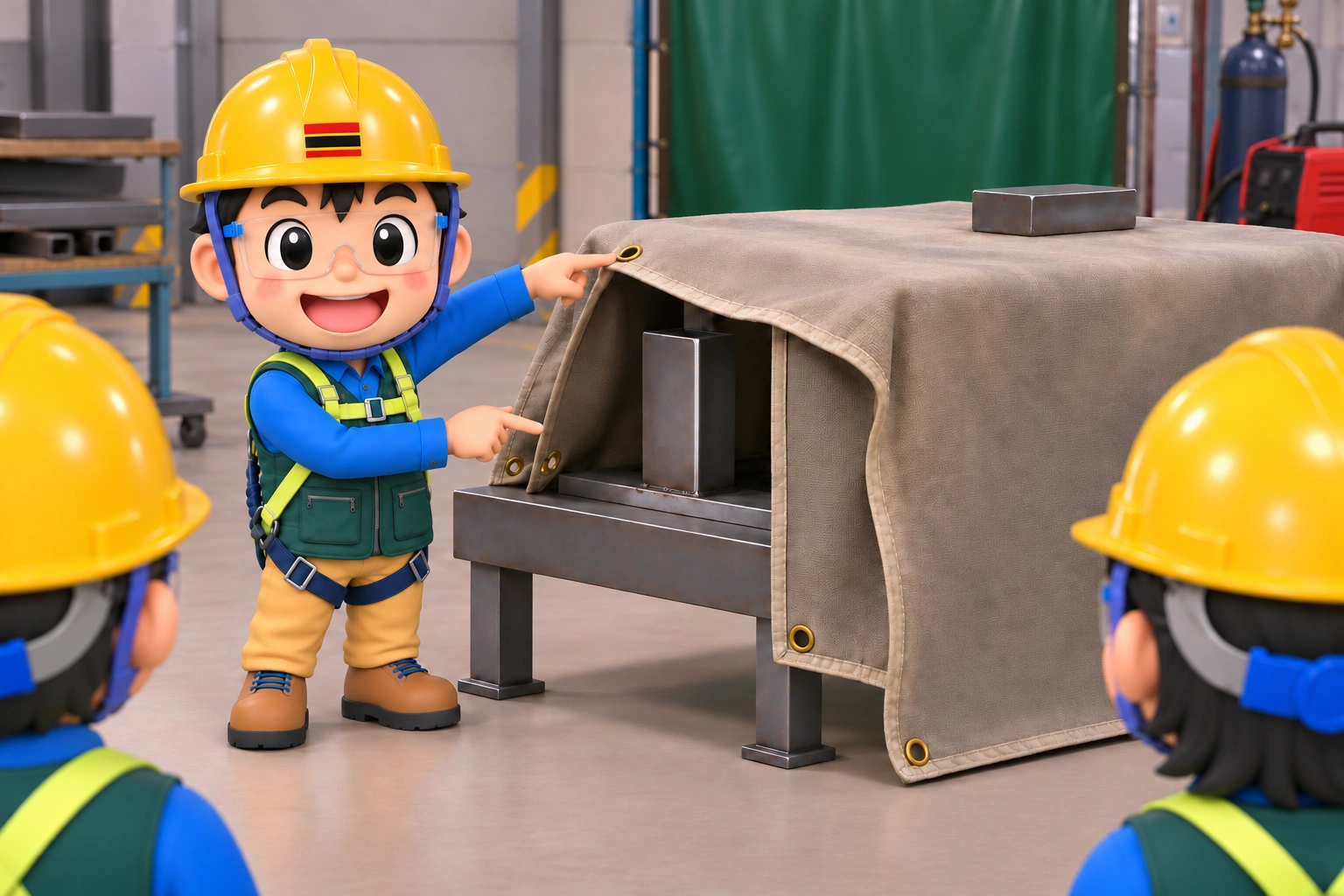
The table separates product identity from installation because either can be unsuitable independently. Record the surfaces and edges checked so that a change of work position triggers a review of the relevant area.
| Point | Question | Follow-up |
|---|---|---|
| Product | Are the actual certification, category and dimensions known? | Record the product being used, not only a packaging image |
| Installation | Can edges, penetrations or overlaps open during work? | Inspect possible bypass paths from another position |
| Adjacent equipment | Could hazardous contents remain in nearby equipment? | Separate particle containment from internal hazard control |
| Completion | Have residual particles under and around the covering been checked? | Segregate damaged stock and check the next issue |
Do not infer performance beyond the marking
Product-specific temperature limits and replacement criteria require the applicable certification and instructions. Flexing categories, spark penetration testing and an actual fire are not equivalent conditions. Consider installation together with material removal, ventilation, fire watch and emergency arrangements; a blanket alone does not authorise hot work.
Sources
- Rules on Occupational Safety and Health Standards (산업안전보건기준에 관한 규칙)
- Technical Standard for Welding Fire-Blanket Performance Certification (방화포 성능인증 기술기준; Korean)
- CSB — PCA DeRidder report
- Welding-blanket certification requirement — implementation notice
- KS F ISO 5660-1 — scope
- ISO/IEC 17025 — reporting test results (PDF)