Cleaning beneath a conveyor: The Massachusetts rock-crusher fatality (2002)
US FACE 02MA001 describes a fatal conveyor/idler entanglement on 7 February 2002. Investigators recommended guarding, hazard analysis, training and lockout/tagout.
What happened?
On 7 February 2002, a worker died after becoming trapped between a conveyor belt and an idler pulley at a Massachusetts rock-crushing operation. An idler supports the moving belt.
The worker’s job involved sweeping and shovelling debris around the machine. It was running before work began.
No one witnessed the incident, so the reason for approaching the belt and the precise entanglement sequence remain unknown.
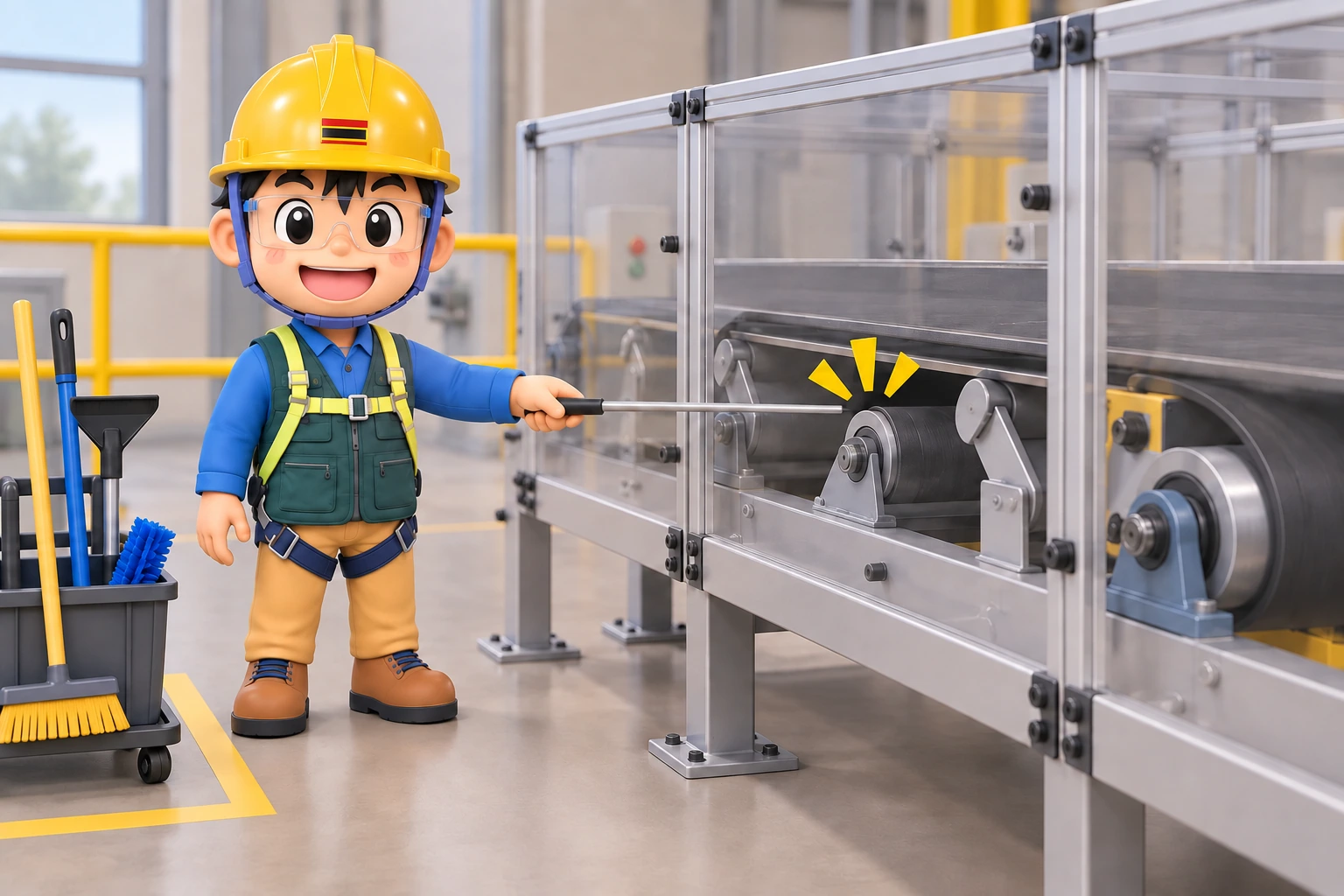
Below the machine does not mean inaccessible
Investigators identified exposed moving parts that could be reached despite their position underneath the machine. People cleaning nearby may face risks even if they do not operate the controls.
Review the cleaner’s route and the reach of hands and tools, as well as the operator’s position. A hidden danger point still needs physical protection.
Check your workplace
- Does cleaning bring people near moving parts?
- Can cleaning avoid opening guards?
- Are energy sources and stored forces addressed?
Connect guarding, isolation and understanding
FACE recommended guarding, hazard analysis, training, lockout/tagout and instruction workers can understand. The employer had no lockout/tagout programme at the time.
Maintain protection during operation. If cleaning, clearing or maintenance requires access inside, establish the appropriate energy-control procedure before intervention.
Pressing stop is different from controlling restart and stored energy.
Plan the cleaning task
Separate areas that can be cleaned from outside the guards from tasks requiring machine intervention. Do not improvise when hands or tools would enter a danger zone.
Ask the responsible person to establish the safe method. Have workers explain the prohibited access area and stop/contact procedure in their own words.
Reassess the route when the method changes.
Putting it into practice
If debris is visible beneath a moving belt, keep hands and tools out. Stop the task, contact the responsible person and establish whether access and isolation are required.
After cleaning, use the restart procedure to account for people, tools and guards.
Technical insight
Trace access to the nip point
Conveyor hazards are not limited to the carrying surface. Cleaning can bring a person or tool into a belt–roller nip. An emergency stop does not itself prevent access.
Review posture and tool reach when choosing a cleaning method. Separate tasks possible outside guarding from tasks requiring isolation; do not treat reach into danger as a routine convenience.
The exact actions immediately before this incident were not witnessed. It is not established as a stored-energy-after-stop event. Use applicable local requirements, equipment instructions and the site energy-control procedure.
Korean safety resources
- KOSHA · Practical safety handbook 53: Automobile manufacturing (2020)
Korean handbook: forklifts p.143, rigging p.164, conveyor hazards p.195 and non-routine work incidents p.225.
Sources
- Massachusetts FACE 02MA001미국 / US