Can sugar dust spread an explosion through a factory?: The Imperial Sugar disaster
A dust explosion and fire at Imperial Sugar in Georgia, United States, on 7 February 2008 killed 14 people; the final report records 36 surviving injured workers. Deposits above floor level were part of the hazard.
Incident sequence and circumstances
The 7 February 2008 Imperial Sugar disaster in Georgia expanded from conveying equipment into the buildings. The CSB described an explosion inside an enclosed belt conveyor dispersing accumulated dust and triggering subsequent explosions.
An overheated bearing was identified as the most likely initial ignition source. Deposits elsewhere supplied fuel for escalation. The initiating equipment event and the later propagation therefore require separate examination.
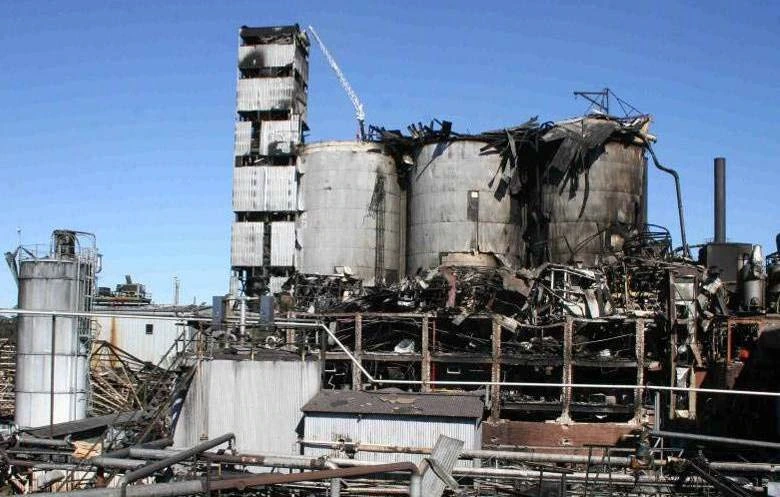
Fire response continued after the explosions
The CSB final report records that major building fires were extinguished the following day, while sugar inside the silos continued smoldering for more than seven days. This photograph was taken on 10 February during that response period; it does not show the initial explosions on 7 February.
Stored material can retain heat and continue burning after an explosion has damaged the structure. The absence of visible flames is not clearance for entry or recovery work: structural stability and residual fire hazards require assessment together.
CSB: Imperial Sugar final report · CSB photograph: site on 10 February 2008

Check your workplace
- Are elevated and internal deposits included?
- Are equipment releases being treated only as a cleaning issue?
- Are the cleaning method and equipment suitable for the dust hazard?
A primary event can trigger secondary explosions
CSB analyzed an initial explosion in an enclosed belt conveyor followed by explosions involving accumulated dust in the building. An overheated bearing was identified as the most likely ignition source, not a definitively proven source.
Control the source as well as housekeeping
The investigation addressed dust collection, conveying equipment, maintenance and accumulation. More frequent cleaning cannot compensate indefinitely for equipment that continues to release dust.
Include elevated beams, pipework, trays and inaccessible spaces in the assessment. Reduce escape at the source and maintain effective collection.
CSB: Imperial Sugar investigation
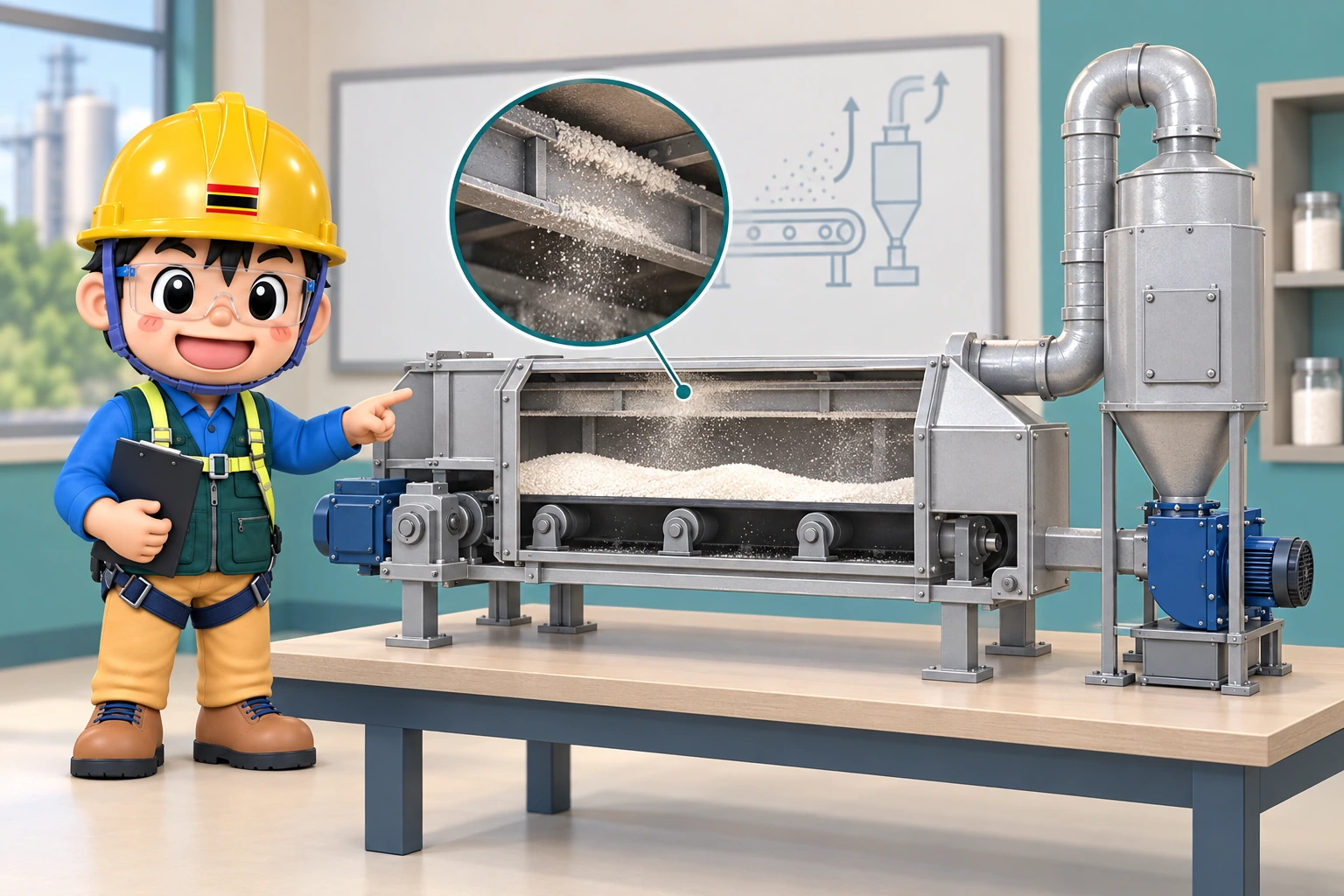
Use material-specific evidence
Combustibility, particle size, moisture, dispersion, confinement and ignition conditions affect the hazard. Do not apply one generic layer thickness or concentration to every powder.
Assess propagation between connected equipment and secondary building explosions. Protective systems need competent design for the actual dust and process.
Do not turn cleaning into dispersion
Select cleaning methods and equipment that do not create a dust cloud or introduce ignition sources. Improvised compressed-air blowdown and unsuitable cleaning equipment can worsen the hazard.
Record recurring deposits, collection faults and missed locations together. Completion means controlling the accumulation and its cause, not simply recording that a floor was swept.
Putting it into practice
Map generation points, deposits, access limitations and ignition sources. Escalate repeat accumulation into equipment and extraction improvements.
Have competent specialists assess explosion propagation and protective-system requirements.
Technical insight
Settled dust can become fuel for a secondary explosion
Dust resting on a floor or beam is not necessarily out of the hazard. A primary event can disperse accumulated material, providing fuel for further explosions. Assessment therefore needs to cover both the initiating equipment and surrounding deposits.
Recurring deposits are evidence to investigate leaks and collection performance, not merely a reason to repeat cleaning. Map sources, accumulation and connected equipment, then track recurrence. Select specific explosion-protection measures through competent assessment using material data and actual process conditions.
Sources
- CSB: Imperial Sugar investigation미국 / United States
- CSB: Imperial Sugar final report미국 / United States
- CSB photograph: site on 10 February 2008미국 / United States