Recognize fragile rooflights before access: The Kentucky demolition fatality (2022)
Kentucky FACE 22KY046 reports a fatal fall through a skylight on 24 May 2022 during demolition. It addresses assessment, fall protection, training and communication.
30-second summary
What happened: A worker fell through a rooflight during roof demolition.
Harm: The fall onto concrete, about 19 feet (5.8 m) below, was fatal.
Why: FACE addressed unprotected rooflights, work at height and weaknesses in hazard control and training.
At your site: Reidentify the remaining working surface and fragile areas at every demolition stage.
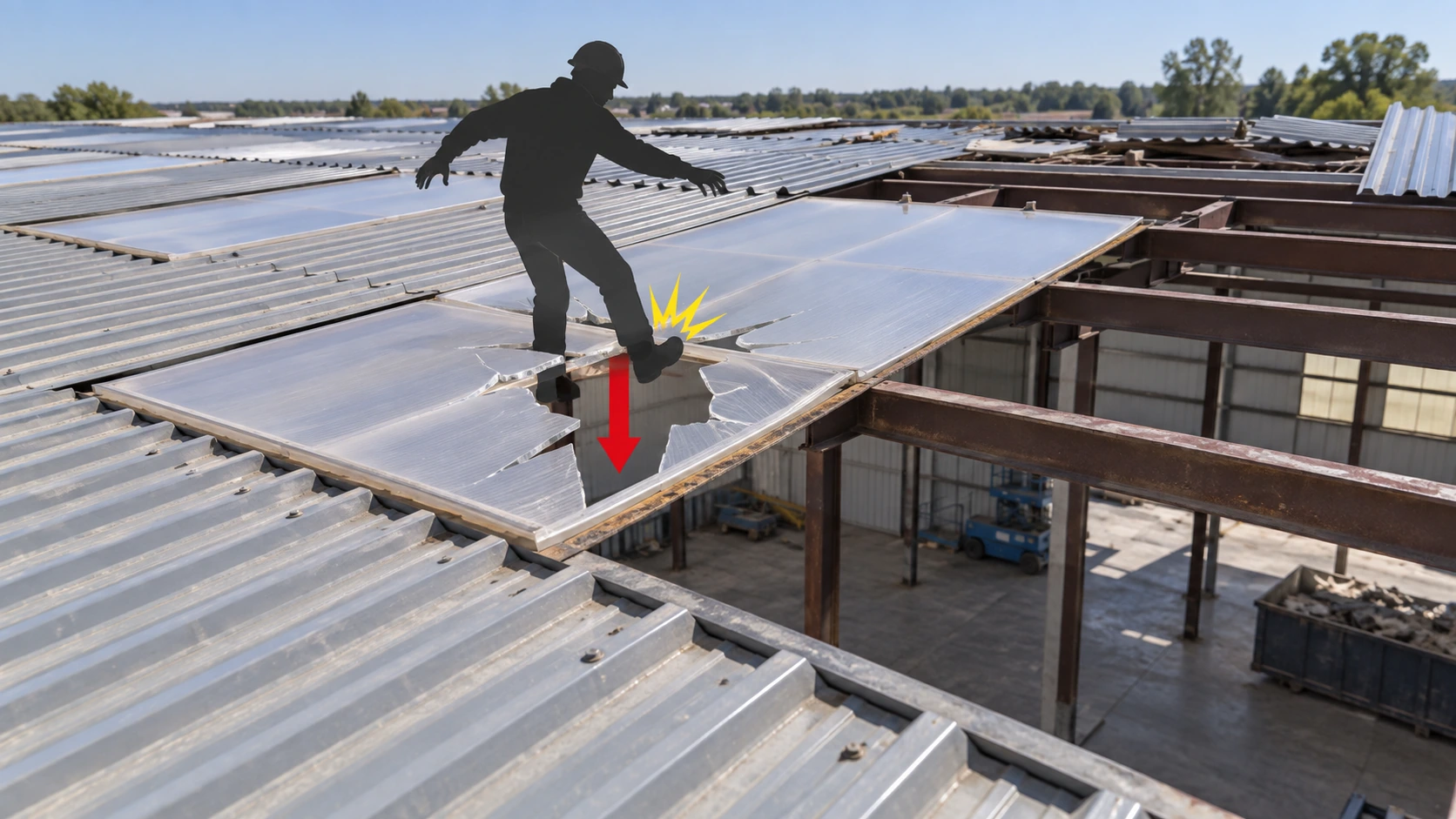
Incident sequence and working conditions
Four workers began roof demolition around 09:00 on 24 May 2022 in Kentucky. Sections had already been removed, exposing both outer edges and internal openings. Eight skylights remained.
FACE reported that a worker stepped backward onto a skylight and fell about 19 feet (5.8 metres) onto concrete. Investigators found no guardrails, covers or personal fall protection in use. The fall path was within the work area, not only at the roof edge.
FACE describes a changing demolition surface: removed roof sections and remaining rooflights occupied the same work area. Moving to the next section depended on the protection then in place.
Firefighters performed CPR after the emergency call and medical responders arrived, but the worker died near the fall location. This response followed the fall; it serves a different purpose from preventing the fall on the roof.
Equipment and process principles — technical explanation
Preventing access to a fragile area and arresting a fall serve different purposes. Focusing only on a harness can leave the roof hazard and access route unchanged.
Review avoidance and a protected work platform first. Where personal fall protection is needed, assess anchorage and continuity of protection while moving.
Technical explanation: A rooflight admits daylight; using it as a working surface requires a separate assessment of support and installation. Similar colour or level to adjacent metal sheets does not establish a safe route. The report does not establish the rooflight material.
A demolition plan identifies both members to remove and access surfaces that must remain. Include stepping back while handling material and turning with a load. Protection confined to the work position may leave the approach and return route exposed. During demolition, yesterday’s route may end at an opening today. Alongside the starting plan, establish the route into and out of each next area when a section is removed. Separate temporary material storage from access and check from the work position whether a detour leads towards rooflights. This is a method for managing changing routes, not an assertion about material storage in this incident.
Protection layers viewed through confirmed facts
| Layer | What is needed | Confirmed condition | Evidence |
|---|---|---|---|
| Identify fragile surfaces | Mark remaining rooflights and openings on the current demolition plan | Eight rooflights remained | Kentucky FACE 22KY046 · 2023-06-07 · PDF 5 |
| Prevent access | Provide secure rooflight covers or access barriers | No covers or guardrails | Kentucky FACE 22KY046 · 2023-06-07 · PDF 5 |
| Working surface and route | Protect the route at each demolition stage | Sections removed; internal and external edges unprotected | Kentucky FACE 22KY046 · 2023-06-07 · PDF 5 |
| Personal fall protection | Plan connection and use for the actual task | No personal fall protection | Kentucky FACE 22KY046 · 2023-06-07 · PDF 5 |
| Training and understanding | Have the crew explain fragile areas and protection | The employer had not provided fall training to the four workers | Kentucky FACE 22KY046 · 2023-06-07 · PDF 3 |
| Emergency response | Prepare notification, access and rescue | Firefighter CPR and EMS attendance | Kentucky FACE 22KY046 · 2023-06-07 · PDF 5 |
Before roof access at your site, identify fragile areas, define routes and ensure workers and contractors receive the same information. Revisit the route when demolition or material movement changes it.
Korean rule 45 includes robust skylight covers within its roof-work provisions. Elsewhere, establish local requirements. Checking harness wear alone does not address the opening and roof-protection assessment.
The layers act at different moments. A cover addresses contact with a fragile opening, while a protected route reduces the need to approach it. Personal fall protection depends on suitable attachment and use. Completing one measure does not complete the others.
Attendance alone does not address FACE’s training and communication findings. Ask the crew to point out the protected route and explain where to stop if the next removal stage eliminates it. The present structure and protection take priority over the previous crew’s use. A cover must stay in place and withstand the forces expected during work. If the removal sequence requires taking it away, establish access restrictions and replacement protection before removal. Where personal fall protection is selected, review structure and sequence together so an attachment is not a member about to be demolished. Equipment issued and equipment usable at the site are distinct checks.
Harm and response
The fall ended on concrete. The failed rooflight and the level difference formed a fatal path. At another site, inspect the actual surface, equipment and obstructions below rather than transferring the report’s height. A smaller height does not remove collision risk.
Responders could not reverse the impact already sustained. Prepare emergency communication and rescue, while first completing access prevention and safe platforms. If personal fall protection is used, establish that attachment remains usable during demolition and prepare rescue before work.
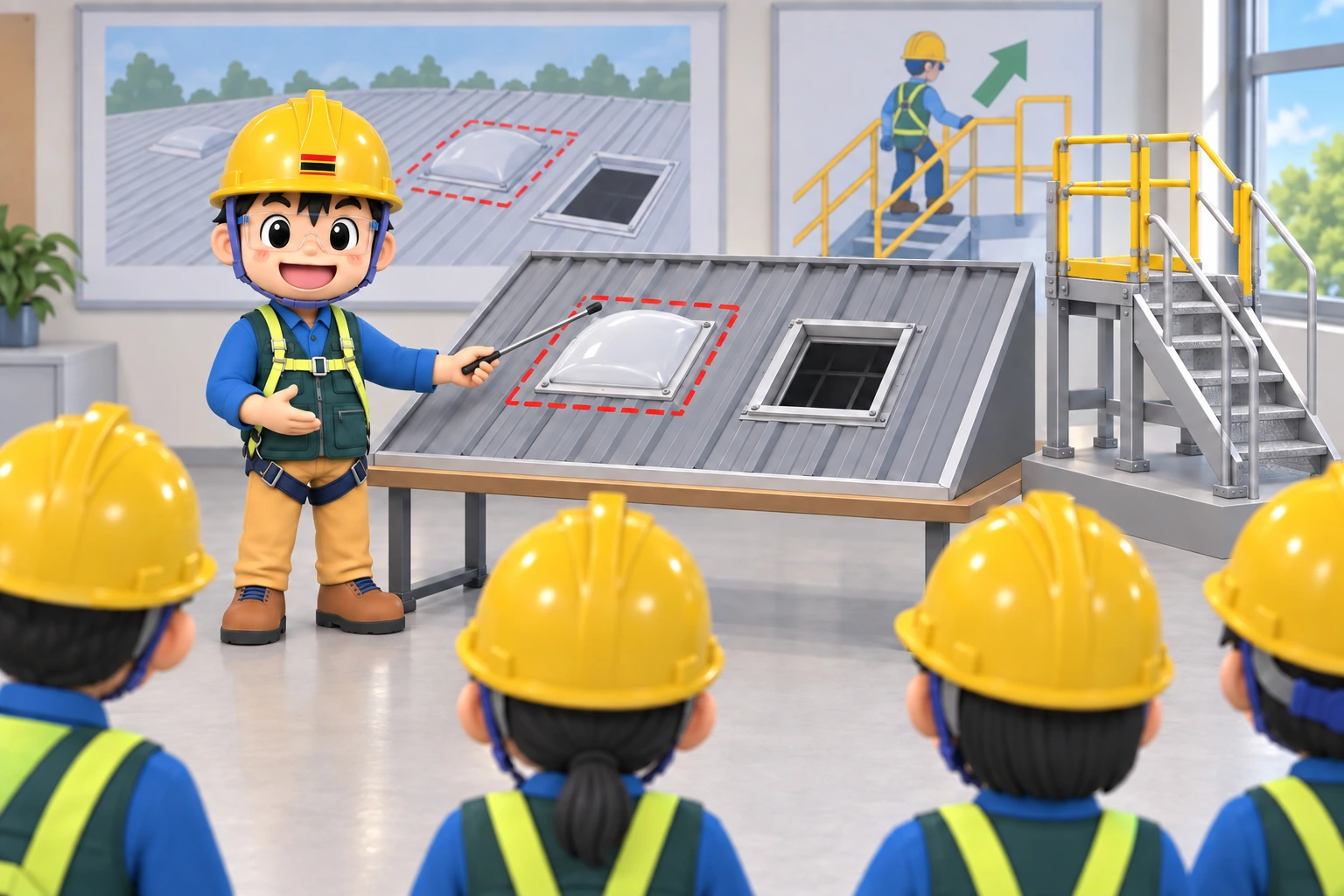
Training can go beyond locating rooflights. At turning points, have the crew identify the safe route and the stopping point if protection changes. Separate the initial check from checks when the demolition area changes. Before using a site photograph for instruction, determine whether removal has progressed since it was taken.
Questions for your site
| Question | How to check |
|---|---|
| Which working surface remains in the next stage? | Mark retained surfaces and the access/return route on the removal sequence and check them on site. |
| Where is access to each rooflight prevented? | Inspect cover security and barrier boundaries, beyond locating a warning mark. |
| Do materials obscure visibility or the route? | Review carrying positions and set-down areas in the plan. |
| Will demolition remove an attachment point? | Where personal protection is used, verify attachment throughout travel with the design/installation lead. |
| Can the incoming crew explain the fragile areas? | Ask workers to identify the roof plan and the protected route on the actual structure. |
| Where will work stop if the route changes? | Specify the stopping point and review authority when removal interrupts protection. |
Application at Korean workplaces
For Korean roof work, first compare Article 45’s rooflight-cover and edge-protection requirements. Articles 42, 43 and 44 address fall prevention, openings and harness attachment according to the location and method. Apply them to the planned task rather than treating a foreign investigation as a Korean violation finding.
Korean e-book, viewer p.178: roof, skylight and opening hazards. Embedded legal/guide references reflect the original edition.
Korean-language technical recommendations on PPE selection, training and maintenance; use alongside the product manual.
Rules on Occupational Safety and Health Standards: MOEL Ordinance No. 450, amended 2025-09-01; effective 2026-03-02.
References
Related cases
The Korea Zinc rooflight case concerns a fragile area within a familiar roof; the warehouse-panel demolition case concerns changing support and movement positions. Compare when the area available for stepping changes.