Can everyone find the way out? The Aricell primary-lithium battery factory fire
Could every worker find an escape route as fire spread through the lithium-battery factory?
30-second summary
A fire at Aricell’s lithium primary-battery plant in Hwaseong on 24 June 2024 killed 23 people. Police examined production pressure, quality control, training and escape arrangements. Trial and appeal judgments followed against the chief executive and operations head; prosecutors appealed the appellate judgment.
Practical prevention extends beyond extinguishers: isolation of abnormal cells, hazard and escape instructions, and usable exits for workers without access credentials. A rapidly developing factory fire may leave no opportunity to explain the route after ignition.
Work background and incident sequence
In August 2024, police described increased production following quality problems and the use of inexperienced labour. SBS reported investigators’ findings concerning substituted test samples, pressure to remake products and insufficient training. Those were investigative accounts; individual offences and sentences were considered in court.
The fire began during battery handling on the morning of 24 June. Investigators reported 37 seconds between the first explosion and the last escape, with many workers trapped away from the exit. This is an incident chronology, not a universal available escape time or drill target.
On 13 August, the government announced measures for foreign workers and small workplaces, including understandable language and visual materials, practical training and escape improvements. Distinguish announced policy from current legal duties, while ensuring workers understand exits and alarm actions.

Police and the labour ministry referred suspects on 6 September. On 24 September, Suwon prosecutors indicted executives and others, alleging failures in hazard assessment, fire response and battery handling. The courts subsequently considered each defendant’s duties, offences and sentence.

The trial court sentenced the chief executive to 15 years on 23 September 2025. On 22 April 2026, the appeal court imposed four years on the executive and seven on the operations head. MBC reported different findings on emergency-exit duties and mitigation for compensation. Prosecutors appealed on 28 April, alleging legal error.
Equipment and work principles
Lithium primary batteries differ from rechargeable cells in use and construction. Assess the actual cell chemistry, form, process and manufacturer information rather than the generic word “battery”. Consider segregation of abnormal cells, storage and propagation, and escape. Do not transfer extinguishing-test conclusions from a different battery type without assessment.
SBS reported investigators’ account that workers without access cards did not know about an exit. Security controls must not obstruct emergency escape. Check the route from the position of a new or agency worker: whether the door opens and whether the onward path reaches safety.
HSE fire guidance connects alarms, escape routes, procedures and training. Knowing how to operate an extinguisher is not the same as being able to escape. Define the response from the substance and risk assessment, ensuring firefighting attempts do not delay escape when fire growth or route conditions threaten safety.
Translated notices do not by themselves demonstrate understanding. The 2024 measures included native-language, visual and practical education. At the site, workers can explain or walk the route from their position. Recheck the route when shifts, locations or layouts change.
Separating quality and safety records can hide heat-related warnings within production recovery. Define identification, segregation, assessment and authorized return of abnormal cells. Assess not only accepted products but also isolated products and nearby workers.
The CSB found that absent evacuation drills and damaged emergency lighting impeded escape at Imperial Sugar in 2008. Battery and sugar-dust hazards have different mechanisms, but both require assessing rapid fire growth with usable escape. Evaluate routes under loss of lighting and visibility, not only normal conditions.
Interpretation of criminal duties and present risk reduction serve different purposes. Appellate reporting concerned legal duties by floor; that does not make an inaccessible or unknown route safe. Apply the law while physically verifying usable escape for every worker.
Published chronology and investigation findings
The chief executive’s safety-management duties and the operations head’s operational responsibilities were considered in the proceedings. Their reported appellate sentences differed: four and seven years. Assess role-specific duties and procedural stage rather than treating all company conduct as one finding.
Prosecutors appealed, alleging serious errors of law. Emergency-exit reviews need to consider the building and each workplace floor, access controls and escape routes together. Assess current legal requirements against the current text and actual structure, with specialist review where needed.
| When | Established account | Source |
|---|---|---|
| 2024-06-24 | Factory fire; 23 deaths | Investigation/court reporting |
| 2024-08-13 | Measures for foreign workers and small workplaces announced | MOEL 16939 |
| 2024-08-23 | Police/labour investigation briefing | SBS report |
| 2024-09-06 / 2024-09-24 | Referral / indictment | MBC and Seoul Shinmun |
| 2025-09-23 | Trial: chief executive sentenced to 15 years | PSPD court review; MBC |
| 2026-04-22 | Appeal: executive four years; operations head seven | MBC 04-23 |
| 2026-04-28 | Prosecution appeals | MBC 04-28 |
Consequences and emergency response
The 23 deaths involved hazards extending from abnormal cells to escape failures. Review whether warnings lead to isolation, alarms lead to action and access controls or stock obstruct the route. Do not assume new or agency workers share permanent staff’s credentials or site knowledge.
Account for people and inform responders from safety. Re-entry into smoke can create further casualties. Assembly arrangements should include that day’s contractor and agency personnel, while rescue requires appropriately equipped and directed responders.
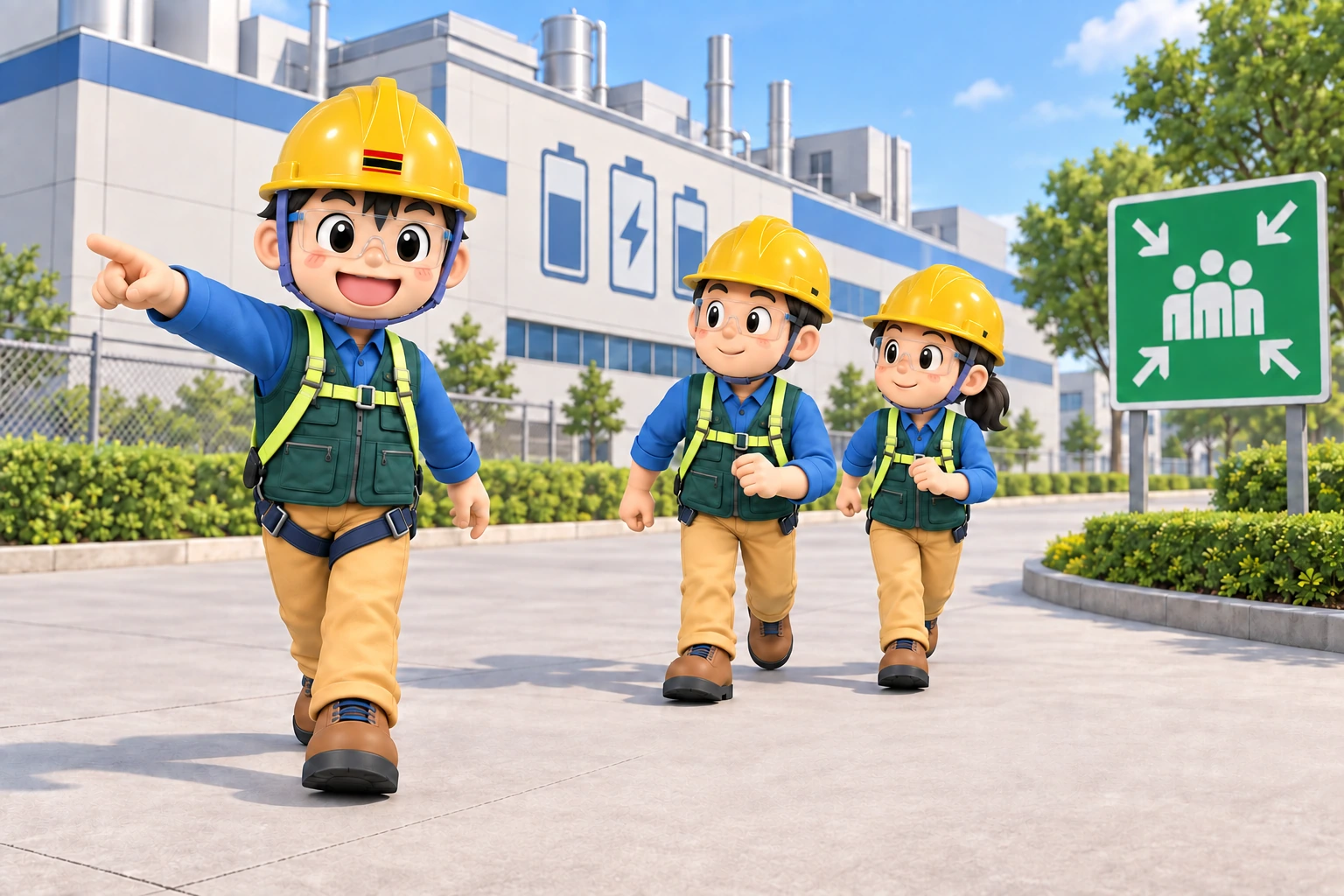
Questions for your site
| Question | How to check |
|---|---|
| Can a worker without an access card open the escape door? | Check doors and onward routes from a new worker’s position. |
| Where are abnormal cells segregated? | Review segregation, return authorization and exposure of nearby workers. |
| Do workers know the route after an alarm? | Explain in an understood language and verify on the actual route. |
| Do escape arrangements reflect staffing and layout changes? | Match headcounts, assembly and routes to the current operation. |
Application at Korean sites
Comparable work in Korea is subject to the Rules on Occupational Safety and Health Standards, MOEL Ordinance No. 450, effective 2026-03-02. The following concerns present work; findings about the incident depend on its investigation and proceedings.
Current Article 17 specifies emergency-exit arrangements for workplaces handling listed dangerous substances and their buildings, including a different direction, at least three metres from the entrance, and doors opening in the escape direction and openable from inside. Check scope and staircase provisions against the text, and whether workers without access cards can use the route. Present precautions do not replace the court’s findings on past criminal liability.
References
- SBS · 2024-08-23
- MBC · 2024-09-06
- Seoul Shinmun (서울신문) · 2024-09-24
- People’s Solidarity for Participatory Democracy (참여연대) · judgment commentary dated 2025-10-16
- MBC · 2026-04-23
- MBC · 2026-04-28
- Ministry of Employment and Labor (고용노동부) · 2024-08-13
- HSE · General fire safety
- CSB · Imperial Sugar, 2009-09-24
- Rules on Occupational Safety and Health Standards (Korean)