Could hydrogen re-enter the line? The SK Energy Ulsan maintenance explosion
An explosion during maintenance on 17 October 2025 ultimately killed two workers and injured four at SK Energy’s Ulsan facility, according to follow-up reporting.
30-second summary
What happened: An explosion and fire occurred during turnaround work at an Ulsan refinery.
Harm: The October 23 report recorded 2 deaths and 4 injuries.
Investigation: A hydrogen release was reported as possible; the specific entry path and ignition source have not been announced.
At your site: Check hydrogen-suitable detection and isolation records for the maintenance area.
Incident sequence and working conditions
The task was turnaround maintenance at SK Energy’s Ulsan complex. The ministry’s same-day notice records a request to stop maintenance on the hydrogen-refining process, establish central/local response coordination and pursue investigation and supervisory action.
Kyunghyang Shinmun’s follow-up reporting described the deaths of contractor workers who had been receiving treatment and progress with the joint scene examination. The timeline below lists the initial injury count and subsequent death counts separately. Police and the National Forensic Service took part in examining the scene to establish the circumstances.

On 21 April 2026, KBS reported that a Korea Gas Safety Corporation report linked the hydrogen release to bolt removal without adequate purging and supply isolation. Police and labour authorities were still investigating suspected breaches of duties of care at the time of that report.
Equipment and process principles — technical explanation
Hydrogen properties: Section 9 of Airgas SDS 001026, v8.02, gives flammability limits in air of 4% and 76%, relative vapour density 0.07 (air=1), and colourless/odourless appearance. These are that SDS’s values. Test conditions and upper limits differ between references; match detector specifications to the site’s substance information.
DOE hydrogen training gives 0.02 mJ as an example of low ignition energy, describes upward dispersion because hydrogen is lighter than air, and notes its pale, nearly invisible flame. Geometry and ventilation affect where gas remains. Suitable detection and sampling locations are needed instead of relying on smell or visible flame.
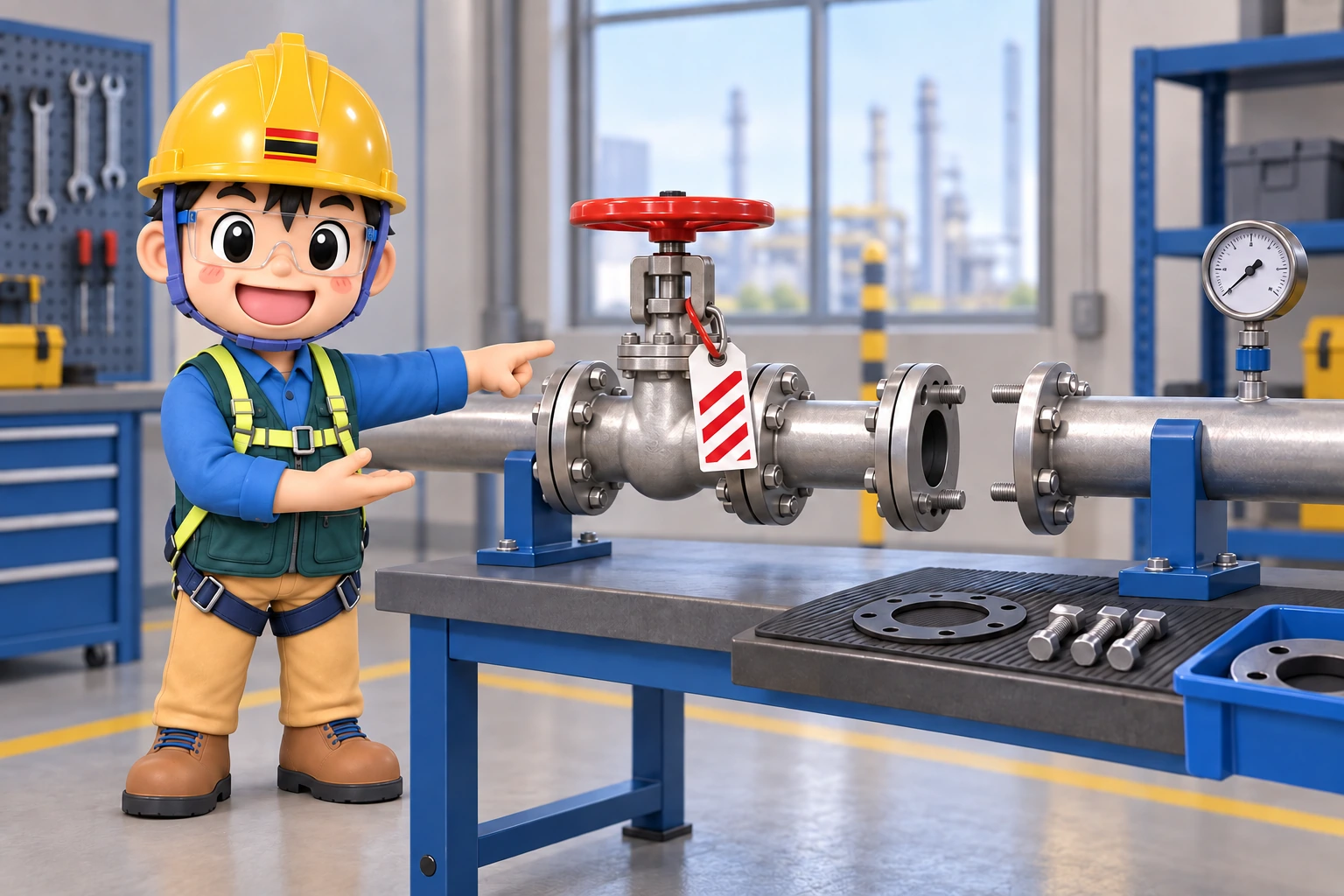
For maintenance, the stopped equipment and its connected piping form the work boundary. HSE HSG253 separates selection of isolation, residual pressure/contents removal, proving and maintenance of the state. Tags identify positions and status; the physical isolation and proving results must correspond across the register, drawing and equipment.
Publicly reported timeline
| Time | Reported fact | Source |
|---|---|---|
| 2025-10-17, about 10:42 | Explosion/fire during turnaround; 6 initial injuries | MOEL notice; Kyunghyang |
| 2025-10-18 | 1 contractor employee died during treatment | Kyunghyang, 2025-10-23 |
| 2025-10-22 | Joint examination by 8 agencies, including police and NFS | Kyunghyang, 2025-10-23 |
| 2025-10-23 | 1 further death during treatment; 2 deaths and 4 injuries | Kyunghyang, 2025-10-23 |
| 2026-04-21 | KBS reports the KGS analysis of purging and supply isolation; investigation ongoing at the time. | KBS · 2026-04-21 |
Harm and response
Deaths during treatment make it necessary to connect the initial injured-person list with subsequent medical progress. Assign responsibility for updating personnel accounting, transfers and medical information so follow-up remains traceable when communication involves several parties.
Questions for your site
| Question | How to check |
|---|---|
| Is the detector suitable for hydrogen? | Match target gas, range, calibration and sample locations to substance data. |
| Do isolation points match the equipment? | Check valve/blind identifiers and branch connections on site. |
| Do blind quantities and tag records agree? | Reconcile quantities, signatures and missing points across lists, drawings and tags. |
| Has isolation been proved after residual removal? | Link procedure-defined proving and results to the permit. |
| Can another task’s testing or restoration affect the boundary? | Compare nearby schedules/removal requests against task-clearance confirmation. |
| Is the response to gas detection established? | Explain stop signals, withdrawal, access restriction and emergency communication. |
Application at Korean workplaces
Article 278 of Korea’s OSH Standards Rules requires task direction, prevention of hazardous-material/hot-steam release and repeated flammable-vapour/gas measurement during chemical-plant disassembly or internal modification, repair or cleaning. Article 92 addresses hazardous maintenance shutdown/restart protection; Article 279 requires stopping and evacuation in imminent explosion/fire danger. Link KOSHA GUIDE C-C-2-2025 (2025.3) planning and HSG253 isolation proving to the work sequence.
Rules on Occupational Safety and Health Standards: MOEL Ordinance No. 450; effective March 2, 2026.
References
- Kyunghyang · 2025-10-23 (Korean)
- HSE HSG253 · second edition, 2006
- HSE — Maintenance of work equipment
- KOSHA GUIDE C-C-2-2025 · 2025. 3. (Korean)
- MOEL press notice · 2025-10-17, posted 2025-10-20 (Korean)
- Rules on Occupational Safety and Health Standards · MOEL Ordinance No. 450 (Korean)
- Airgas Hydrogen SDS 001026 · v8.02 · 2025-04-11
- U.S. DOE · Safety Planning for the H-Prize Competition · 2015-08-06
- KBS · 2026-04-21
Related cases
The turnaround article concerns changing temporary arrangements and restart conditions. The residual-pressure/contents article examines verification after draining. Compare scheduling and physical proving with the needs of your task.