Residual pressure after draining
HSE isolation guidance addresses draining, isolation and changing process conditions. Operating a drain is not proof that residual hazards are gone.
Understand the situation
A low gauge reading or a drain that stops flowing is evidence to interpret, not a complete explanation of the system. Blockages, trapped sections and connected sources may remain.
Verification needs a defined method and an understanding of the boundaries.
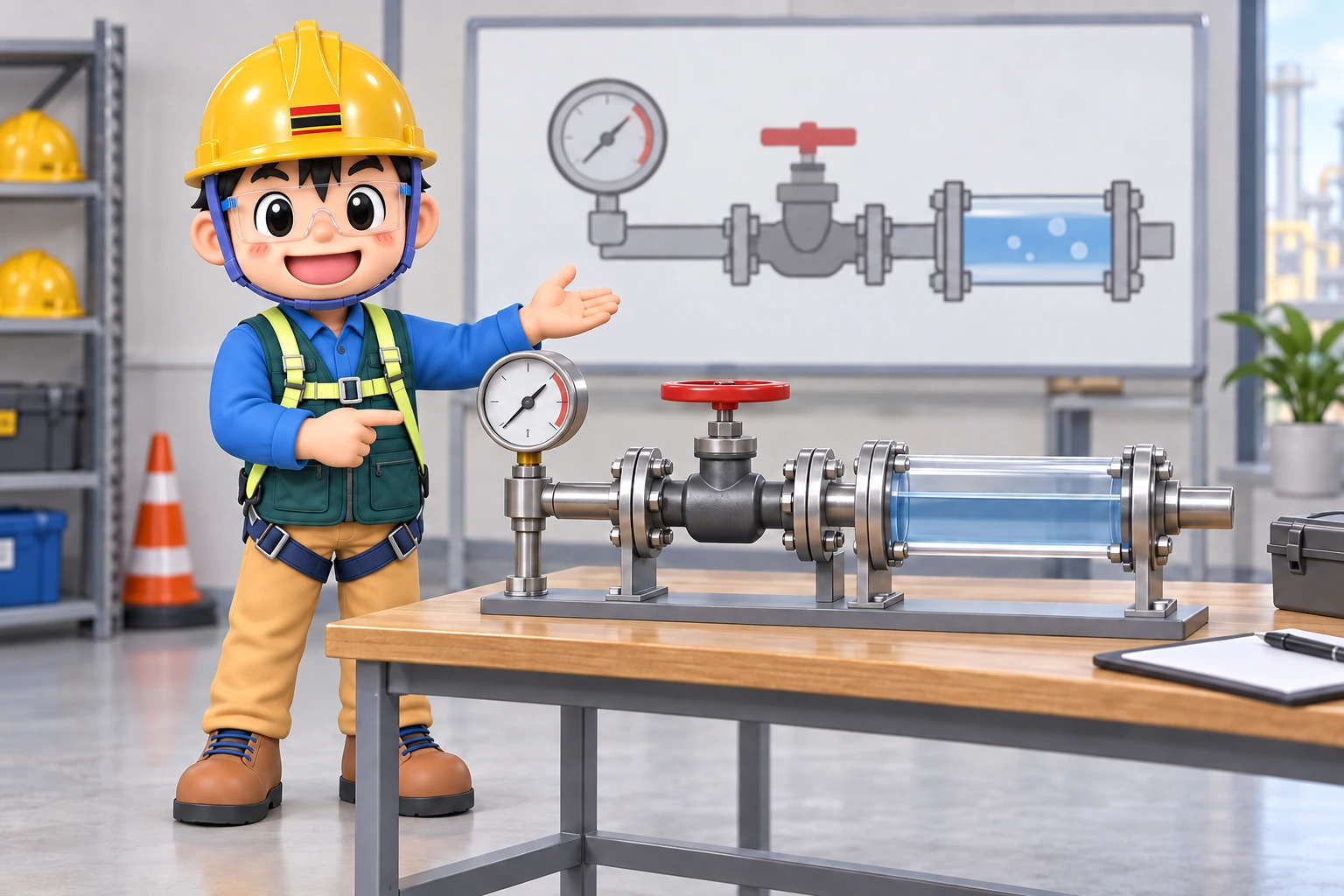
Review the task
Operations and maintenance agree on the equipment boundary. Mark isolation points, drains and possible re-entry paths.
Use the site procedure to establish how each section is verified; conflicting or unavailable evidence keeps the opening step on hold.
Check your workplace
- Are there trapped sections or blockages?
- Can pressure or material re-enter?
- Who verifies the safe state and how?
Apply the lesson
Record where and how the condition was checked. ” This is a recording method, not an assessment of real equipment.
Avoid a common mistake
Reassess if leakage, odour or pressure changes appear, including changes in connected operating systems. Loosening bolts is not a substitute for proving a safe state.
Putting it into practice
Record isolation, drains, verification methods and unresolved sections together. Do not use initial bolt loosening as a pressure test.
Technical insight
Zero indication versus verified depressurisation
A pressure indication must be interpreted in relation to its location and condition. Trapped sections or a route for re-entry can remain after apparent draining.
Mark the gauge, drain and opening point separately on the isolation drawing. Select a verification method for the equipment and fluid; loosening a joint is not a substitute for that assessment.
Actual process and isolation selection require site engineering review.
Korean safety resources
- KOSHA GUIDE C-C-2-2025 · Chemical plant maintenance planning
Korean-language PDF on maintenance planning and preparation; technical recommendations.
Sources
- HSE — Safe isolation HSG253영국 / UK