Inspection is exposure too: the Seosomun overpass collapse
How should collapse hazards be checked before entering a remaining demolition section for inspection?
30-second summary
On May 26, 2026, suspended scaffolding and part of a slab collapsed in a remaining section of the Seosomun overpass demolition. Three people died and three were injured, including inspectors and a public employee below. Entering a structure for a safety inspection still exposes people to its collapse hazards.
An inspector’s competence and a structure’s ability to support entry require separate checks. At each demolition stage, review how the remaining members and temporary supports carry loads, and connect that assessment to entry authorization and control below.
Work background and incident sequence
The remaining span crossed railway tracks. Newsis, reporting Seoul’s account, stated that suspended scaffolding installed for falling-object protection and part of the slab collapsed around 2:33 p.m. during an inspection. Five inspectors and a public employee driving below were affected. The fact that an inspection was underway does not establish the support configuration or failure sequence.
Rescue was completed at 4:40 p.m.; the reported toll was three deaths and three injuries. Rail services and nearby traffic were restricted while further collapse risks were addressed. A demolition exclusion area may need to cover vehicles, pedestrians and railway movements below, as well as workers. Rescuers entering afterwards also need assessment of the remaining structure.

On May 28, Seoul announced plans to crush the remaining structure using excavators from outside. The stated aim was to avoid worker entry and lifting damaged girders. This was a post-incident recovery plan, not a report establishing the collapse cause. Planned methods and completion times require confirmation against actual performance.
Equipment and work principles
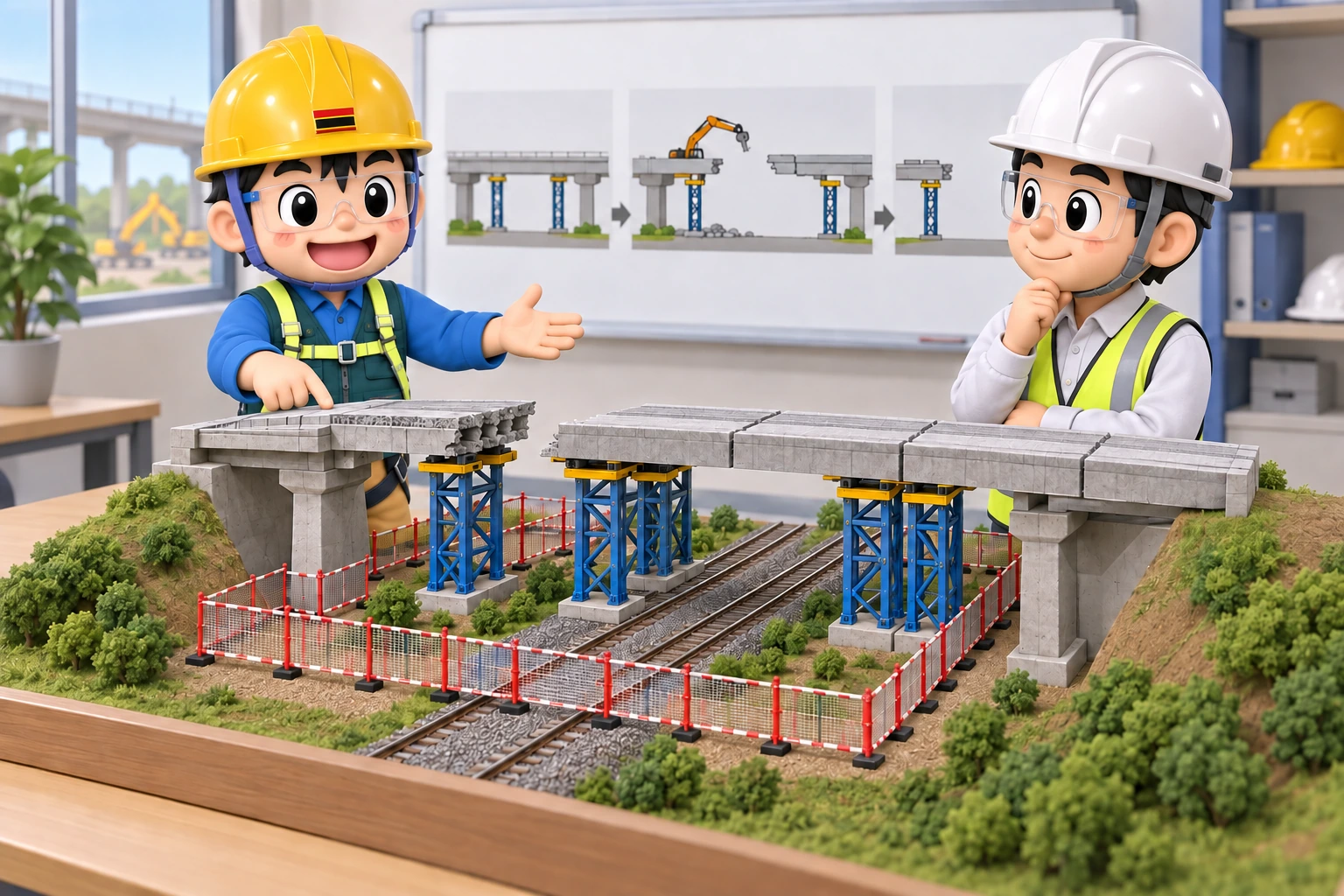
Demolition is not simply construction in reverse. Members share loads in a completed bridge; cutting a member changes the load path. A member stable in one stage may lose support or experience different forces in the next. Stage drawings should identify retained members, cuts and temporary supports together.
HSE guidance calls for a structural survey, suitable temporary support and a planned sequence. Undocumented changes or damage require reassessment of the plan. Inspector entry belongs within the loading conditions for the particular stage. Establish a way to assess condition from a suitable location before placing people and equipment on the structure.
Suspended scaffolding and debris protection have design-specific functions. A facility designed to catch small debris cannot be assumed to protect people from an entire slab collapse. Check whether supports attach to members scheduled for removal, whether demolition impact reaches them and whether the exclusion area accounts for falls exceeding the protective facility’s capacity.
External crushing can reduce direct entry, but is not a universal bridge-demolition method. Working reach, ground capacity, railways, underground facilities and debris extent require site-specific design. A method change also requires review of exclusion boundaries and signals for the new equipment layout.
A comparable load-path issue appears in the 2022 mixed-use building collapse recorded in the MOEL white paper. It describes changed support arrangements, early removal of lower supports and insufficient concrete strength. The comparison concerns tracing loads through each construction stage; it does not establish the cause of the Seosomun collapse. It supports checking the current support condition before inspector entry.
Published chronology and investigation findings
| When | Established account | Source |
|---|---|---|
| 2026-05-26 about 14:33 | Suspended scaffold and slab collapse during inspection | Newsis incident paragraph |
| 16:40 | Rescue complete; three deaths and three injuries | Rescue paragraph |
| Immediately afterwards | Rail and traffic restrictions; precautions against further collapse | Seoul’s account |
| 2026-05-28 | External crushing plan announced | Seoul press release |
Consequences and emergency response
Victims included inspectors and a person below the work. Structural assessment and entry conditions should be settled before scheduling access; urgency does not remove the need to control areas below. Inspection movements and times need coordination with both demolition personnel and road or railway control.
Moving closer for another look after finding cracking, deformation or connection movement may increase exposure. First identify information obtainable remotely, supports installable from outside and the evidence needed for assessment. Work plans need authority to close the area and conditions for authorizing inspection to resume.
Questions for your site
| Question | How to check |
|---|---|
| Which member carries the load after the next cut? | Compare stage load paths and temporary support drawings. |
| Does structural assessment cover inspector entry? | Include people, positions and equipment in that stage’s assessment. |
| Are vehicles and trains below within the control arrangements? | Confirm restriction times and release conditions with transport authorities. |
| Who stops entry when damage differs from the drawings? | Check stop authority and reassessment arrangements. |
Application at Korean sites
Comparable work in Korea is subject to the Rules on Occupational Safety and Health Standards, MOEL Ordinance No. 450, effective 2026-03-02. The following concerns present work; findings about the incident depend on its investigation and proceedings.
For demolition, apply the relevant Article 38 and Annex 4 requirements. Investigations for work over railways should connect the remaining members, work extent and temporary support conditions to the plan communicated to workers.
Article 39 requires task direction for specified plans and sets exceptions for vehicle handling. Where people attach and guide loads, assess actual access and collision exposure.
Article 51 requires compliance with design and demolition documents and measures addressing loads during construction or demolition. Verify that retained members and supports match each stage.
Article 52 requires safety assessment where its listed conditions apply, including collapse risks and changes to main structural design or methods. Connect its findings to decisions about inspector access.