Plan the route as well as the task: a maintenance fall in Yeosu
A contractor worker died after falling during maintenance at a chemical plant in Yeosu on 17 April 2026. Access and movement deserve the same planning as the work position.
30-second summary
A pipe welder fell during turnaround work at a chemical plant in the Yeosu industrial complex.
One worker reportedly died after a fall of about 10 m at around 16:20 on April 17, 2026.
At the time of the report, police and firefighters were examining the circumstances and the labour ministry planned to investigate possible breaches.
Assess welding posture together with protection during access to that position.
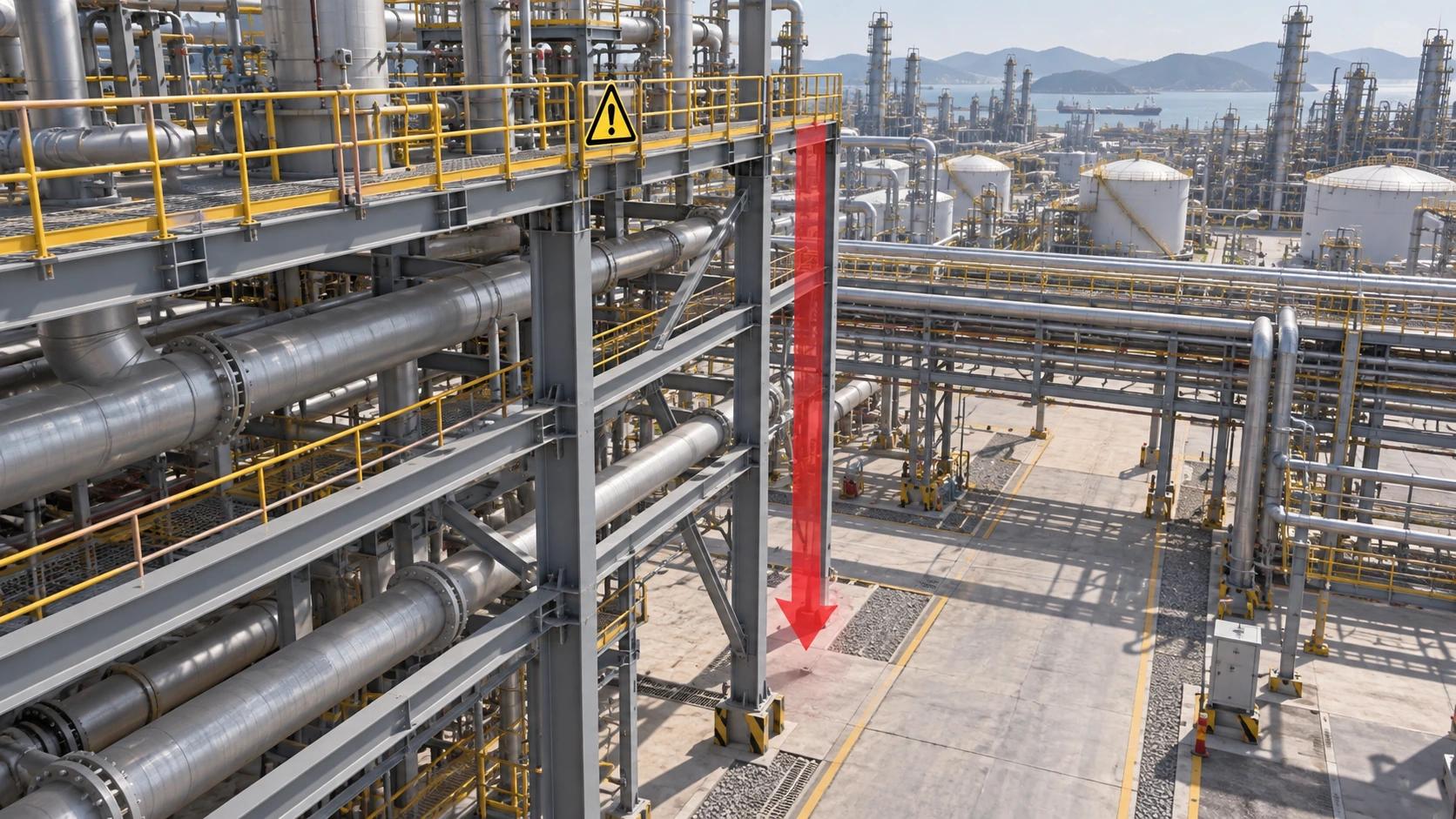
Work background, incident and investigation
Seoul Shinmun reported the April 17, 2026 incident during turnaround work at a chemical plant in the Yeosu industrial complex. The subcontractor employee was welding piping.
The reported fall occurred at about 16:20 from approximately 10 m. The worker received CPR during hospital transfer but died. The article does not describe access to the position or the type of work platform.
Police and firefighters were to examine witnesses and plant personnel, while the labour ministry planned to investigate fall protection and safety equipment. This describes investigative plans, not established violations or court findings.
Equipment and work principles — site checks
Pipe-joint orientation changes body and tool positions. If a weld can be reached from the platform centre but its underside requires leaning out, reconsider the platform-to-joint arrangement. Check room for welding posture and transitions before starting.
HSE’s hierarchy considers ground-level work, fall prevention and measures for remaining risk. In maintenance, check whether today’s joint can be worked on within protection, not merely whether a platform exists. Access space must remain after placing tools and cables.
When another maintenance contractor opens a hatch or removes a guardrail, access conditions change for the next trade. Physically control the changed area and check it after restoration. Reviewing the actual platform separately from its tag helps identify changes since the last inspection.
During turnaround work, pipe welding positions and access routes can overlap. Include tool collection and material receipt on the platform plan. Provide protected access instead of using pipes as a walkway, and coordinate temporary-platform removal so it does not interrupt another trade’s route.
Openings or removed platforms may remain after welding ends. Secure covers against displacement and arrange barriers without forcing workers onto unsafe detours. When closing a welding permit, check fire precautions and leave the platform and route in a condition the next worker can use.
For travel around pipework, an available anchor alone does not establish continuous protection. Identify each connection change between entrance and work position and whether tools interfere with a protected posture. Include material transport in the work plan so carrying equipment does not compete with safe connection and movement.
Published chronology and investigation status
| When | Established account | Source |
|---|---|---|
| 2026-04-17 about 16:20 | Pipe welder fell about 10 m during turnaround | Seoul Shinmun, 2026-04-17 |
| First aid and transfer | CPR and hospital transfer followed by death | Same report |
| At publication | Circumstances examined; fall protection and equipment investigation planned | Same report |
Consequences and emergency arrangements
Include equipment removal after welding in the access plan. Check for backward movement while collecting cables or lowering tools at a platform edge. The article gives no pre-fall movement for this incident; this is a review of comparable pipe-maintenance sequences.
Where plant and piping are below the platform, assess fall-protection connections and rescue access against equipment instructions and the actual structure. Consider travel and lower obstacles rather than selecting a lanyard solely by height. Share equipment identification and access routes with responders.
Check the route between the responder arrival point and the actual casualty position. In congested pipework, a nearby ground assembly point does not guarantee access to a fall location. Identify passage width, temporary platforms and rescue-equipment positions, and include area identification, level and height in the emergency information.
Questions for your site
| Question | How to check |
|---|---|
| Can the whole joint be viewed from within protection? | Before welding, check front, back and underside access from the platform. |
| Does stable footing remain when welding posture changes? | Set posture-change positions and remove the need to lean out. |
| Do cables or hoses obstruct the travel route? | Check the route to the exit after arranging cables. |
| Has another trade changed guardrails or hatches? | Compare alteration controls with actual guardrails and decking. |
| Has harness connection been checked against actual movement? | Check equipment instructions and anchor assessment. |
| Have access routes for clearing and rescue been planned? | Plan tool retrieval separately from casualty transfer. |
Application at Korean sites
For comparable work in Korea today, the reference is the Rules on Occupational Safety and Health Standards, Ministry of Employment and Labor Ordinance No. 450, effective 2026-03-02. These provisions guide current work; they are not findings of a breach at the time of the incident.
Article 42 establishes working platforms as the primary measure for work with fall risks and distinguishes safety nets and further measures where installation is difficult. Define preparation and movement before selecting protection.
Article 44 requires suitable attachment arrangements and pre-work checks where harnesses are used at heights of 2 m or more with fall risks. Providing a harness and providing a safe attachment arrangement belong together.