Drained does not mean safe to dismantle: the Gyeongju press explosion
An explosion and fire during press dismantling in Gyeongju on 8 September 2026 reportedly killed one worker and seriously injured two.
The reported incident
The initial account described cutting during machine dismantling and an ongoing cause investigation. It did not establish the complete ignition sequence or prove a particular residual substance caused the explosion.

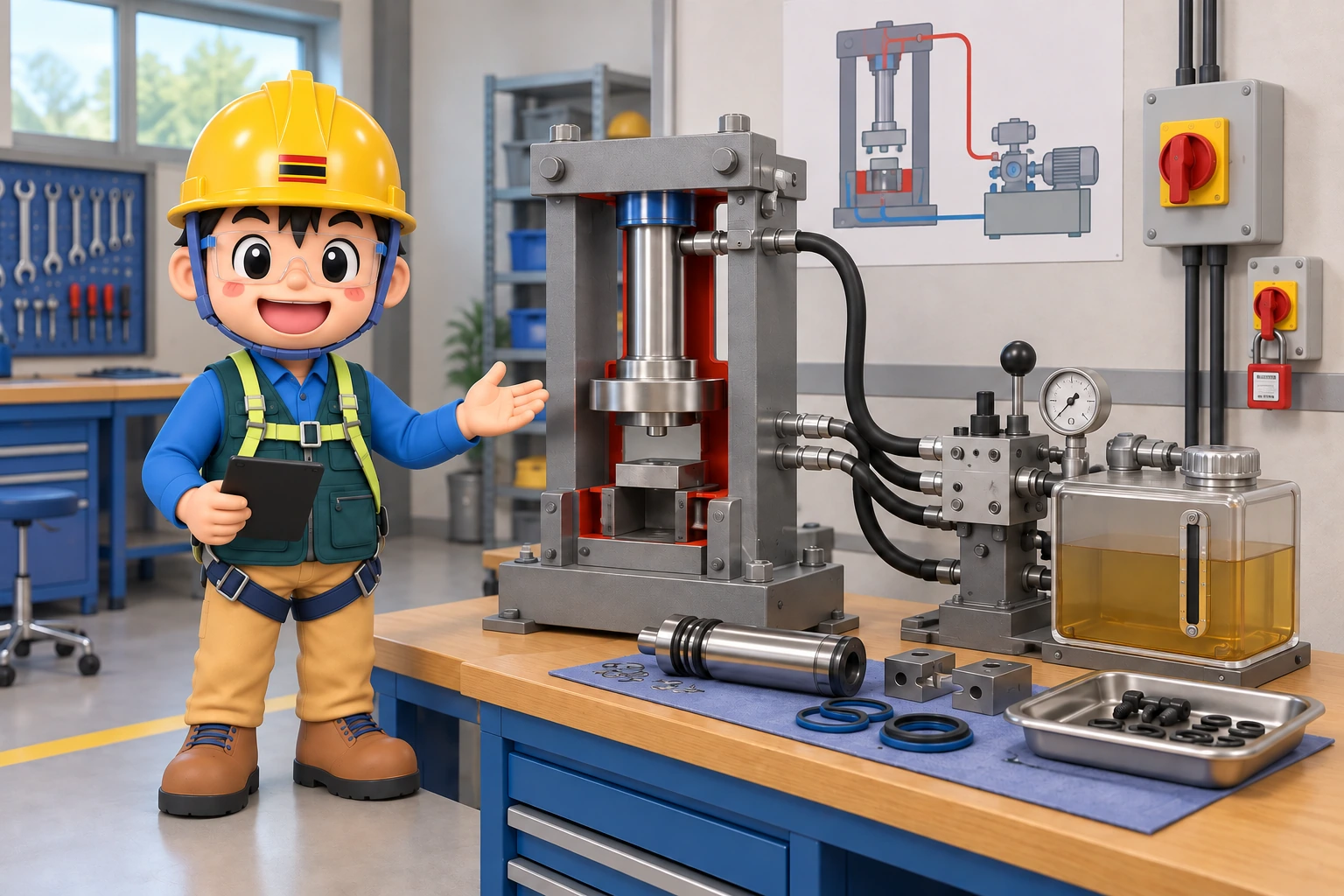
Consider more than electrical power
Dismantling requires assessment of stored hydraulic energy, moving or falling components and remaining material. Draining a system does not demonstrate that every pocket is empty.
Do not heat or puncture a part to investigate it.
HSE · 설비 정비 / Maintenance of work equipment
Check your workplace
- Have hydraulic and gravitational energy been considered?
- What could remain inside the part to be cut?
- Has a lower-ignition-risk method been assessed?
Match the method to the actual machine
Use equipment information and the installed condition, including modifications. Assess methods that reduce ignition sources.
Any necessary hot work needs controls appropriate to the remaining material and exposure.
Stop when reality differs from the plan
Unexpected leakage, noise or an unknown connection calls for withdrawal and reassessment. Do not continue opening the machine to find the problem at close range.
Putting it into practice
Stop cutting if residue or an undocumented connection appears. Confirm what has actually been checked and what remains unknown before selecting the next step.
UK references are general guidance rather than an accident-cause finding.
Technical insight
Empty does not necessarily mean ready for dismantling
Draining does not establish removal of residues, pressure or connected energy. The proposed dismantling method may introduce heat or impact.
Link the equipment’s energy sources and internal spaces to draining and cleaning records. Avoid treating “empty” as a complete description of the work condition.
Korean safety resources
- KOSHA · Practical safety handbook 53: Automobile manufacturing (2020)
Korean handbook: forklifts p.143, rigging p.164, conveyor hazards p.195 and non-routine work incidents p.225.
Sources
- 노컷뉴스 · 경주 공장 프레스 해체 폭발대한민국 / South Korea
- HSE · 설비 정비 / Maintenance of work equipment영국 지침 / UK guidance
- HSE · 설비 격리 / Safe isolation of plant and equipment영국 지침 / UK guidance