Is the valve secure before connection?: The 2012 Gumi hydrogen fluoride release
On 27 September 2012, hydrogen fluoride escaped during preparation for transfer from a road tanker to a storage tank in Gumi, South Korea. The release affected people beyond the workplace.
Incident sequence and circumstances
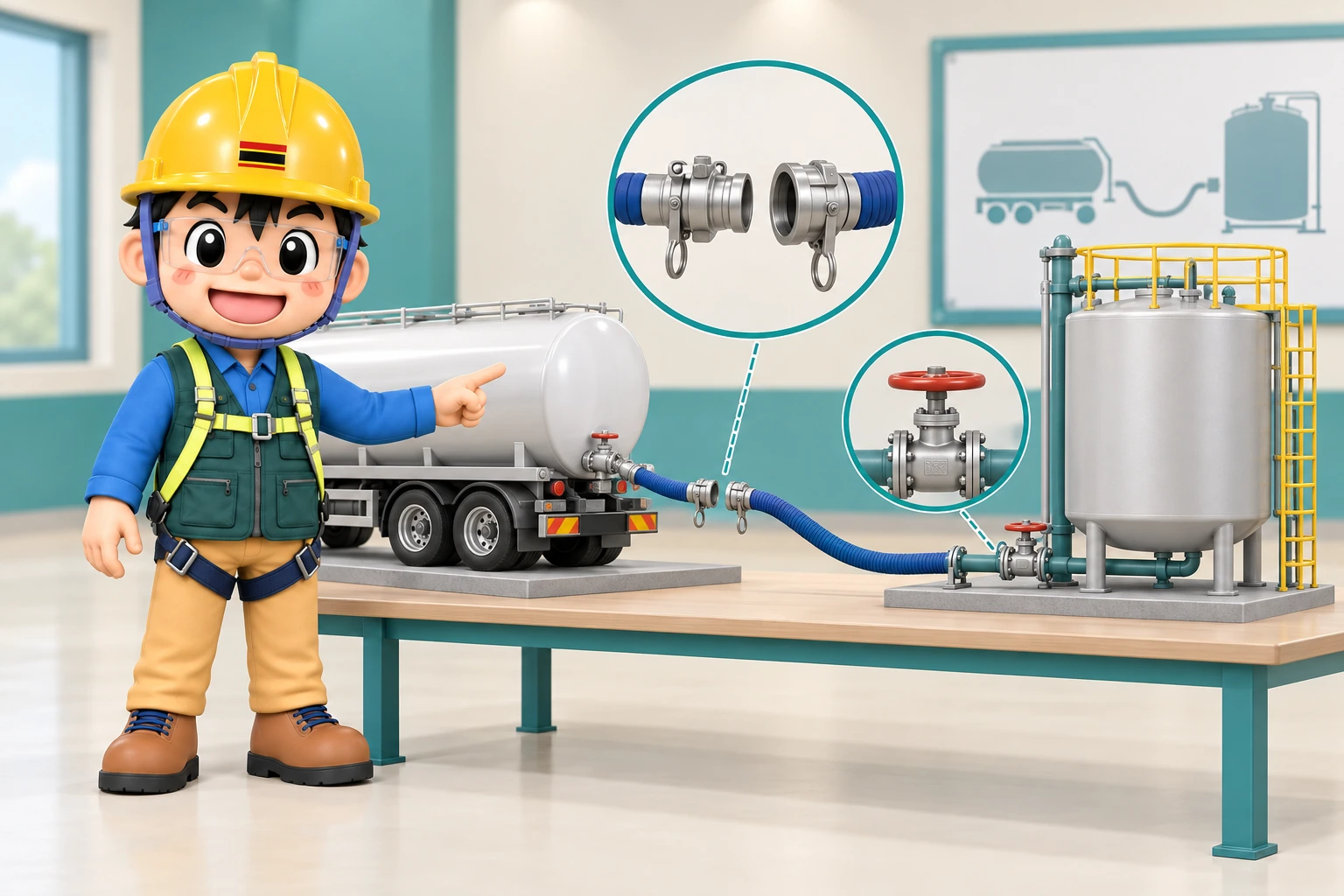
On 27 September 2012, workers at Hube Global in Gumi were preparing to transfer hydrogen fluoride from a tanker. The police announcement of 17 October described a product valve opening during air-hose connection.
Police said the prescribed sequence connected the air side before opening the product-side connection, whereas both were opened first. Five people died. This account describes that installation; it is not a universal transfer procedure or a complete explanation confined to individual actions.
Korean National Police Agency: Gumi release investigation briefing
Original reporting and investigation records
The Korean National Police Agency briefing dated 17 October 2012 describes the connection sequence and release. It records the investigation findings available at that time.
The source is in Korean.
Korean National Police Agency: Gumi release investigation briefing
Check your workplace
- What prevents a valve opening before the connection is complete?
- Does the actual sequence match the approved procedure?
- Can people raise the alarm and initiate the planned shutdown from safety?
A release during connection
The Korean police briefing of 17 October 2012 attributed the release to a product valve opening during hose connection and reported five deaths. It described a departure from the prescribed sequence.
This is an account of the police findings. Prevention also requires examining why an incomplete connection could expose people to the chemical, rather than stopping at individual actions.
Korean National Police Agency: Gumi release investigation briefing
Treat every transfer phase separately
Preparation, verified connection, transfer and disconnection have different hazards. Define required valve positions and the approved means of checking pressure and residual material for each phase.
Trace the route from source to destination using equipment identifiers. The historical sequence in the investigation is not a generic instruction for every tanker: use the actual system and manufacturer-approved procedure.
Korean National Police Agency: Gumi release investigation briefing
Look for engineered barriers
Review prevention of incorrect connection and unintended opening, remote isolation capability and the approved leak-check method. Training records alone do not demonstrate that people can recognize an unsafe configuration.
Replace a vague “valves checked” entry with equipment identity, required state, verifier and stop criteria. Agree who monitors transfer conditions and how abnormal flow or pressure triggers a stop.
Korean National Police Agency: Gumi release investigation briefing
Withdraw and communicate during a release
Hydrogen fluoride presents severe toxic and corrosive hazards. Untrained workers should not approach a release or attempt improvised neutralization. Withdraw to a safe location, raise the alarm and follow the emergency plan.
Plan chemical identification, exclusion zones, specialist response and emergency care arrangements. Select response protection through competent assessment, not by its appearance. Local requirements govern implementation.
Korean National Police Agency: Gumi release investigation briefing
Putting it into practice
At the pre-transfer briefing, match tanker, receiving tank, hose and valve identifiers. Make connection verification a distinct gate before transfer starts.
A changed connection or suspected leak triggers a stop and reassessment, not an improvised continuation.
Technical insight
Identify the containment boundary before transfer
An open product valve without a completed hose connection provides a release path rather than a contained transfer path. The Korean police findings on the Gumi connection sequence call for examining both human actions and the equipment and procedural barriers against premature opening.
Separate verification of the connection from authorization to introduce material. Link equipment identifiers, required valve states and responsibility to the actual procedure. An unverified condition is a reason not to start; the approved procedure for the specific tanker and receiving system determines the operating sequence.
Sources
- Korean National Police Agency: Gumi release investigation briefing대한민국 / South Korea