Portable hazardous-location blowers: checking the system from fan to duct outlet
At a glance
A portable blower moves air. A motor and enclosure suitable for hazardous locations do not measure the gas present or the oxygen concentration. A running fan and an atmosphere suitable for work are separate things to verify.
The applicable hazardous-location blower manual specifies the construction and operating conditions for RAMFAN UB20xx. Its ducting, power and servicing requirements do not automatically apply to other models. See the related air-assessment tool and confined-space article for atmospheric assessment and entry procedures.
Where does the air from the impeller go?
The motor turns the impeller, which creates a pressure difference across the housing. A connected duct directs the moving air. Normal motor rotation alone does not establish the airflow at the duct outlet. Duct length and configuration affect backpressure, which is why the manufacturer provides airflow-versus-pressure curves.
The maximum airflow in a product table is different from the airflow in a ducted installation. In the manual, maximum airflow refers to free-air conditions without backpressure. Using that figure for a long or bent duct ignores the losses in the actual arrangement. Compare required airflow with performance under the installed duct conditions.
Supply and exhaust ventilation move air in different directions. For supply ventilation, identify where clean air enters and how it reaches the work position; for exhaust, identify where contaminants leave. Air that turns back near an opening or leaves stagnant areas behind internal structures may not adequately ventilate the work position even while the fan is audible.
- 1 Clean-air intakeidentify the air source to avoid drawing discharged contaminants back in.
- 2 Hazardous-area blowercompare its nameplate and protection with the substances and hazardous location.
- 3 Conductive duct connectioncheck specified accessories and secure joints to maintain the conductive path.
- 4 Work and measurement locationverify testing and ventilation where the worker breathes; a running fan does not establish air quality.
- 5 Contaminated-air dischargeestablish a route that does not send contaminants back to the intake or occupied routes.
- 6 Suitable power and earthingcheck cable, connector and earth against the equipment conditions.
Check the air path separately from the power and earthing path
Suitability must extend through the connections
The UB20xx manual addresses duct and accessory connections as well as the blower. It requires the conductive components to be securely joined to maintain the grounding path, and specifies flexible conductive ducting when the blower is positioned remotely in a potentially explosive environment. A general-purpose duct of the same diameter is not necessarily an equivalent accessory.
The cable jacket, plug and connector are also part of the hazardous-location system. A rating on the housing does not justify continued use with a crushed cable or damaged plug. Verify the supply-side earth connection and connector suitability, and check whether an improvised connection or replacement changes the manufacturer's specified assembly.
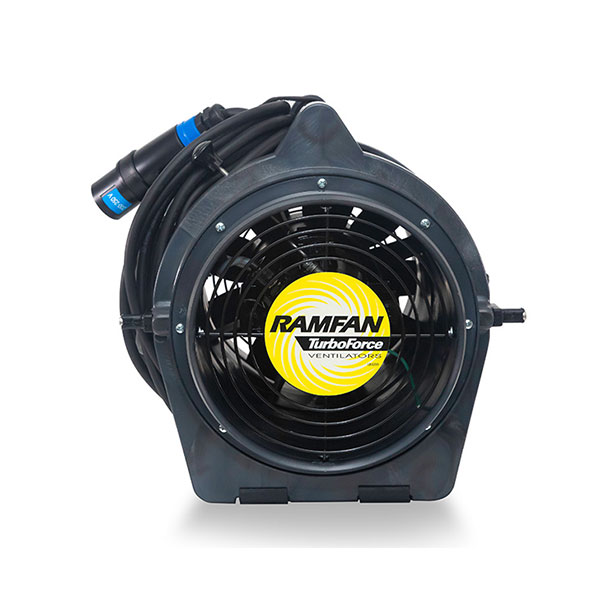
- Handle: identify the carrying point; the blower must not be moved while running.
- Guard: inspect before use because damage or missing sections defeat protection against rotating parts.
- Housing: check for cracks or deformation before use; stop use and request an inspection if damage is found.
- Cable and connector: inspect the jacket and connection as part of the complete power arrangement.
Start selection with the operating conditions
Gas or vapour hazards and dust hazards are not interchangeable. The protection must suit the substances and area classification at the site. Compare the manual's model list, nameplate power specification, ambient conditions and certificate conditions for the same unit. Part numbers within a product family can have different power requirements or configurations.
An overseas hazardous-location marking identifies the scope of that certification scheme. It does not automatically establish compliance with Korean requirements or Korean certification for the model. Compare the actual nameplate, certificate and installation conditions, including any special conditions of use.
Inspect the impeller and cable before connection
Before connecting power, verify that the switch is off. The manual prohibits starting with shipping damage to the impeller, guards or housing. Missing or damaged guards no longer provide the intended protection against access to rotating parts, so the unit must not be used. Check that duct connections are secure at this stage.
Fully uncoil the power cable and route it away from heavy equipment and trip hazards. If relocation leaves insufficient cable length, reassess the supply and manufacturer's instructions rather than simply adding any extension lead. After moving ducting, inspect the joints and check for crushed sections.
Do not overlook restart after a trip
Stop the blower if mechanical noise, vibration or another abnormal condition appears. Equipment covered by this manual has automatically resetting thermal overload protection, so the motor may restart without warning after a trip. Do not reach inside or disconnect ducting merely because it has stopped; isolate power and investigate the cause.
Where ventilation is required throughout work, loss of airflow changes the working conditions. A restarted fan alone does not justify resuming work before reassessing ventilation and measurements at the work position. Confined-space ventilation, testing and access control remain separate from restarting the equipment.
Cleaning must not damage the protective construction
Isolate power before inspection, disassembly or cleaning. The manufacturer prohibits immersing or directly spraying the motor and instructs cleaning dust from the impeller and motor with a damp cloth. This condition addresses electrostatic charging and should not be replaced by vigorous dry wiping. Keep water and cleaning agents out of socket contacts.
Impeller clearance, guard damage, cable condition and connector condition are different inspection items. No single test verifies the whole blower system in the way a gas detector calibration checks its measurement response. Record the prescribed checks and actual damage, and do not arbitrarily change the motor make or model. Parts not designated for user servicing require the manufacturer's repair process.
A light became an ignition source during tank painting
NIOSH FACE 89-38 describes tank painting with a non-explosion-proof halogen light. The worker inside wore supplied-air respiratory protection, but that did not remove the ignition hazard from the light. One worker died from burns and the coworker outside was injured. This was not a blower failure: it illustrates why respiratory protection and electrical ignition hazards require separate checks.
Check both ventilation duties and equipment suitability
Article 311 of Korea's Rules on Occupational Safety and Health Standards requires electrical equipment suitable for the vapours, gases or dusts in hazardous locations and maintenance of its protective performance. Article 620 requires ventilation before and during confined-space work to maintain an appropriate atmosphere. Its respiratory-protection exception is limited to the conditions in the provision; having a hazardous-location blower does not replace entry authorization.