After a gas alarm: evacuation, communication and the decision to re-enter
When an alarm stops, who can tell a returning worker what has actually been checked?
The person hearing the alarm and the person investigating it
When a gas alarm sounds, people who must stop and move away have a different role from the designated personnel investigating the cause. General workers follow the site response for that alarm, move to safety and communicate, rather than searching for the leak. Pass on what remains unknown; leave any return for verification to the designated response arrangements.
Detector selection and confined-space measurements are covered in related articles. The site procedure should identify alarm meanings, routes, assembly locations and contacts. Before starting, identify the route available from your own work position.

- Alarm device: Before work, check that the signal is recognizable from your position.
- Evacuation path: Identify the route from your work position to safety in advance.
- Access barrier: After evacuation, confirm the designated return instruction before re-entering.
- Communication point: Identify a contact point outside the hazard area and the communication method in advance.
Evacuate when fire or explosion danger is imminent
Article 279(1) of Korea’s Rules on Occupational Safety and Health Standards requires an employer to stop work immediately and evacuate workers to safety when an industrial accident from fire or explosion presents imminent danger. A sounding alarm alone does not automatically establish that legal condition in every situation. Predetermined alarm responses and immediate evacuation when danger is imminent must work together.
Paragraph 2 requires exclusion of people who are not concerned with the work until the risk of industrial injury has been confirmed absent, with a readily visible notice. Releasing access restrictions and authorizing a particular task to restart are separate checks. Ask the responsible person whether the conditions of that task’s permit have also been restored.
Separate alarm reset from resolution of the release
Information that the sound has stopped should be separated from information that the cause of a release has been addressed. HSE guidance recommends planning the action to take following detection. A detector provides a warning; the response procedure must connect that indication with what people will do.
Useful handover questions are: “Has the indication reset, or has the cause been addressed?”, “Which area has been checked?” and “Who will communicate permission to enter and restart?” These are practical prompts for reviewing a site procedure, not universal legal concentration limits for re-entry.
- Alarm indicationAsk separately about reset and correction of the cause
- Access boundaryConfirm the permitted area and responsible contact
- Work restartRecheck the permit conditions for your own task
Make the handover brief and specific from a safe location
After evacuation, distinguish where and when you received the alarm, the task you stopped, the status of people who moved with you and matters still unconfirmed. Separating direct observations from information relayed by others helps the response team decide its next check. An alternative contact route for a communication failure is another question to settle in advance.
HSE’s leak and gas detection guidance considers whether warnings can be seen, heard and understood alongside the response procedure. Ask both whether the alarm operated and whether it was recognizable at your work position. Where noise or protective equipment could hinder recognition, confirm the communication method with the responsible person before work.
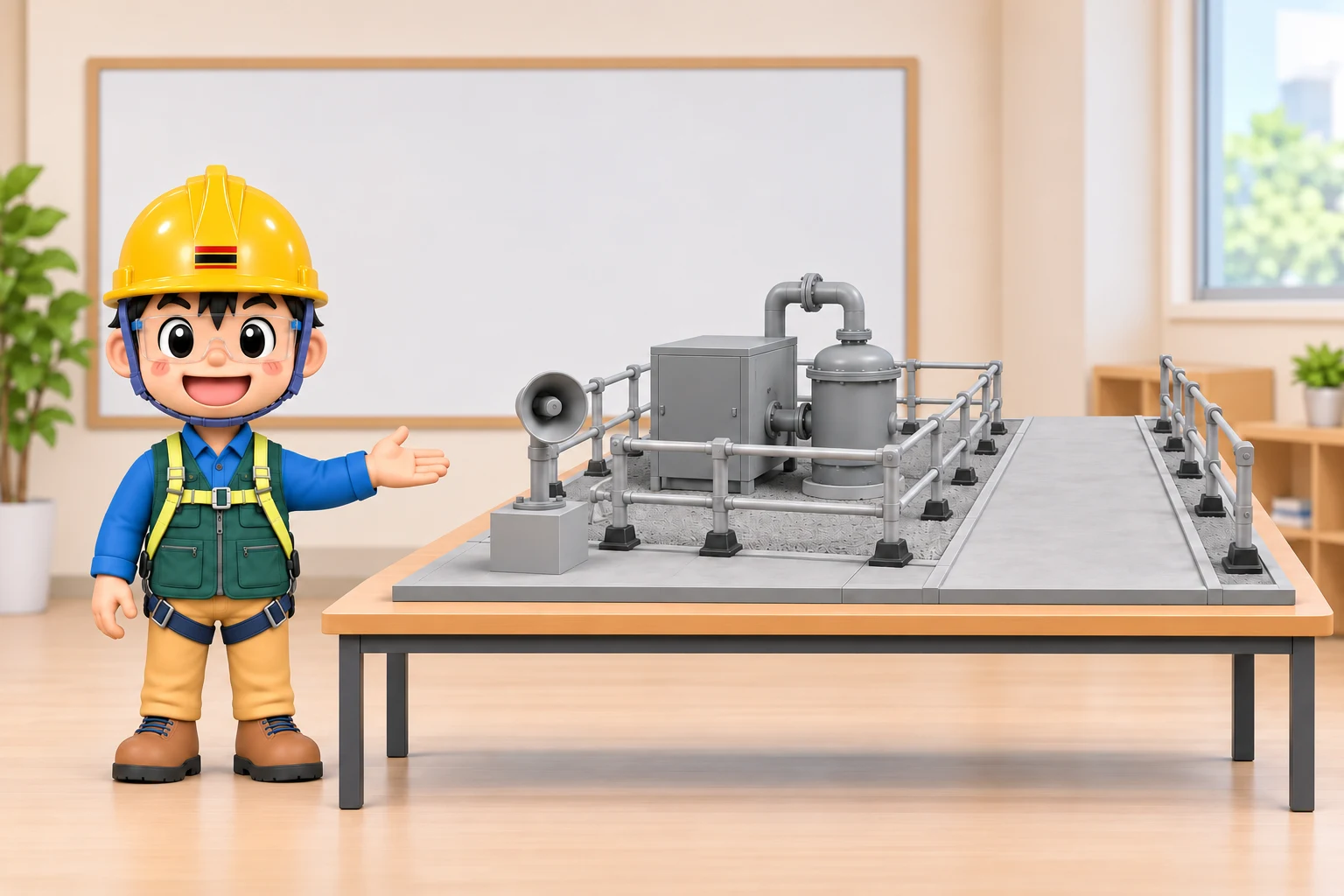
Check the boundary while waiting outside it
A closed entrance may still leave access through a side route. Treating the exclusion boundary and the evacuation route as the same line can obstruct people leaving. When checking the layout, identify the boundary preventing entry separately from the path leading to safety.
When a return instruction arrives, confirm who issued it, the area it covers and the task authorized to resume. Check the conditions for your own work rather than extending permission for one area to another area or task. Recovering tools left during evacuation also involves entering the controlled area and belongs within the designated procedure.
Account for people, not just the total at the assembly point
At the assembly point, check names and work locations when establishing whether everyone in the team has left. The US OSHA emergency-action-plan standard treats evacuation and post-evacuation accountability as separate elements. As a practical reference for a Korean site, the plan can identify who checks the roster and where reports of unaccounted people go. A matching head count alone can conceal a person at another assembly point and another whose location remains unknown, so distinguish confirmed assembly from an unconfirmed location.
If a colleague is absent, give the designated contact their last confirmed work location, direction of travel and contact status. Reporting this information is separate from search and rescue. OSHA separately addresses rescue and medical duties; Korean Article 279 requires stopping work and evacuation in imminent danger of an industrial accident from explosion or fire, with unrelated people kept out until the risk of industrial injury is confirmed absent. An ordinary worker should relay verified information from outside the danger area to the response team rather than return on their own because a colleague is unaccounted for.
Define any essential shutdown role before an alarm
Conflicting expectations about who shuts equipment down and who evacuates can delay communication. OSHA’s nonmandatory appendix discusses essential services and processes requiring staged shutdown, including the conditions for the assigned workers to leave. This calls for planned roles, not a general instruction to remain in danger. A worker independently going to close a valve is different from an assigned person carrying out an approved emergency procedure.
Before work, distinguish those who leave immediately, those who communicate from safety and those who direct the equipment response. Ask what signal ends each assigned role and where that person then goes. Revisit the briefing when responsibilities or the plan change. OSHA’s plan-review provisions cover initial assignment as well as changed responsibilities and plans; they offer a practical reference for keeping the briefing current.
Where evacuation routes meet other teams
When several contractors share a plant area, compare the interfaces between their evacuation plans. Check whether an assembly point blocks another team’s route or emergency access and where accountability reports converge. OSHA’s nonmandatory appendix recommends coordinating plans in multi-employer buildings to reduce confusion and conflict. For a plant task, use the actual layout and access boundaries to coordinate routes rather than copy an assembly arrangement from another location.
When reviewing a drill, follow the sequence beyond passing the exit to assembly and completed communication. Look for places where people gathering immediately outside an exit could obstruct others or the response. OSHA’s appendix advises moving away from exit discharge points and avoiding assembly that hampers emergency operations. Practical follow-up questions include where the route ends, where assembly begins and who guides visitors or people needing evacuation assistance.
Carry the return decision into the next handover
Before resuming work after an alarm, check both the earlier permit status and current access conditions. If hazard clearance, area access and task restart are communicated by different people, identify how those messages join up. Article 279(2) ties restricted access to confirmation that the danger is absent, not to a shift change. A practical handover therefore distinguishes the scope already checked from the scope still under control.
Recognize the signal and cover alarm-system outages
Workplaces contain operating signals, telephones and vehicle warnings. Explain the emergency signal together with the destination and action it requires. US OSHA calls for a recognizable warning that can be perceived amid ambient noise or lighting. As a practical Korean-site question, check recognition at the actual work position and how the message reaches people who have difficulty hearing or seeing it.
During alarm-system maintenance, who will report an abnormality, and how? OSHA specifies backup warning arrangements when the alarm system is out of service. Such communication does not certify that a person replaces a detector’s function. The responsible person should identify the unavailable function and area and assess continued work under site procedures; workers need the revised contact route.
If routine radios or telephones also carry emergency warnings, agree how urgent messages take priority. OSHA specifies priority for emergency messages on a shared alarm communication system. A practical question is who receives and passes on the urgent message when a channel is busy. After a failed contact, review the usable communication means and receipt by the responsible person, not just the contact list.
After an alarm has been used, confirm readiness to convey the next warning. OSHA calls for prompt restoration of alarm systems after tests or alarms. Manage that restoration separately from removal of the release hazard: receive both the hazard-control result and the alarm-system availability. This separates ending the warning, restoring the system and authorizing work restart.
Related reading
Original sources
- Rules on Occupational Safety and Health Standards, Article 279(1)–(2)
- HSE — The selection and use of flammable gas detectors, paragraphs 5 and 30–33
- HSE — Leak / gas detection, alarm recognition and response procedures
- US OSHA 1910.38(c), (f) — evacuation, accountability and roles (US requirements)
- US OSHA Subpart E nonmandatory appendix §§1–3 — emergency planning guidance
- US OSHA 1910.165(b), (c)(2), (d)(3) — warning and backup arrangements (US requirements)