Setting the exclusion area for exchanger bundle extraction
Identify the extraction axis and support transitions before removing an exchanger bundle. Confirm where passage can reopen even after movement stops.
Identify the extraction axis and final position
Most of a shell-and-tube exchanger bundle is hidden while inside the shell. Clearing only the space for the cover can leave too little room once the bundle extends. Before equipment placement, the work supervisor identifies the extraction axis with the crew. Check the direction from the shell, the extractor position, and where the fully withdrawn bundle will sit. Agree when people across the aisle must stop approaching.
Do not estimate the required distance by looking at the shell. Compare the bundle and extractor information to find the farthest moving point. The extractor may extend farther than the bundle, so distinguish both ends when reviewing the layout. A space between the shell and the extractor may look like a place to stand until movement creates a pinch area.
Look beyond the immediate sides of the extractor. Hoses or cables crossing a side aisle can draw people toward the boundary as they try to step over them. The setup crew should review the exclusion boundary and service routing together. Where a wall or column leaves no detour, agree how to manage passage with operations before starting.
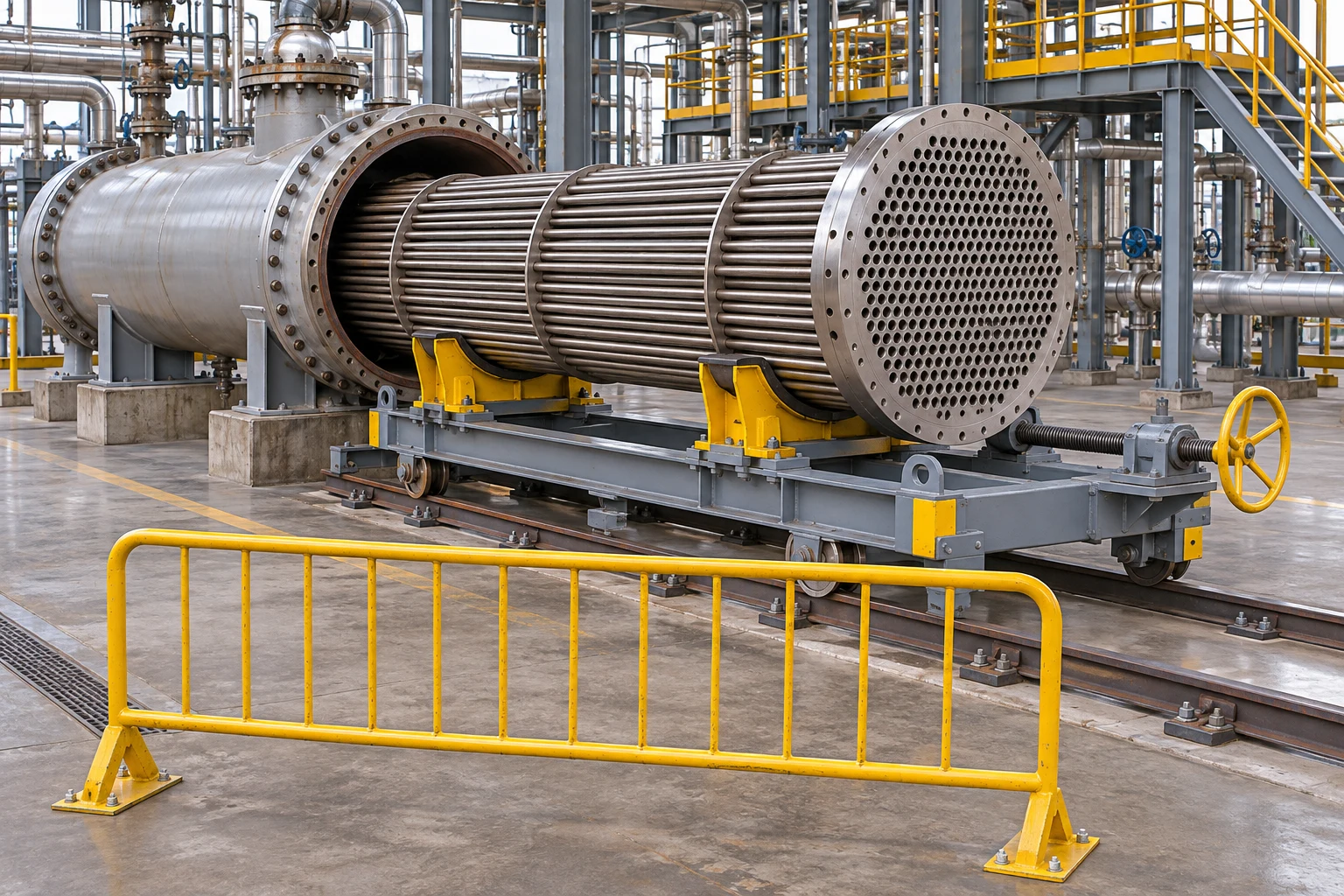
- Tube sheet: identify the direction of travel and final position.
- Cradle: verify the stage at which the supporting point changes.
- Extractor wheel and rail: match equipment travel to the plan.
- Portable barrier: position it where the access restriction is visible.
Keep extraction setup and process opening checks separate
Extractor setup does not authorize opening the shell or pulling the bundle. Operations and maintenance separately verify the equipment, opening authorization, and conditions for extraction. Stop if isolation or residual-content checks are incomplete. Communicate boundary readiness and opening authorization as different checks.
Cover handling and bundle extraction can have different travel paths. Check whether the staged cover obstructs the bundle axis or occupies a support position. Review whether the previous boundary still works before changing stages. If the cover or tools must move again, coordinate the sequence while the bundle is stationary under safe conditions.
With similar exchangers in a row, verify that the open shell is the intended unit. If setup and barrier crews identify different units, the actual exposure remains even with a barrier in place. Repeat the equipment, work face, and extraction direction and confirm that everyone indicates the same end.
Stop to verify before the load transfers to another support
As the bundle emerges, the load-bearing points can change. Define each support transition and who verifies it in the plan for the equipment and bundle. A support nearby does not establish that it is ready to take the load. Stay clear until maintenance has verified the support condition for that stage.
Report different views from the shell side and far end to the supervisor. A support that looks aligned from one side may appear obstructed or displaced from another. Keep out of gaps between moving and fixed parts. If the point cannot be seen safely, stop and agree how to verify it. Do not infer load sharing or suitability from a visible gap.
Review the support floor before and after equipment setup. After setup verify that the planned positions and supporting surfaces still apply. Report new interference around supports from hose routing or nearby equipment. Review and communicate a revised plan before changing support materials or heights.
Handover sequence
| Stage | Owner | Decision or check | Record |
|---|---|---|---|
| Identify unit and axis | Supervisor and maintenance | Match unit, direction and extractor travel | Work face and travel range |
| Verify opening conditions | Operations and maintenance | Confirm opening authorization and boundary readiness separately | Opening conditions and restrictions |
| Set boundary and signals | Supervisor and crew | Check approaches and operator–signaler sightlines | Access points and signal method |
| Verify support transfer | Maintenance and supervisor | Check support and next-stage conditions | Support and stage |
| Stop and reassess | Crew and supervisor | Stop for binding, interference or lost signals | Stopped position and change |
| Hand over | Maintenance and incoming crew | Separate remaining movement and reopened passage | Support condition and restrictions |
Define work positions and access points separately
Not every position outside a boundary is suitable for observation. The supervisor separates operator and signaler positions from waiting areas for other crews. A person on a blind side may be hard to warn if movement changes. Stop movement before relocating an observer and communicate the new position to the whole crew.
Where a boundary crosses an aisle, tool deliveries can meet normal traffic. The people controlling access should know who can enter during each stage. Instead of lifting the barrier briefly for passage, stop and verify safe access with the supervisor. Confirm both that people have left and that movement is about to resume.
Check approaches from above and from the opposite side. Where a stair or entry is hidden from below, another crew may not see extraction start. Verify that restrictions can be understood from each affected approach. Where emergency routes are affected, coordinate access and evacuation paths with operations before work.

Stop and reassess interference, binding, or loss of signals
Stop extraction if the bundle appears to depart from the expected axis or its movement changes unexpectedly. Do not enter between the bundle and extractor to look for the cause. Report the stage and direction of change, then establish safe conditions for maintenance to inspect the equipment and supports. Do not increase force or push from another direction to clear an unknown obstruction.
If the operator loses sight of the signal or communication fails, nearby workers should not improvise a substitute. Stop and have the supervisor decide when to resume after confirming the designated signaler and method. Identify noisy locations beforehand. If the view changes during work, verify communication while stopped.
Concurrent work can change. If a handling vehicle enters an adjacent aisle or a temporary platform appears, check the boundary against the extractor's travel again. A brief pause in another job does not establish that the area will remain clear. Have both work leads share the change and coordinate movement.
Verify supports and access after movement stops
Do not remove the boundary as soon as the fully extracted bundle stops. The supervisor and maintenance confirm what carries the load, whether transfer remains, and where people may enter. If cleaning or inspection takes over, explain any restrictions needed for further movement. Separate reopened paths from areas that remain closed.
The next crew needs the bundle location and the support condition it is taking over. A stationary photo alone cannot show the stage or whether a support was moved later. Record the stage and check result, and distinguish the next movement from the checks that precede it. Reconcile the field and record before moving again if they disagree.
Article 38 and Annex 4 of the occupational safety rules address advance surveys and work planning for heavy-load handling. Article 39 addresses supervision under the plan. The actual extractor, supports, loads and floor conditions belong in the site plan. A clear area is one condition. The supervisor coordinates checks as extraction, support transfer, and handover progress.
Coordinate the extractor footprint with other crews
The extractor can narrow an aisle before the bundle moves. Operations should tell the crew where people normally approach valves or instruments. If a check point ends up behind the setup, agree how long access is restricted. Distinguish general passage from required operating checks so an alternate way to complete those checks can be arranged.
A long extractor can make the far boundary hard to see. Check the view from the main aisle and from the opposite work area. Where the boundary continues behind a column, directions may need to be given at a different point. The access crew should identify where the boundary lies before and after a change.
Nearby piping or a platform can interfere at bundle height even when the floor is clear. Tell the supervisor which stage brings the equipment close. Include tools or temporary structures at the side or above. Agree on safe clearance and sequence in advance rather than planning to clear items by hand during movement.
During the handover from setup to extraction, distinguish completed setup from a cleared work area. Identify which crew confirmed remaining connections and personnel. Check whether the incoming crew's tool stand blocks the signaler's view. Before extraction, verify that the checks refer to the same arrangement and stage.
Describe the stopped condition during an interrupted job
If extraction pauses for a shift change or a schedule change, record where the bundle stopped. Distinguish the part remaining in the shell from the part supported by the extractor. Verify allowable parked conditions against the equipment and work plan. The supervisor communicates which restrictions and equipment conditions must remain in place.
Before resuming, verify that the previous shift's setup is still in place. Other crews may have used the aisle or moved nearby equipment during the pause, changing boundaries and sightlines. Reconcile open items with the field and review signals for the current layout. Communicate any changed permission before starting.
If cleaning follows immediately, schedule the arrival of hoses and stands separately. Staging hoses simply because the bundle is stationary can obstruct a later transfer. Ask whether support transitions and movement are complete and confirm which area can be set up. If movement is needed again after cleaning begins, clear people and materials and re-establish the boundary.
When clearing the work area, identify any side still awaiting handover. Record differences between the planned and current boundary. If an opening is moved, check the opposite approach for points that must stay closed. The supervisor tells affected crews which sections will be restricted again when the next stage starts.