Coordinate transport routes with maintenance access
Place transport routes and maintenance access points on the same plan. Assign shared segments and connect start messages, unloading and passage handback to clear ownership.
Collect maintenance access points before transport starts
Map where the maintenance team enters and leaves its workface, as well as the vehicle's start and destination. Work areas may be separated while trips for parts or tools still intersect the transport route. The coordinator should show the vehicle segment and repeated maintenance movements on the same reference. Their interfaces must be agreed before transport starts.
The transport team provides the equipment, load, start and destination, and intended route. The maintenance team provides work location and height, material access and workface entry points. Link timing to the segment actually occupied. Describe which team uses which segment and when, rather than listing only activity names and overall schedules.
During a joint field review, check that the mapped entry points remain available. Update the route if temporary storage or maintenance preparations have changed movement. Explain a changed path at the actual access point, where workers might otherwise choose the familiar route. Aligning the plan with the physical layout gives both teams the same operating conditions.
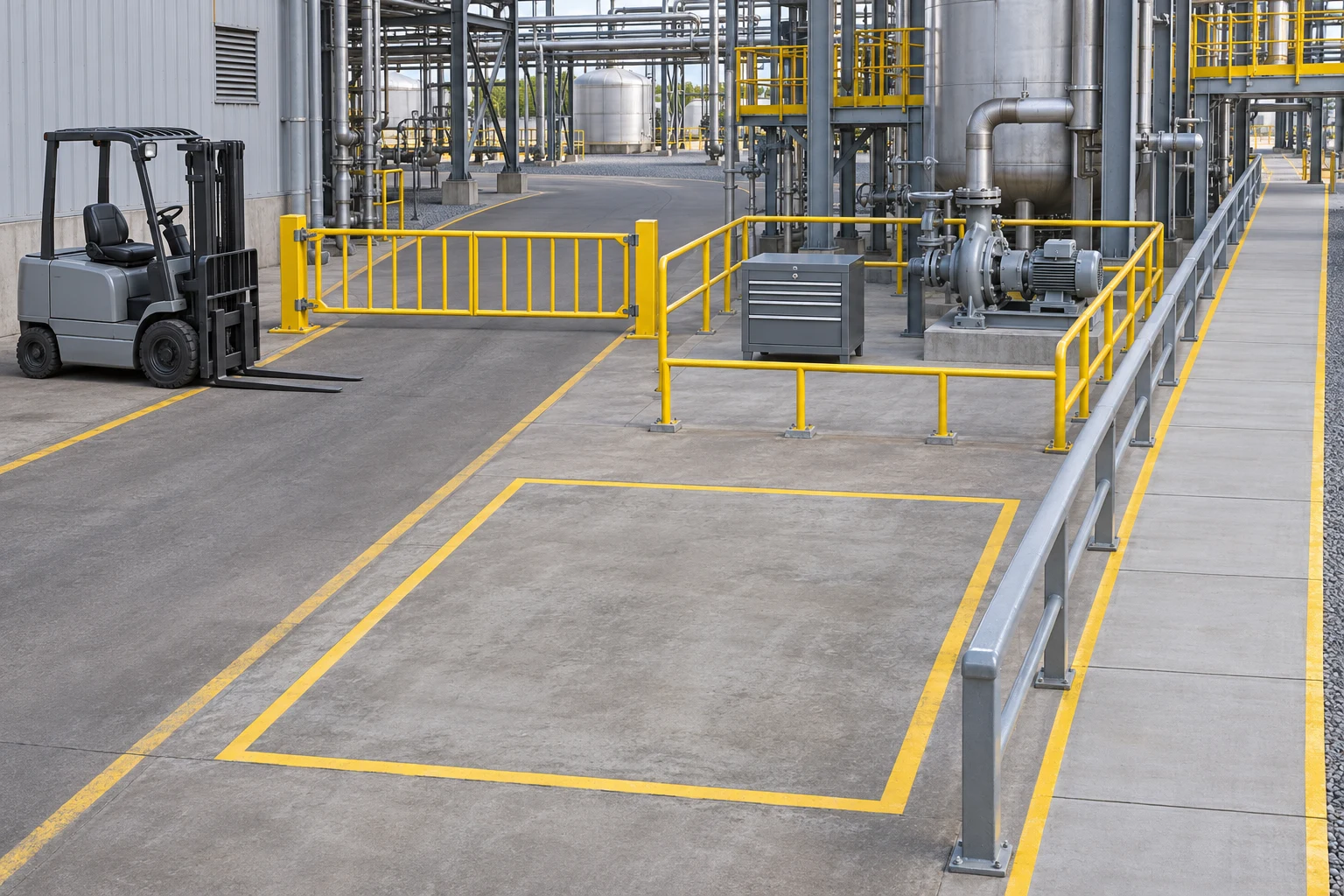
- Vehicle-route barrier: change the control after segment handover and movement authorisation.
- Maintenance boundary: distinguish retained maintenance controls and their owner.
- Unloading-bay marking: confirm placement limits and clearance after unloading.
- Separated walkway: verify a clear continuous path to maintenance access.
Overlay other workers' movements on the transport plan
For work using vehicle-type loading and transport machinery, establish the survey and work-plan requirements under Article 38 and its applicable schedule. The plan must reflect survey findings and be communicated to relevant workers. Distinguish the exclusion for road travel by freight vehicles. Link route coordination with the applicable transport plan and work records used in the field.
KOSHA's Practical Guide illustrates plans that include equipment and load locations, routes, guide and worker positions, obstructions and other workers' paths. Use those elements of the sector-specific example to overlay maintenance access on the transport plan. Determine actual speed, width and equipment capacity from site conditions rather than adopting numerical values from the example.
Distinguish the waiting location from the unloading location on the same drawing. Even while stationary, a vehicle or deposited load may affect maintenance access. Consider space occupation from preparation through unloading and clearance, rather than matching only the destination. Ensure related teams use the same revision and acknowledge the changed portions.
Define spatial and time separation at shared segments
Select separation measures after checking available space and hazards where transport and maintenance paths meet. If a separate walkway is available, walk it from entry to destination to verify continuity. A path that merges back into a vehicle segment still has an interface to coordinate. Compare the drawn boundary with a physically usable route.
Where spatial separation is difficult, establish which activity goes first and the state required to hand the segment over. Identify where maintenance access is controlled during transport and where vehicles wait during pedestrian access. Communicate both entry and return conditions. Connect an apparent gap in the schedule to verification that the actual segment is available.
Article 22 requires safe worker passageways to be provided and maintained in usable condition. Before blocking an existing maintenance path for transport, verify that the alternative is usable. Temporary unloading can also alter access, so distinguish storage space from passageways. If a segment becomes obstructed during work, notify affected teams and resume movement under the coordinated conditions.
Handover sequence
| Stage | Owner | Decision or check | Record |
|---|---|---|---|
| Collect interfaces | Transport and maintenance owners | Identify route/access conflicts | Location, timing, segment |
| Allocate use | Authorised coordinator | Choose separation and waiting positions | Sequence, incompatible work, owners |
| Prepare the field | Control implementation owner | Check boundaries, access and unloading | Readiness and open conditions |
| Confirm start | Director and controller | Confirm clearance, receipt and permission | Segment and permitted action |
| Review changes | Coordinator and affected teams | Review route and permit conditions together | Revision and resumption conditions |
| Return the passage | Controller and receiving team | Check remnants, retained boundaries and access | Handover time and open conditions |
Connect access control with transport direction
Apply Article 172 access restrictions where contact with transport machinery or its load may endanger workers. Review the provision for movement under an assigned work director or guide together with its conditions. Maintenance workers should confirm the agreed access condition with the controller rather than interpreting a visible vehicle as evidence that passage is permitted.
Determine the need for a work director by comparing the scope and exceptions in Article 39. Where maintenance workers move nearby, examine actual access and collision risk before considering an exception based on the absence of that risk. If transport direction and maintenance access control have different owners, align their contact points and roles. Identify who confirms clearance and who directs movement.
KOSHA's Practical Guide recommends a position from which the work director can understand the work, participants can recognise signals, and the director remains safe. Use that principle to place controllers outside vehicle and load hazards. Where one person cannot observe every interface, agree additional communication and segment ownership before starting transport through unverified areas.

Include the segment and permitted action in the start message
Before transport starts, confirm that both teams mean the same segment. The coordinator identifies the segment being handed over, the team that must wait and the condition for starting movement. The recipient confirms the action required of their team. State which access is permitted and which controls must remain, rather than merely announcing that work is starting.
Maintenance trips for parts and shift changes also need to reach the access controller. Use the planned crossing method and keep the boundary in place during transport. If contact or segment-clearance confirmation is unavailable, hold the affected movement and contact the responsible person. Identify who acknowledges messages and who decides resumption, as well as the communication channel.
KOSHA Technical Support Regulation (KOSHA GUIDE) C-C-49-2026 recommends cooperation from the relevant operations manager where nearby process areas need notification for work safety. Link that cooperation to the plan and communication chain when transport interfaces with permitted maintenance. Communicate the agreed conditions to each team, leaving approval and operational decisions with the people authorised by site procedures.
Reconcile maintenance access when unloading locations change
Before arrival, compare the unloading point with maintenance movement space. Distinguish load placement from waiting positions and check what passage remains after unloading. Delivery alone is not a complete return condition if packaging or empty handling equipment changes access. Tell the coordinator what will be cleared and when the segment will be handed back.
If unloading must move, review the vehicle route, load location and maintenance access together. A small relocation within the same area may change a boundary or interface, so mark it on the shared reference. Communicate the change and verify the actual boundary against the revised plan before proceeding. Obtain renewed confirmation before using a location different from the one previously agreed.
When transport waits, check whether its waiting position obstructs maintenance access. Agree any relocation and movement conditions with the coordinator instead of creating an improvised diversion. Keep ownership of the occupied segment explicit while the load and vehicle are stopped. Recording the waiting state reduces the chance of another team treating it as vacant.
Review resumption conditions across affected activities
When a closure, expanded workface or changed storage position affects an interface, review both transport and maintenance movements. The coordinator communicates the changed location, held activities and required controls. Reconcile the shared segment so teams do not resume solely on the safety of their own task. Use the actual layout and current personnel when reviewing the change.
C-C-49-2026 addresses permit reissue when work, safety requirements or other conditions change. Review affected permit-controlled work under those criteria and site procedures. Connect a transport-route change with any change to the maintenance permit boundary. Deliver the revised references to the field and check that nobody continues to act on the previous plan.
Record the revised boundary, usable route, controller, communication method and order of segment handover. The implementation owner confirms that barriers and passageways match the decision and reports to the coordinator. Once the teams' conditions are aligned, communicate resumption under site procedures. The record should connect the agreed decision with actual field readiness.
Hand back a usable passage when transport ends
Distinguish the end of vehicle movement from readiness for maintenance access. Check the locations of the vehicle, load and remaining materials, plus controls still needed, and identify the segment being returned. The controller verifies the physical state before informing the receiving team. Check the next team's access conditions rather than removing barriers on a schedule-complete message alone.
Retain boundaries needed for ongoing maintenance after transport finishes. Separate transport-only controls from maintenance-workface controls and assign their removal. If only part of a route can open, communicate both the available and restricted portions. The receiving team checks continuity to its destination and refers remaining clearance work or obstructions back to the coordinator.
A useful final record states handover time, verifier, available segment and remaining conditions. Recheck that state as the starting condition for the next delivery or shift. Update the shared drawing against the actual layout rather than simply retaining its previous lines. Both teams need the same understanding of the returned passage for subsequent movement to follow the plan.