Verifying drain and vent end closures during restoration
Check handle position, end fittings and discharge routes separately. Distinguish temporary connections from those intended to remain in service.
Separate valve position from end closure
After maintenance, operations first identifies the drains and vents used during the job. Record the handle position separately from restoration of any required cap or plug. A closed-looking handle does not establish internal isolation. Even when an end fitting is visible, its identity and suitability must be checked separately.
Removing a temporary drain hose does not establish restoration. Operations and maintenance should verify the intended configuration at the connection. Distinguish hose removal from end closure in the work list. Small parts can get mixed with returns from other work, so match removed parts to their actual restoration points.
A vent routed to a closed header may sit beside a drain used with a temporary hose. Similar handles can lead to different end arrangements. Do not use an adjacent valve's cap as the reference. Verify where each branch leads and how it is normally configured before assigning restoration checks.
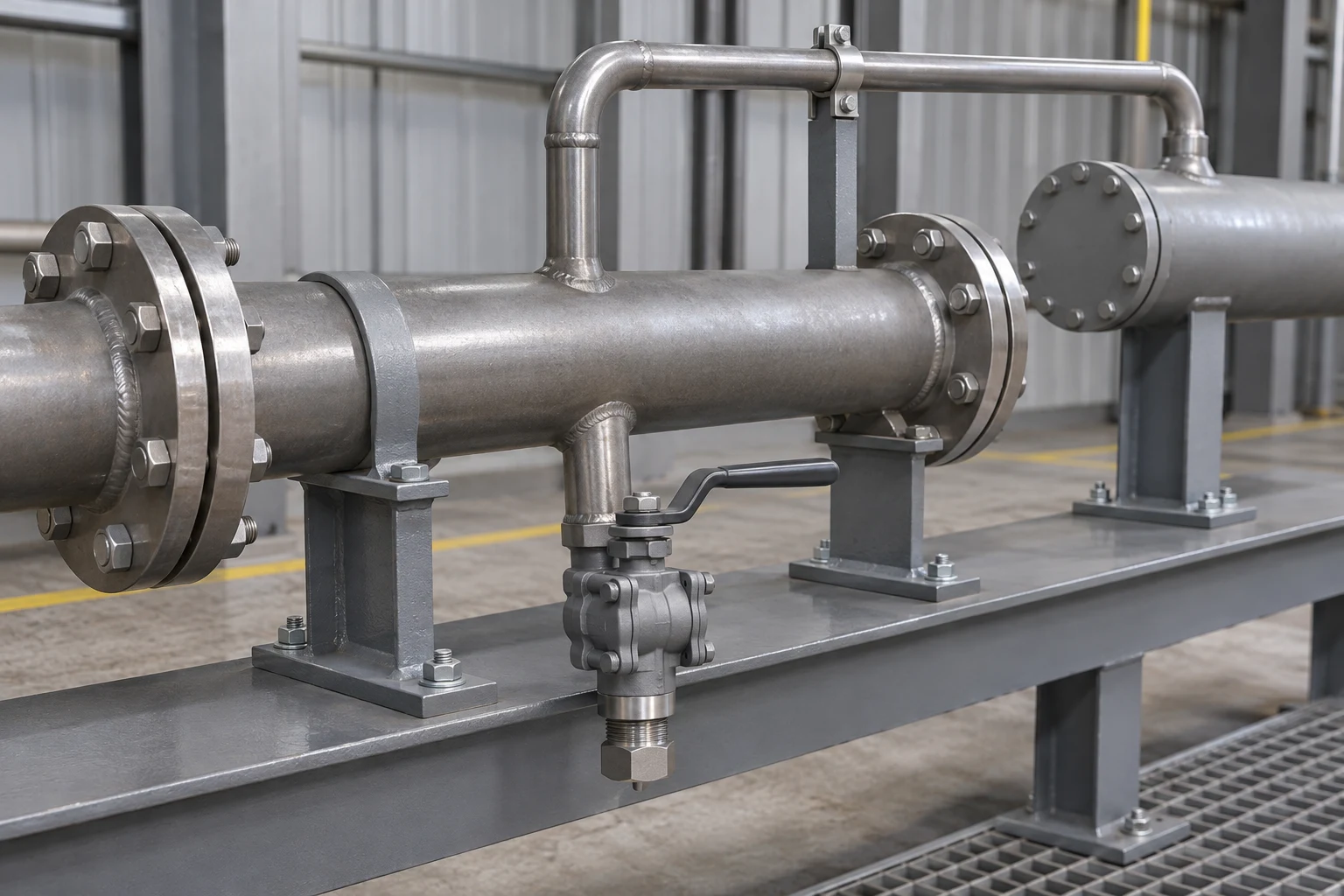
- Drain valve body: match the branch to its parent line.
- Valve handle: record the visible direction separately.
- Threaded end fitting: have maintenance verify the specified cap.
- Upper connection pipe: verify the system it leads into.
Trace each branch from its origin
Where drains cluster near the floor, the outlet alone may not identify the equipment. Start from the parent line verified by operations and follow the visible branch from a safe position. Separate what is visible from what has actually been traced where lines cross. Agree on safe access and verification before reaching or moving behind piping.
A high vent can overlap another outlet in the view from below. Do not mark obscured parts as checked. Revisit from an authorized approach once safe conditions are in place. Include the parent line and branch direction in photos so others can locate the same assembly.
Even when the equipment and handle tag match, check the work list for the actual branch. Where several outlets were serviced, maintenance and operations may identify different points. Use a fixed landmark or a change in pipe direction to locate the same branch. Hold the check and reconcile the list with the field if the teams point to different places.
Identify where caps and plugs belong
A cap generally covers an outer end while a plug fits into an opening. Use the actual connection and restoration list to identify the specified part. Maintenance verifies the fitted component. Similar hex shapes can conceal different fittings, so record which connection needs review.
A capped point does not call for turning it by hand during a round. Report apparent misalignment, damage, wetness, or suspected leakage separately from the normal observation point. Checking tightness or opening the fitting requires safe system conditions and an authorized procedure. Report suspected leakage from a safe location without approaching for a photo or manipulation.
An apparent closure may have been fitted temporarily to keep debris out, or it may be part of a permanent connection. Do not decide its function by appearance alone. Identify what was installed for the job and what belongs in service. Assign removal of any confirmed temporary item as a separate task.
Handover sequence
| Stage | Owner | Decision or check | Record |
|---|---|---|---|
| Identify branch | Operations | Trace the serviced branch from its parent line | Location and scope |
| Verify required state | Operations and maintenance | Confirm intended end configuration and destination | Configuration and destination |
| Observe position | Operator | Record visible handle direction | Position and observation limits |
| Verify fitting | Maintenance | Check specified fitting and temporary removal separately | Restored part and remaining connection |
| Handle open items | Operations and maintenance | Report suspected leaks or unverified points under procedure | Location and verification conditions |
| Hand over for restart | Operations | Separate verified results from restrictions | Status needed for restart decision |
Distinguish discharge routing from closure restoration
Check the discharge destination separately from the end condition. A branch used with a temporary hose and one permanently routed to a recovery line require different checks. Similar directions in a drawing do not establish a common destination. Operations verifies the actual destination and required state, and maintenance reports restoration of the parts it worked on.
A completed branch and one still prepared for later work can share an area. Restoring a cap on the completed point does not imply closing the other. Confirm the purpose and removal conditions of a temporary connection left in place, and record who took it over. Reconcile each branch before operating or removing anything.
Do not add a cap to a connection routed into a closed discharge system merely to stop flow. If ventilation or discharge is part of the design, closing it can affect equipment function. When the required state is unclear, report the actual connection to operations for review with the equipment team. Keep the check open meanwhile.
Match the checks performed by operations and maintenance
Maintenance reports removed or replaced components and the work completion scope. Operations verifies normal valve positions and restart conditions. A report that a cap was installed is separate from valve lineup verification. Record who checked each part so one sign-off does not obscure the other.
If access conditions are incomplete, record only what is visible from outside. Leave high or hidden end fittings unverified. Agree when they can safely be checked and communicate which restart checks remain open. Identify the limits for the incoming shift so it does not open anything simply to resolve the record.
Even when completion is reported for the whole job, track each drain and vent individually. Valve position may be checked while the end is obscured, or a restored end may coexist with another temporary connection. Separate statuses so follow-up can focus on open points. Reconcile the list and field before restart when they differ.
Leave a handover record of visible findings
The reader needs the valve location and observation face. Link the parent line, branch direction, expected end state and visible condition. Distinguish the visible handle direction from the verified valve state. If a close photo is unsafe, describe the obstruction from a safe position. Do not enter a suspected discharge path for a photo. If the handle and end are in separate pictures, label the branch in each.
Before handover, identify which checks remain. Finding a missing fitting and tracing a discharge destination require different work. If a temporary connection remains for another job, identify who verifies its conditions. When an item is resolved, link the field location and finding to the original record.
Article 257 of the occupational safety rules addresses leak prevention at specified joints on chemical equipment and piping. Article 258 addresses indication of opening and closing directions to prevent misoperation. Article 277 applies pre-use checks in the cases stated. Determine each verification from the actual equipment configuration and work scope.
Distinguish a missing fitting from an unclear purpose
If an outlet looks open but the work list does not establish its required state, identify the system and branch with operations before calling it missing. Record what appears open and leave the intended cap or connection to be verified. Distinguish locating a fitting from confirming that it belongs at that point.
Where multiple fittings look the same size, identify where each was removed. Similar appearance does not establish matching connection or service conditions. Fitting an unidentified part temporarily can be mistaken for completed restoration. Communicate who will verify the part and keep the item open until confirmation.
If staining appears on a support or floor beneath a branch, do not speculate about when it formed. Record its location and extent. Report a changing condition or suspected leak from a safe position. Do not touch or smell the material to identify it. The response team verifies the system and decides how to handle remaining traces.
Do not remove insulation or a guard just to expose a restoration point. Ask maintenance what work was done and locate the unresolved check on the list. Until safe verification is arranged, do not infer complete restoration from visible fittings. Tell the next shift both what is hidden and what conditions are needed for a check.
Reconcile restoration across concurrent jobs at handover
Maintenance and preparation for another job on the same parent line can change which branches are restored. A general message about a change is insufficient for the incoming shift. List branches already changed and those still awaiting field verification. After operations and maintenance agree the required state, communicate the affected scope to each crew.
When temporary lines cross several areas, removing one end can leave the other in place. Confirm which branch and connection were addressed in a removal report. Separately record any remaining line whose purpose or release conditions are unclear. Do not pull or open it to trace the far end.
Keep before and after photos distinct for the incoming shift. A consistent viewpoint helps compare changes. If the viewpoint differs, note it so an obscured fitting is not mistaken for a missing one. Without photos, a written branch direction and observation point can still guide a follow-up.
Before closing the job, review each open item. Identify whether it concerns valve position, a temporary connection, an end fitting, or a discharge destination. Record the location and access conditions for the next check. Where a restart decision is pending, tell operations exactly what verification remains.