Reducing dropped tool and material exposure during elevated plant maintenance
Before elevated maintenance, identify dropped-object paths and coordinate work above and below. Check tethers, staging and the lower boundary separately.
Stage only what is needed for each step
Before working on an elevated platform, match what goes up to the work sequence. Separate tools needed immediately, parts for later, and removed items going down. Loose items mixed in one pouch can lead people to set things on an edge while searching. Arrange a secure storage point inside the platform first.
Even briefly used items need a pickup and return location. Tight work areas can tempt people to rest tools on rails or pipework. Keep those points out of staging and use a closable container or designated storage. Check available space above and the boundary below before sending up extra items.
Distinguish existing items from those brought for this job. Do not use or remove an unidentified tool on assumption. Knowing the owner and storage point helps account for items at the end. Coordinate delivery and removal if multiple crews use the platform.
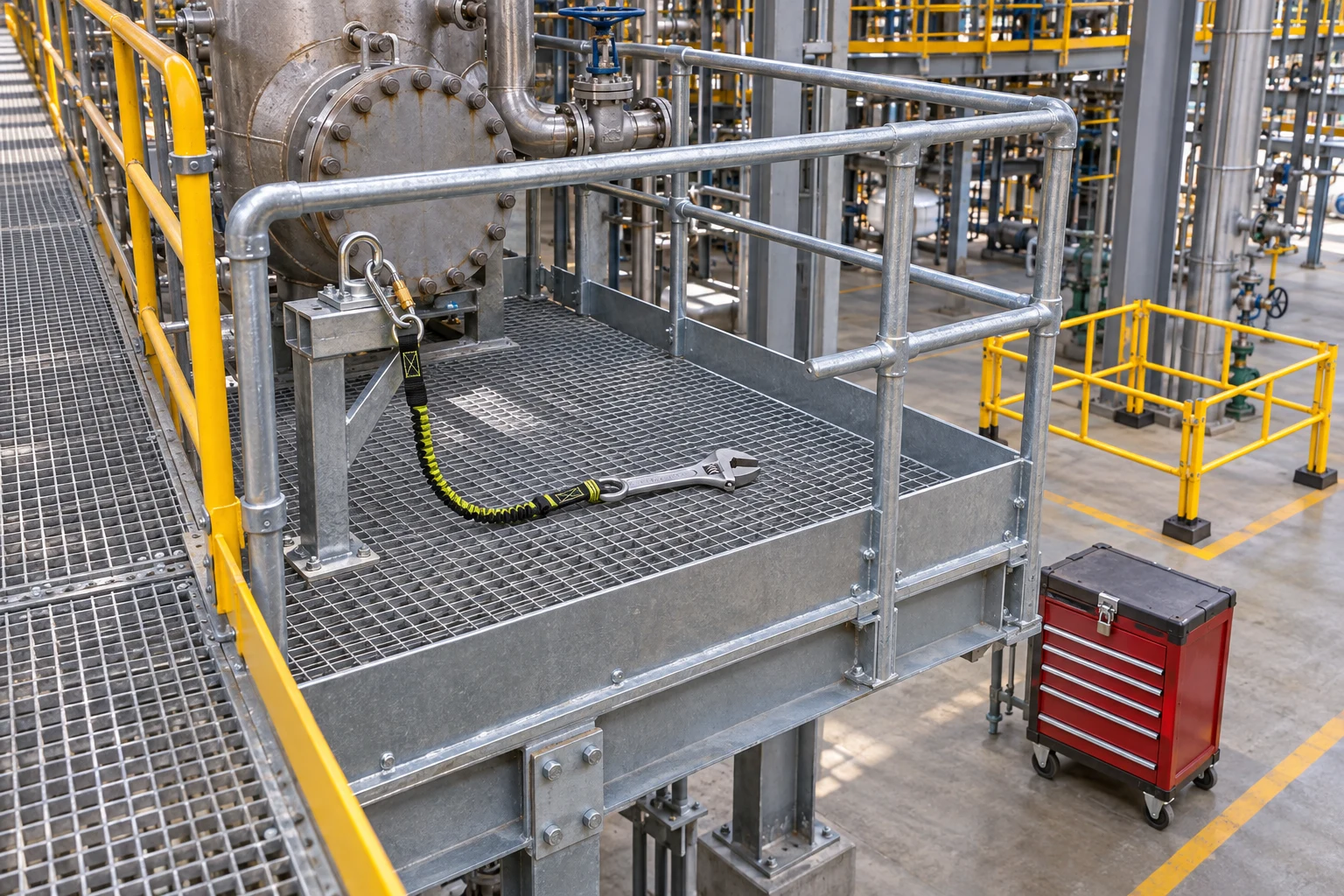
- Tool anchor: verify its intended use with the tool and tether.
- Tether and tool: check connections and visible damage before work.
- Toe board: separately check for remaining floor gaps or openings.
- Lower barrier: check approaches from adjoining routes.
Match the tool tether and attachment points
Where tools are tethered, verify the tool attachment, tether and anchor as a system. A point that accepts a clip is not necessarily suitable. Match equipment conditions and expected movement before work. Check whether a body attachment is suitable for the particular tool and system.
Personal fall-protection connections and tool attachments have separate purposes. Do not substitute one for the other because an unused ring is present. Check whether the tether can catch on equipment or interfere with work. If a connection is unverified, resolve it before taking the tool beyond the platform.
If wear is visible or the connector lock is unclear, secure the tool in storage first. A tether that is present may still need its connection checked. Do not knot a damaged tether as a temporary repair. Check the replacement together with the tool and anchor.
Control small parts and removed materials
Before loosening a bolt or washer, check where it could fall through gaps. A toe board can leave gaps or work openings elsewhere. Plan where removed parts will be received and stored so they cannot roll. If a near drop reveals a path, reassess staging and the boundary before releasing another part.
Check whether the latch is engaged before moving a closed-looking toolbox. A spill during transfer can affect the area below. Choose appropriate containment and handling before moving loose parts. Set the opening point away from edges and gaps.
Removed covers or piping parts may need different storage from hand tools. Without a receiving point, someone may hold an item while waiting and lean it against a rail. Confirm the receiving point and onward transfer before removal. Stop and review handling if weight or shape differs from the plan.
Handover sequence
| Stage | Owner | Decision or check | Record |
|---|---|---|---|
| Plan sequence | Work crew | Separate incoming tools and removed parts | Items and staging |
| Verify connections | Work crew | Match tools, tethers, anchors and storage | Intended use and replacements |
| Set boundary | Work crew and operations | Review lower and adjacent approaches | Boundary and detour |
| Coordinate levels | Work and ground crews | Sequence tool transfer and other work | Start and stop points |
| Respond to change or drop | Work crew and operations | Stop and review boundary and residual exposure | Change point and open checks |
| Clear and reopen | Work and ground crews | Separate cleanup from passage release | Release and remaining restrictions |
Set the boundary below and along adjacent approaches
People below may not know which platform is active. Review the area directly beneath, openings between levels, possible deflections from equipment, and side approaches. Define the boundary for the job and layout. Check where people first see it from the lower level.
Where routine rounds normally pass below, coordinate a detour or timing before work. A barrier on one route can leave another doorway open. Identify which approaches stay closed and which remain available. Operations reviews the evacuation route if emergency access is affected.
A move to the far end of a platform can leave the exclusion area aligned with the old point. Do not assume the ground crew noticed the shift. Communicate the next location and confirm the boundary before releasing or moving items. Stop if the new boundary cannot be verified.
Sequence work when crews overlap vertically
Dismantling above and inspection below may overlap. Agree the sequence and confirm the lower area is clear before starting overhead work. Schedules set by different shifts may no longer match after a delay. Repeat the confirmed state for starts, stops, and reopening.
Do not open passage below solely because a tool has been set down. Verify the condition of parts being removed and items remaining on the platform. Tell both crews when any temporarily opened access will close again. Confirm passage is complete before overhead work resumes.
If an item drops, stop work above and below and report it under site procedure even if nobody was struck. Do not enter the exclusion area to retrieve it. Report the drop point and work location so further exposure can be reviewed first. After recovery, verify remaining items, the lower boundary and restart separately.
Verify cleanup and reopening separately
At completion, account for tools and removed parts against the storage points. If a small fastener is missing, keep the boundary and arrange a safe check with the crew. Do not lean outside the platform to search. Record the last known point and result so another crew does not repeat an unsafe search.
Even when hand tools are removed, temporary storage or material awaiting transfer can remain. Tell the ground crew which platform was cleared and confirm where passage can reopen. If items remain, identify the continuing boundary and who will check it next.
Article 14 of the occupational safety rules addresses measures where falling objects can endanger workers. Choose controls for the actual job and layout. Tether use still leaves staging and lower-level access to address. Toe boards and toolboxes have distinct roles, so check attachments, storage and passage together.
Check for new exposure when the work changes
Switching to a longer tool can change turning space and tether routing. Check where the tool extends past the rail and where it could catch adjacent equipment. Verify the anchor and storage point before changing tools and communicate any changed exposure below.
A change in the receiving crew or cleanup timing can leave items on a platform longer than planned. Set storage and access responsibility until the next step. Secure open containers and staged material before leaving the area unattended.
When the ground crew changes shifts, confirm which overhead work is still active. One platform may be clear while material transfer remains on another level. Communicate status and restrictions by level and retain the signs until the team responsible for release verifies conditions.
Keep receiving and staging positions clear during transfer
Before tools arrive above, clear a place where the receiving worker can put them down. Separate the handling path from waiting positions. Stop sending items if there is no receiving space. Confirm who is exposed to a possible drop and use the planned transfer method.
Small parts may sit near a lid or handle when a container is opened. Open it at a stable position inside the platform, away from the rail. Return items before the next move. When several people share a container, have the receiving person verify its closure.
If a removed item's shape differs from the plan, reassess containment and securing. Long parts can project and contact equipment during transfer. The receiving crew separates its standing point from the set-down point. Repeat the sequence before moving the item.
Check gaps between platforms and equipment
Grating can support workers while allowing small fasteners to pass through. Check gaps beside the equipment separately. Verify suitable temporary protection and securing so a loose cover cannot become a dropped object. Review effects on both levels before blocking a walkway or platform.
A continuous toe board on one side can coexist with work openings or changes in level elsewhere. Recheck the floor and routes beneath a new work position. Tell the ground crew if the exposure changes, and review staging and sequence. Do not leave the platform to inspect a hidden opening.
An item may be deflected sideways by piping or structure even if the area directly below is empty. Consider those paths when setting boundaries. Do not reduce the boundary by eye or test by dropping objects. Confirm visibility from other levels and a shared understanding of the location names.
Stop before resolving a snag or tangled tether
Do not yank a tether caught on equipment or tangled with another tool. The tool can slip or nearby parts can move. Stop and determine whether the tool can be put in a secure position. Arrange safe resolution and communicate whether the boundary must remain closed.
A previous tether left on the platform can obstruct passage or catch another tool. Return unused equipment to storage and identify connections that must remain. Verify that the tool is secured before disconnecting it. Pause to sort out any confusing arrangement.
Verify each level before releasing restrictions
Tools or small parts can remain for inspection after maintenance is complete. Tell the ground crew which work and level are finished. Verify separately whether personnel and items are clear. Where another job is planned, distinguish the current reopening from the next closure.