Identifying burn exposure around steam traps and condensate outlets
Check hot contact points separately from the paths of condensate or steam around a trap.
Start with where people stand
When a steam trap sits beside a normal route, its location alone does not define exposure. Include the places where workers turn to read gauges, put down tools, or step aside for others. Identifying where people come close to the piping helps the crew discuss contact and discharge exposure before work.
A low trap may be out of sight until someone crouches. Include sweeping beneath equipment or picking up materials. Record the direction and task that brings a worker near it. Distinguish passing through from work that keeps a person in the area.
Large insulated steam lines can draw attention away from small branches. From a safe point, see which exposed parts of the trap or connections sit near the route. A dry surface and absence of visible vapour do not establish that it is cool. Leave any required check to equipment staff instead of touching it.
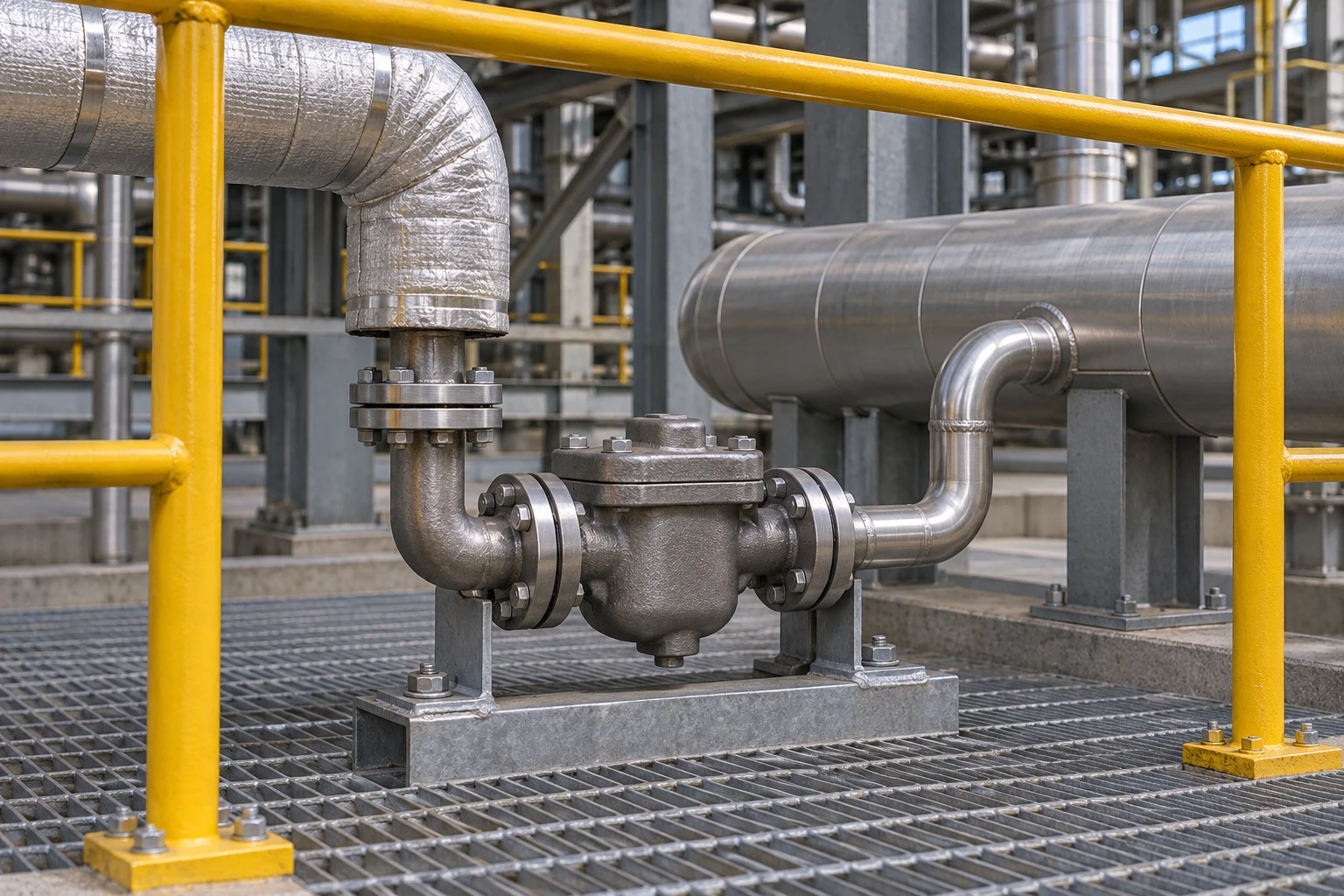
- Insulated inlet: locate where insulation ends.
- Trap body: observe its visible condition from safety.
- Return connection: verify the system it leads into.
- Guard rail: check directions of approach.
Distinguish contact from discharge exposure
Review contact with hot surfaces separately from the path of discharged condensate or steam. A guard on one side can leave exposure along a side route or below. Confirm the actual discharge route with operations before assessing approaches. Do not stand in front of an outlet to see whether it discharges.
A low outlet can direct water onto a walking surface. Do not infer temperature or fluid type from a wet floor. Report the wet area and any discharge point separately. Arrange traffic control and equipment review from safety before approaching to clean up.
Discharge striking a wall or pipe can affect an unexpected direction. A front-only boundary can leave side approaches exposed. Do not approach suspected discharge to measure its reach. Report the observed direction and approaches to be restricted from a safe position.
Identify closed return and open discharge points
A trap connected to closed condensate return and one routed to an open discharge require different checks. If routing is unclear, distinguish the visible span from obscured portions. Have operations verify the destination and distinguish normal conditions from temporary work arrangements.
A connected return line can still have changes at a receiver vent or remote outlet. Keep local and remote observations separate and verify whether they belong to the same system. Do not attribute another device's discharge to this trap without tracing the route.
Temporary hoses or collection arrangements can change the normal route. The work crew coordinates passage around movable equipment. Do not handle a hose end or move a receiver toward a suspected discharge to check it. Report the location and current access status if the setup differs from the plan.
Handover sequence
| Stage | Owner | Decision or check | Record |
|---|---|---|---|
| Locate people | Operations and crew | Identify standing and crouching positions | Approach and task |
| Separate exposures | Operations | Review contact and discharge separately | Contact and discharge points |
| Verify route | Operations and equipment staff | Check closed return and open outlet points | Destination and obscured spans |
| Report change | Round checker | Hold approach and report observations | Location and operating state |
| Coordinate access | Operations and crew | Align detours and concurrent work | Boundary and sequence |
| Recheck | Operations and equipment staff | Separate restoration and access release | Check conditions and restrictions |
Do not diagnose a trap by visible vapour alone
Hot condensate can partly flash as pressure falls. A visible plume alone cannot distinguish flash steam from leaking live steam. Record the time, point and change observed. Equipment staff diagnose the trap using methods appropriate to the operating conditions and design.
Surfaces or retained condensate can remain hot without visible vapour. If told the equipment is stopped, ask what was stopped and whether access conditions were verified. Do not touch or loosen connections to check for retained water. Confirm the safe state and conditions separately before intervention.
If noise increases or a pipe appears to move, report the observation without assigning a cause. Note the operating activity and whether nearby equipment was also moving. Do not press an ear or hand to the line. Report from a safe position and agree whether access needs to be restricted.

Coordinate nearby work with discharge exposure
A neighboring maintenance crew can create a new waiting point by staging a toolbox near a trap. Operations and the crew should review when and where people stand. Coordinate controls and sequence if work overlaps changing operation. Record whether passage depends on removing the staged items.
Closing one route can send people around the opposite side. Check whether the detour brings them closer to another hot line or outlet. Communicate the route from the actual approaches. If no suitable detour exists, coordinate separate access times.
Describing a restriction as housekeeping alone can lead the next shift to reopen after the floor dries. Identify the equipment, observed direction, and whether cleanup or equipment checks remain. Agree who determines release and which approach signs change.
Include operating conditions when checking corrective work
After insulation or a barrier is restored, check whether the discharge arrangement also changed. Record the protective work and the conditions under which the area was revisited. Review access from the normal route and agree whether restrictions remain until safe access is verified.
Distinguish trap replacement from restoration of the condensate route. A temporary outlet can still affect where people may stand even with a new trap. Reconcile the work scope and field state, and hand over restrictions at unverified points.
The US Department of Energy steam survey guide explains that flash steam can appear around traps and recovery systems. Equipment staff assess trap condition alongside operating conditions even when discharges look similar. Define burn exposure and access restrictions for the actual piping, operation and job.
Compare access before and after startup
A crew inspecting during shutdown and a crew checking after startup may see different conditions. Separate the clear path observed while stopped from access conditions during operation. Ask whether exposed joints face a work position or whether a normally unused point is part of a temporary discharge route. Label shutdown photos accordingly.
If no discharge was directly observed, identify who checked what and from where. Distinguish visible piping from a hidden return connection. Confirm the same system and operating state before using another observation. Keep the item open when it cannot be verified safely.
Startup can draw extra workers around the system. If a crew intends to wait beside a valve, agree on a different location with operations if needed. Check both expected discharge exposure and whether the group blocks passage. Move to the agreed position and confirm communication.
Review protective measures by component
Distinguish thermal insulation from a barrier that separates access. Do not assume a small exposed connection is protected by nearby insulation. Work can still bring hands beyond a barrier. Have equipment staff and the crew review body position and tool movement against the control.
Do not rewrap loose temporary insulation on operating piping. Locate the branch and report any access concern. Equipment staff determine safe conditions and restoration. Distinguish restored insulation from any newly protected span in the result.
If a barrier is moved, confirm the reason and available path. Distinguish a temporary opening for equipment from a lasting boundary change. Operations verifies the arrangement after work. Communicate the current boundary so an old photo does not direct the next shift the wrong way.
Report the information needed for a suspected discharge
If apparent vapour suddenly appears by a route, warn people approaching it. Do not move closer when the shape changes or disappears. Tell operations the equipment vicinity and direction from your viewpoint. Identify approaches for control from safety and await further action.
Keep reports of a wet floor and observed hot discharge distinct. Separate direct observations from information received. Record the time and operating state if known. A dry floor does not remove another finding, so track which items the response team verified.
If the discharge direction was initially misidentified, retain the distinction between the original viewpoint and the route confirmed by operations. Communicate a revised boundary to affected approaches. Have the receiving crew read back the location so people are not directed to the wrong equipment.
Leave specific follow-up locations for the next shift
Describe remaining restrictions from the actual approaches. Distinguish the trap, return line and remote outlet so other crews can recognize conflicts with their routes. Identify cleared and unverified spans and who owns follow-up.
Before reopening passage, check that maintenance completion and field verification refer to the same conditions. Distinguish checks made under a different operating state. Reopening passage does not authorize hands-on work. Match the field signs to current access status.