Maintenance handover after finding a pump seal support system abnormality
Report wet traces and indications separately and verify access and maintenance restart conditions.
Wetness beside a pump
A maintenance crew approaching a pump sees a wet patch below an auxiliary tubing connection. Familiarity may tempt someone to dismiss it as condensate, while its location may prompt another person to call it a seal leak. Both conclusions combine observation and cause. Stop at a safe position and tell operations where the trace is and which work is affected.
Depending on the seal arrangement, the support system may provide cooling, lubrication or control of fluid conditions around the seal. A quiet pump or a reservoir in its normal location does not establish that the support system is healthy. Distinguish visible changes at the reservoir, tubing or instrument so operations can identify the system. Designs vary, so avoid assuming that an unfamiliar unit works like a familiar one.
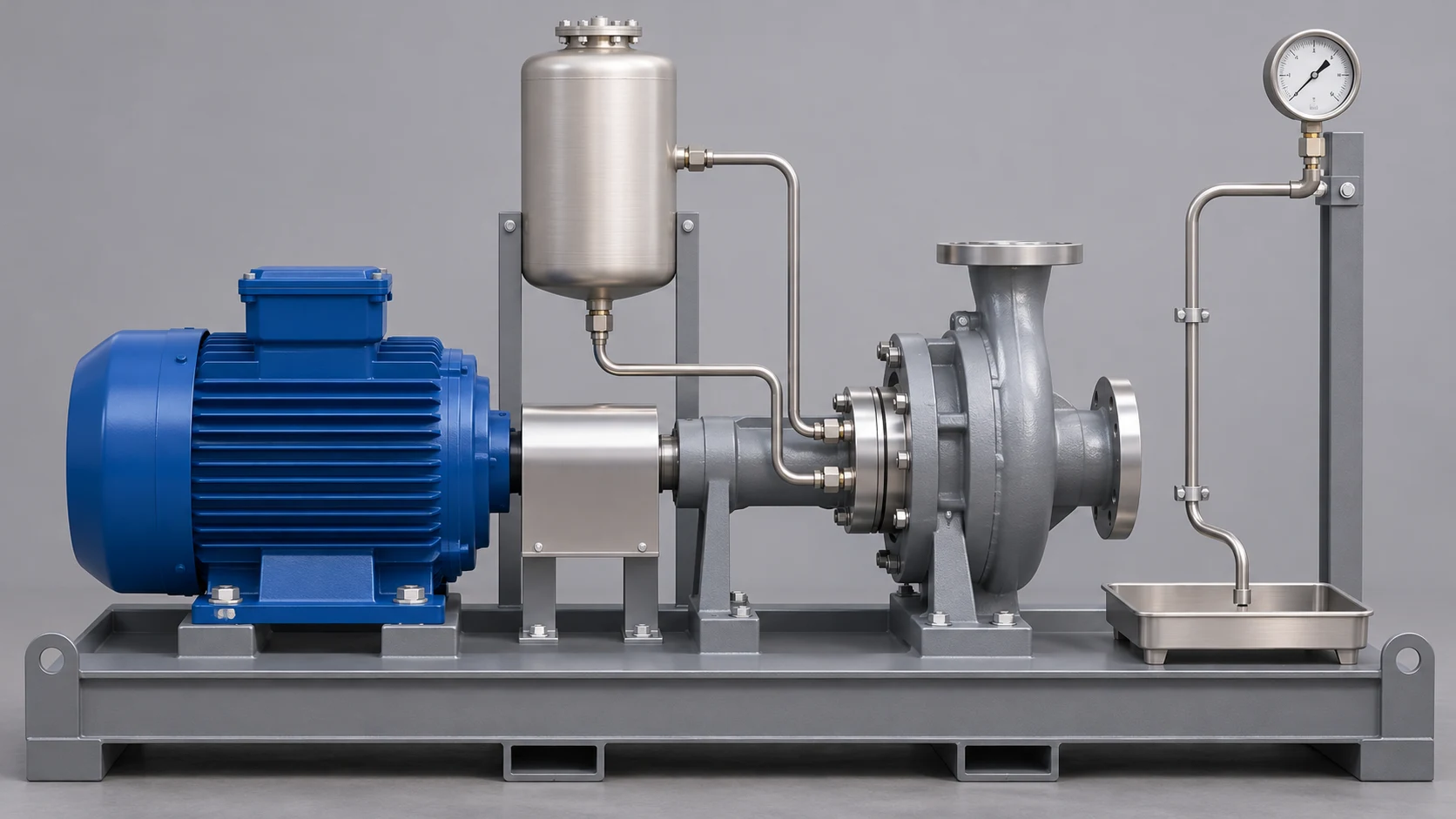
- Motor casing: Distinguish the motor side from the seal support side in the report.
- Auxiliary reservoir: Locate visible wetness on the reservoir and its connections from a safe distance.
- Local pressure gauge: Report readable indications and unreadable items separately from an authorized location.
- Drip tray: Record where liquid is visible and refer identification and cause to operations.
Do not follow the trace into the area
A wet trace leading under equipment is no reason to follow it. When the cause and fluid are unknown, the floor may be slippery and a release could develop elsewhere along the tubing. Do not lean close to smell or inspect the equipment. Report what can be seen from an authorized position and state what could not safely be checked. If there is a suspected immediate hazard, leave and notify others under site emergency procedures.
Other crews may already be in the aisle or moving materials while the abnormality is reported. Tell area control what access restrictions are known and which tasks are immediately affected. Follow site procedures for barriers and alternate routes. A small visible patch does not establish the full affected area. Do not redirect people past it before clearance, and identify a waiting location after stopping work.
Locate the component and its side
Where several pumps are close together, “the tubing beside the pump” is ambiguous. Give the readable pump reference, reservoir location and viewing direction together. Fixed landmarks such as the pump side, auxiliary tubing side or underside of the reservoir narrow the search. If the label is obscured, say so and use a walkway or nearby structure visible from safety.
Where a trace is visible may differ from where fluid is escaping. Distinguish a trail from the reservoir to the floor, wetness confined to a joint and liquid found only on the floor. Record if the direction of view prevents checking an upward trail. Do not wipe or feel a connection to locate the origin. Pass information operations can use to plan the next check without touching equipment.
Handover sequence
| Stage | Owner | Decision or check | Record |
|---|---|---|---|
| Observe | Crew | Check visible changes from an authorized position | Location and time |
| Hold | Work lead | Stop affected work and approach | Task and crew |
| Identify | Crew | Match pump reference and viewing direction | Reference and face |
| Report | Operations | Receive indications and observations | Open items |
| Handover | Shift crews | Confirm work and access limits separately | Waiting point and contact |
| Release check | Work lead | Verify isolation, permit and access | Authorized scope |
How should indications and field observations be separated?
If an indication is visible from an authorized position, report what was read and from where. Mark it unreadable if glare or distance prevents a reliable reading. Do not infer the cause of a pressure or flow abnormality by combining a single display and a wet patch. Describe floor traces, joint wetness and access limitations separately so operations can compare them with the indication.
When recording an update from the control room, include its source and time. Keep firsthand observations separate from reported information so an incoming shift does not mistake it for a field reading. Comparing changes in a trace requires comparable viewing positions and times. If lighting or visibility changed, record each observation and leave the trend for operations to confirm.

Report changed conditions even under a permit
Finding an abnormality after a permit was issued means conditions may differ from those checked at authorization. Hold work and notify operations and the work lead of affected equipment and access. Follow site procedure to place people and tools safely and wait. Do not re-enter a restricted area simply to retrieve tools. Agree recovery scope and timing with the work lead first.
An external inspection permit does not extend to opening auxiliary tubing or removing an instrument to investigate the cause. Preparation and opening are different work scopes, and fluids and residual energy vary by installation. Record any additional inspection request separately and wait for isolation and authorization to be established. Distinguish the suspended task from the new request.
Separate contractor reporting from process decisions
Operations checks the support arrangement, indications, operating status and conditions for access. The maintenance crew reports where a change was seen and which job it stopped. If operations is still reviewing, record the waiting location and response status. Whether and how to operate or respond belongs to operations procedures. The crew's record should identify open questions and work impacts.
General rules on stopping machinery for maintenance and preventing hazardous leaks apply within their stated equipment and task scope. Support arrangements and readings are not universal. Similar-looking reservoirs can serve different functions. Give the equipment reference and visible location so the responsible team can match the installation to its documentation before applying equipment-specific procedures.
Carry the same status into the next shift
Record the discovery point, observed side, held job, waiting location and responding function at shift change. If conditions change, add the new observation and retain restrictions that still apply. “Pump under review” does not identify which task is held. If crews share equipment, read back the reference and confirm permitted passage separately from permission to perform maintenance.
Even after operations identifies the cause, check separately whether the permit and access restrictions have been cleared. Before restarting, reconcile isolation, safety conditions and authorized work, and communicate changed boundaries to affected crews. Confirm where tools and materials can be staged again. Separate completion of reporting from clearance to work.
Keep unresolved details visible
If another crew already cleaned the floor, or poor lighting hides the extent of a trace, record the discovery time and observation limits. If a patch appeared to be drying, distinguish that observation from a conclusion that leakage stopped. Do not select a source simply because several units are nearby. Start with fixed references and tell operations which components and directions need to be distinguished.
Where photography is permitted, record both the context and the visible trace with time and direction. A tight close-up can obscure which tubing is shown and lead to the wrong equipment. Mark an unreadable label or gauge as such. Even without photographs, record the observation point and access restriction in writing. Carry missing information as an open check instead of filling it with assumptions.
Crews may use different names for locations around a seal and its support system. If “behind the reservoir” was heard as “on the suction side,” reconcile the fixed reference and direction. Do not pass the location as confirmed until it is clear. Observe only as far as needed to describe the next check, and carry any newly identified work restrictions into the handover.
If field indications and the crew's understanding still conflict after an operations response, identify the discrepancy and request clarification. Check whether only the permit status changed or access changed as well. A usable handover lets the receiver state what work remains on hold and who will respond. If conditions change again after restart, stop and report under the same criteria.
Use photographs and records to prevent misidentification
In a row of pumps, mixing front and rear photographs can send the receiver to the wrong location. If photography is authorized from a safe position, include the walkway and fixed landmarks. Link the wet area in the detail image to its position in the wider view. Confirm the receiver understood the equipment and direction, and leave a written description that works without the images.
Access for an adjacent task can be cleared while operations is still identifying the support arrangement. If the jobs share one record, permission to use an adjacent path can be mistaken for permission to resume pump maintenance. Track area access and equipment work separately and identify each confirming function. If the access route changed, brief the crew before bringing tools back even after its permit is revalidated.
When one shift reports the observation and another receives the response, details can be split across records. Link the response to the initial entry and mark which question it resolves. Record a new trace at another location as a separate observation rather than replacing the first report. This preserves whether the initial location was corrected or two sites were actually observed. Avoid presenting another crew's report as a firsthand observation.
If another pump abnormality is reported at the same time, crews may confuse which response they received. When checking by radio or phone, read back the equipment reference and work location before confirming current conditions. For a continuing hold, identify the waiting point and responding function. If responses change repeatedly, record the change and when it applies. The crew can first account for its own task and people.
Operations may ask about reservoir orientation or the shape of a pool to locate it. Do not return into a restricted area to answer. Separate what was visible initially from what requires further inspection. If nothing more can be seen safely, tell operations and retain current work and access restrictions until a separate check is arranged.