Check and hand over fixed pump-coupling guard condition
Match the pump-motor guard to equipment records, observe its body and fixings, and distinguish external checks from maintenance access and restoration decisions.
Match the guard to its pump and motor
Establish the relationship between pump, motor and their connection before inspecting a nearby guard. Similar adjacent equipment can make colour or size unreliable identifiers. Match physical identity to the record and establish which connection the guard covers before observing its exterior.
A fixed guard prevents contact with or access to moving hazards. Distinguish a guard resting on the floor or loosely placed over equipment from one secured in its intended position. Observe its extent from a safe position without lifting it to see the rotating shaft.
Nameplates and site identification connect observations to the correct equipment. If they are obscured or unreadable, record the position and fixed landmarks for the owner to identify. Confirm equipment type and guard configuration before applying another unit’s reference photograph.
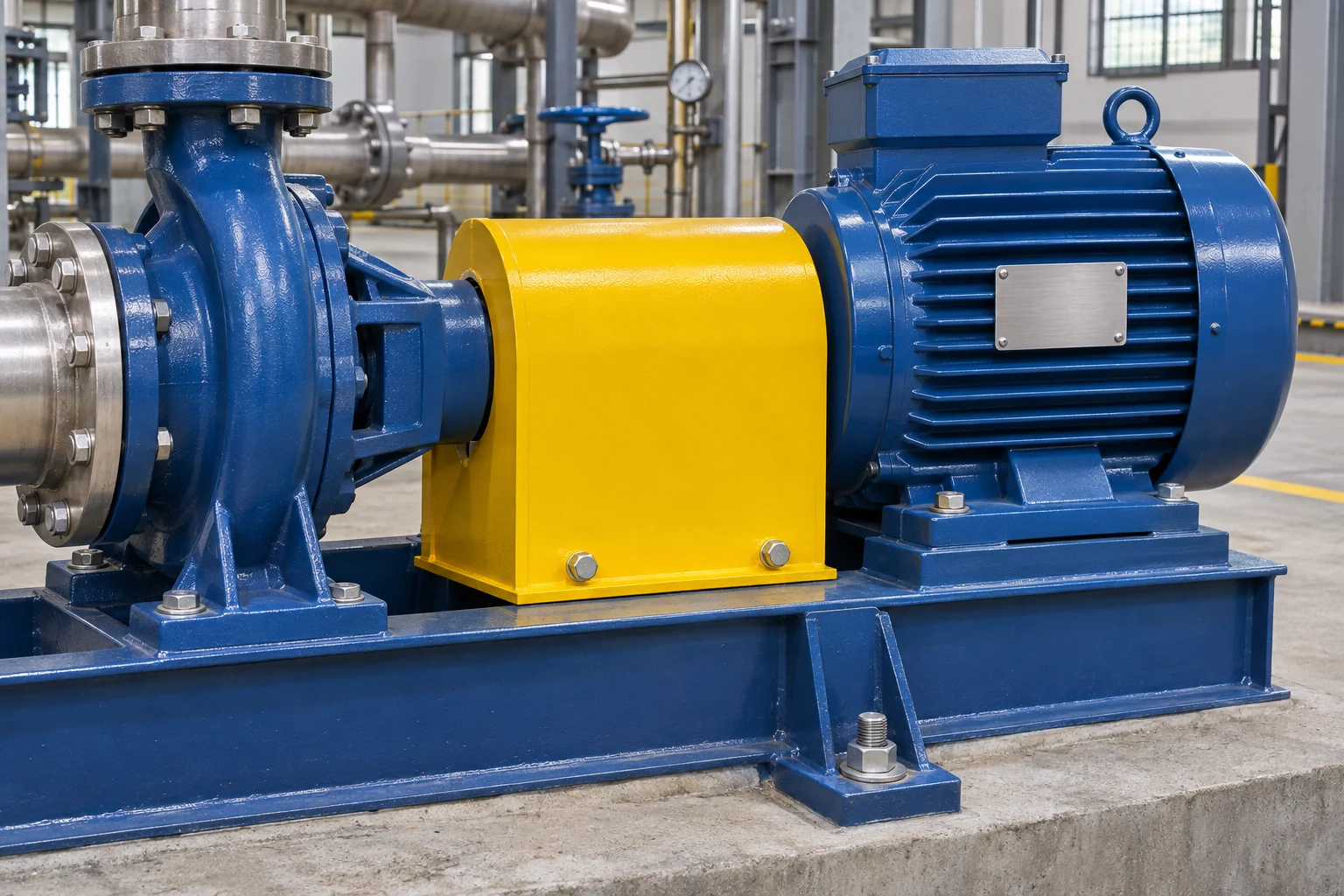
- Guard body: compare installation position and visible damage.
- Guard fastening bolt: record omissions and changes at visible fixings.
- Base fixing: identify the supported equipment and visible connection state.
- Motor nameplate: match the recorded target to the actual equipment.
Establish the scope of rotating-part protection
Article 87 of Korea’s Occupational Safety and Health Standards Rules addresses guards or fences at prime movers and rotating shafts presenting danger, including shaft keys and pins. Match the hazard to the installed protection using equipment records. A visible cover alone does not establish that every protection condition is met.
KOSHA Technical Support Regulation B-M-37-2026 addresses covers against joint or coupling separation and contact with rotating parts. It supports identifying the hazard that the pump-motor connection guard is intended to enclose. Connect observations to equipment conditions for responsible review.
Fixed guards differ from movable interlocked guards in structure and function. Do not apply another machine’s interlock test or judge this pump solely by sensor presence. Compare missing, damaged or changed components with the approved configuration and management records for the actual equipment.
Separate guard position from deformation
Observe installation position separately from surface condition. Locate apparent displacement, dents or damaged edges. Where deformation raises concern about internal clearance or contact, retain it for responsible inspection rather than inserting a hand or tool to investigate.
Include end panels and side plates in the observation. Compare unusual separation or missing components against reference information. Retain hidden areas as unverified, and do not accept opening or ventilation geometry by appearance alone. Connect design judgments to equipment-specific technical verification. Record viewing direction because the guard top and sides are different areas. Retain a hidden opposite end as a separate inspection item rather than treating one exterior photograph as verification of the whole guard.
B-M-37-2026 addresses guards suited to their purpose without creating additional hazards. Record protruding or apparently sharp damage from a safe position. Distinguish guard damage from nearby piping damage, even when both appear in one photograph, because their ownership may differ.
Handover sequence
| Stage | Owner | Decision or check | Record |
|---|---|---|---|
| Match equipment | Site and equipment owners | Pump, motor and guard correspondence | Identity and records |
| Observe body | Verifier | Position, deformation, ends, panels | Part, change, obscured area |
| Observe fixings | Verifier and equipment owner | Visible bolts, plates and base | Target, location, unknowns |
| Transition to maintenance | Authorised owner | Need for internal access or removal | Work and protective conditions |
| Check restoration | Maintenance and equipment owners | Worked parts and normal function | Scope and verification results |
| Hand over status | Owner and recipient | External findings and remaining limits | Current state and next owner |
Record visible fasteners and fixing locations
Check how the guard relates to its intended fixing points as well as where the body sits. Use visible bolts and plates to locate missing parts or changed positions. A visible bolt head does not establish adequate fastening; distinguish observed appearance from the fixing condition needing verification.
The regulation addresses secure fixing, prevention of unauthorised removal and maintainability. Avoid tightening bolts or shaking the guard as part of this observation. Locate missing or changed fasteners and refer inspection to maintenance personnel working under the appropriate conditions.
Identify what each base fixing supports. Nearby pump supports and guard fixings can be confused when reporting an issue. Locate the observation relative to a guard end or motor and describe the visible component so the responsible owner can find it and determine the required inspection. Compare visible fasteners with the equipment configuration rather than inventing an acceptable count. A fastener hidden behind another component remains unverified rather than automatically missing.

Recognise the transition from observation to maintenance
External observation differs from opening a guard or handling its fasteners. Article 92 addresses stopping equipment and preventing another person from starting it for maintenance, cleaning or inspection presenting danger. Access inside the guard requires the applicable maintenance procedure and protective conditions.
Consider the danger and stated conditions of Article 92 against the actual action. Do not group every external observation into the same task. If lifting, reaching inside or adjusting fixings becomes necessary, stop the observation and communicate the intended action and access point to the responsible owner.
Touching the guard to infer rotation or leaning close to illuminate its interior can exceed the observation scope. Refer internal checks and operating-state decisions to designated personnel under equipment procedures. Distinguish externally checked parts from requested internal checks in the record.
Compare the returned guard with the repair scope
After guard removal for maintenance, match the required returned components to the same equipment. Article 93 restricts removal or disabling, addresses repair, adjustment and replacement exceptions, and requires restoration of normal function after completion. A nearby cover or completion message alone does not verify restoration.
Establish which guard was removed and which parts were worked on. Match the body, panels, visible fasteners and supports to the scope and retain unresolved items. Separate what external photographs show from maintenance findings so appearance is not mistaken for verification of fixing strength or internal clearance.
For replaced components, have the responsible owner confirm correspondence with equipment documentation. Distinguish approved protection from temporary sheets or another machine’s guard. Do not select replacement dimensions or fabricate a substitute; receive established use conditions after the change basis and verification are connected.
Report missing or damaged parts precisely
Immediately report a missing or damaged fixed guard by equipment and part. B-M-37-2026 addresses reporting missing or failed safety devices and procedure violations. Distinguish the body, fastener or panel observed and the unverified scope before adding general impressions about the equipment.
Make the location traceable alongside equipment identification. Connect overview and detail photographs without approaching rotating hazards for a closer image. Retain areas not visible from a safe position for responsible inspection rather than expanding the observation through unsafe access.
The KOSHA Practical Guide’s pump and compressor checklist addresses damaged or missing rotating-part covers and fences and maintenance of their function. Use it as supporting material after matching the actual equipment configuration. Separate guard concerns from concurrent fluid or electrical issues for their respective inspections.
Separate visual checks from restoration decisions at handover
Communicate the equipment, protective components observed and action status. Separate externally observed parts, documented changes and maintenance restoration findings. Keep completed and unresolved items distinct, leaving each outstanding location with an owner. Separate observations made before and after subsequent maintenance. Identifying the work stage avoids mixing pre-removal and post-restoration photographs and helps the owner trace completion of outstanding checks.
The recipient matches identity to the equipment and checks current restrictions. Connect changes from previous photographs to their reasons and verification results. Do not treat an observation record as proof of all protective performance; establish the required equipment-specific checks and use conditions before continuing the assigned work.
A fixed guard combines its body and end sections with fixings that keep them positioned. Report visible omissions and changes accurately, and refer maintenance through the established procedure. Traceable identity, location and scope let the next owner continue managing protection after removal or replacement.