Check crane pendant directions, buttons, cable and storage
Match crane and pendant, check directions, buttons and cable, establish a safe operating position and signals, and return the controller to designated storage.
Match the crane and its pendant
Identify the overhead crane and the pendant controlling it. Where several cranes share an area, compare equipment identification and management information rather than relying on the pendant location. The designated operator should identify the machine, controller and work scope together.
Article 89 of the Occupational Safety and Health Standards Rules addresses checking for danger to workers before machinery starts and taking necessary measures. Connect the equipment that will move with nearby people’s positions. Resolve ambiguous or unreadable identification before starting movement.
KOSHA Technical Support Regulation (KOSHA GUIDE) B-M-34-2026 addresses designated operators and pre-work checks. Prepare under the relevant training and equipment procedures. Keep operation responsibilities clear and unknown conditions explicit instead of allowing others to press buttons to discover which machine responds.
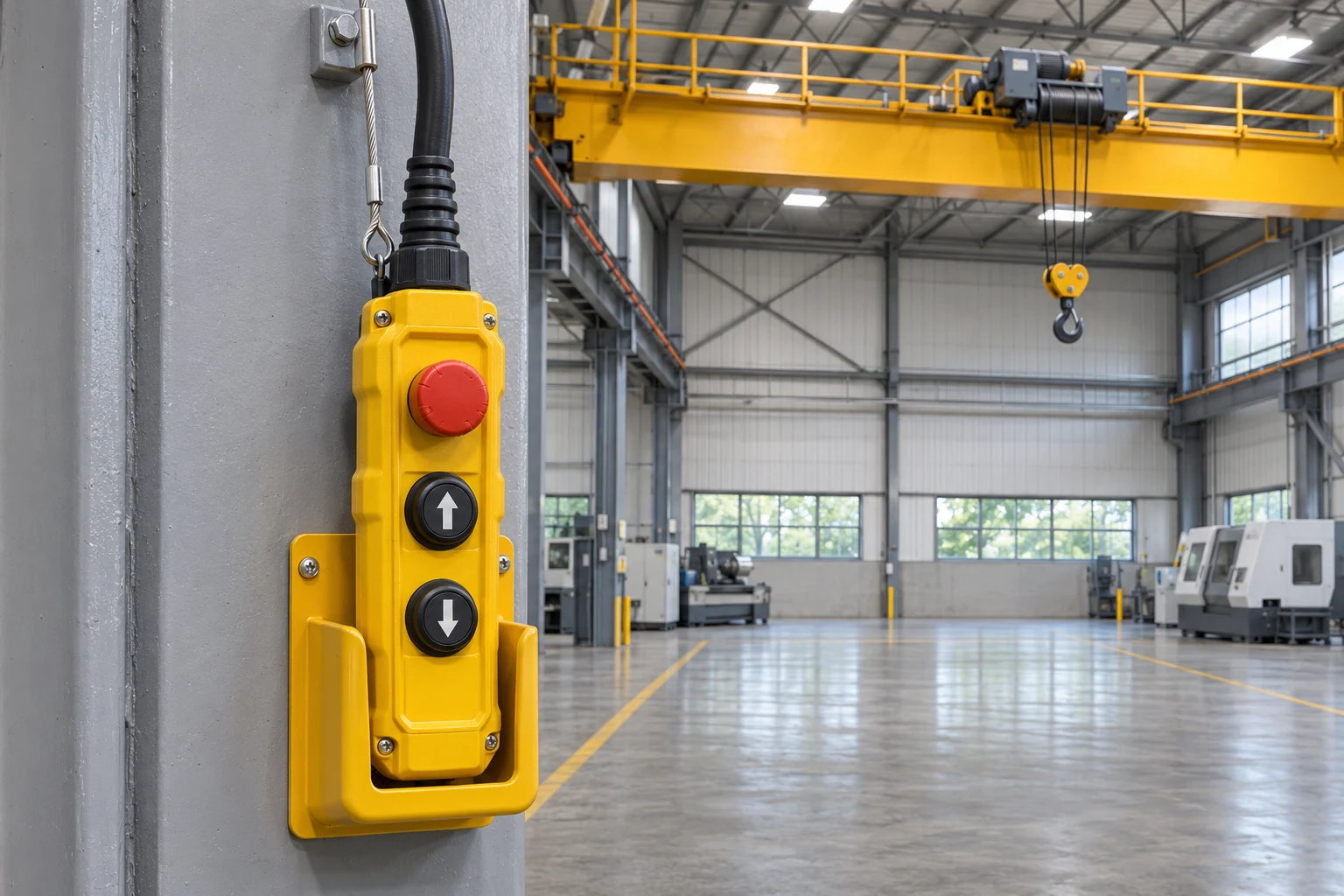
- Direction buttons: match crane indications and report worn or inconsistent markings.
- Stop button and upper controller: check damage and conditions that could cause unintended pressing, and report conditions requiring a use hold.
- Cable and support connection: distinguish twisting, strain and termination concerns for the owner.
- Designated storage: check that storage avoids button pressure and cable snagging.
Read direction indications on both controller and crane
Compare pendant button indications with the crane’s direction markings. A change in the operator’s orientation can make bodily left and right differ from machine directions. Identify commands from the equipment markings and procedures rather than memory or informal gestures.
B-M-34-2026 addresses checking control directions on the crane and pendant; KOSHA Practical Guide 65 also lists these markings for inspection. Record worn or inconsistent indications and obtain equipment-owner verification. Do not add replacement markings from memory before verification.
Check readability in the actual operating posture, not merely the presence of arrows or words. Look for reversed handling or twisted cable conditions that could cause confusion. Use the intended posture and report unclear information. Recheck the controller-to-machine relationship after markings are restored. Distinguish obstruction from worn markings, and separate the result of clearing an obstruction from a need to restore the marking itself.
Separate housing and button condition checks
Look for cracked or deformed housing and objects that obstruct or unintentionally press buttons. Record damaged buttons separately from damaged markings. Refer taped-over or improvised covers on damaged housing for equipment-owner assessment before treating the controller as ready.
B-M-34-2026 addresses pendant cable and pushbutton operation checks. Carry out required checks under equipment procedures and safe conditions. Hold use if a button fails to return or movement appears unexpected. Refer the condition to maintenance rather than fixing a button in position or opening the housing to adjust contacts.
Distinguish normal stopping, emergency stopping and maintenance isolation. The presence of an emergency-stop button does not establish maintenance readiness. For hazardous maintenance or cleaning, verify stopping and prevention of restart under Article 92 and site procedures. Separate observation responsibilities from maintenance actions in handover.
Handover sequence
| Stage | Owner | Decision or check | Record |
|---|---|---|---|
| Identify | Designated operator and site owner | Crane, controller and task match | Equipment and pendant identity |
| Condition and markings | Operator and equipment owner | Directions, buttons, housing, cable | Part, issue, unknowns |
| Position and signals | Operator and area control owner | Safe position, visibility, signals | Position and area result |
| Check operation | Designated operator | Equipment procedure and safe surroundings | Checked scope and holds |
| Hand over issues | Operator and maintenance owner | Use hold, maintenance conditions, actions | Observation, equipment, owner |
| Finish and store | Operator and recipient | Controller state, storage, open issues | Storage, limits, next check |
Check cable strain, twisting and support
Follow the safely visible cable route for kinks, twists, crushing or conditions that load the termination during handling. Compare the intended handling method and support arrangement so movement does not pull on the conductors themselves. Report identified locations and parts.
KOSHA Practical Guide 65 addresses auxiliary wire support to prevent cable twisting and excessive force. Identify the installed support arrangement and check for missing or damaged components. Treat support and cable condition as separate observations rather than assuming one establishes the other.
Do not pull hard to free a snagged cable. Maintain a safe work state and notify the operator and equipment owner of the snag and its effects. Refer wiring or support changes to competent personnel. Recheck operating space and termination condition after action.
Provide a safe operator position and movement space
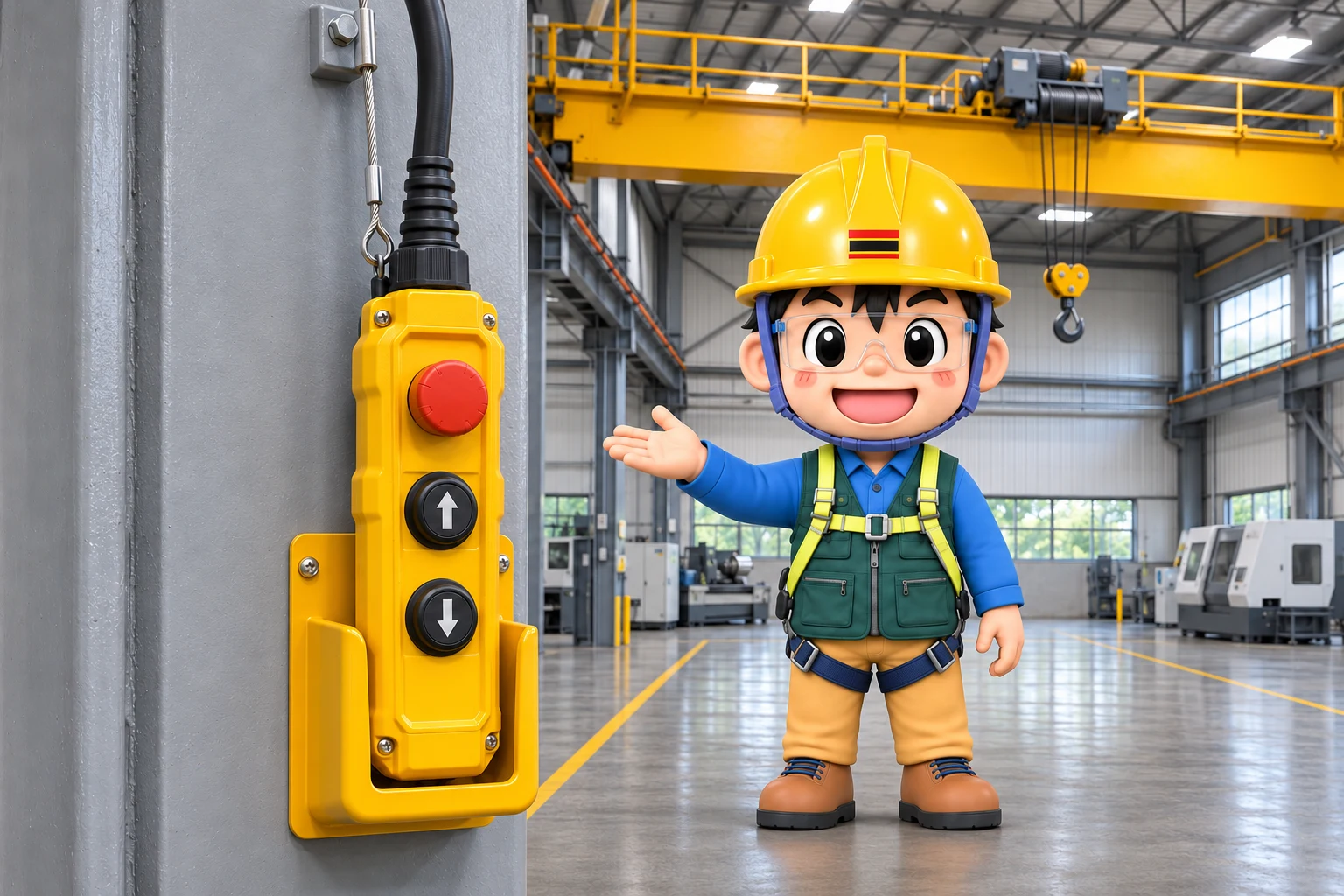
Check both visibility and safe standing and movement space. Avoid positions beneath the load or between a load and a wall. Consider obstacles and snag points when the operator steps back or changes orientation.
B-M-34-2026 addresses walking areas, clearance and avoiding operation beneath loads or between loads and walls. Connect these conditions with Article 146 measures against loads passing over workers. Coordinate observation responsibilities so attention to the pendant does not obscure awareness of loads and people.
Check the route and nearby work before changing operating position. Do not force an unsafe position merely to accommodate cable length; refer equipment and work conditions for reassessment. Hold movement when adequate visibility or space cannot be maintained, and communicate verified positions and restrictions.
Connect signals and area checks to starting movement
Article 40 addresses defined signalling methods and compliance for lifting equipment work. Confirm that operator and signaller know the agreed method and pre-start information. Resolve competing instructions or unclear messages before starting movement.
Verified buttons and directions do not establish that people and routes are clear. Connect the control owner’s area check to the operator through the agreed signals. Share stopping criteria for entry into the area or loss of visibility or communication before work.
Perform prescribed movement checks under equipment procedures and safe conditions. Continue watching people and machinery during any check. Hold operation and report unresolved direction or signal-response issues rather than repeating commands without clarification. Record what has and has not been verified.
Make pauses and abnormality handover explicit
During pauses such as slinging, establish controller status and who may resume operation. Connect the B-M-34-2026 provision on switching off control power during paused slinging to equipment procedures. Store and control the pendant so objects cannot press its buttons.
Report controller identity, affected buttons or cable parts and observed behaviour. Make the use hold clear so others do not repeatedly press buttons to reproduce a fault. Have the maintenance owner establish action scope and necessary stopping and restart-prevention arrangements. State whether the observation concerned a particular button or visible damage noticed while changing cable position. Keep an unverified fault cause open and link the use state to the maintenance request.
Match a return-to-use message to the correct crane and pendant. Identify what was checked or replaced and communicate remaining restrictions. Do not close unrelated unknowns merely because a component was replaced; reconnect them to required pre-start checks.
Store in the designated place and hand over to the next user
Finish controller-state arrangements under equipment procedures and return the pendant to its designated place. Consider direction confusion and accidental button pressing described in KOSHA Practical Guide 65. Check for contact by people or stored materials and for cable snagging on the floor or equipment.
Check that surrounding objects do not press the housing or buttons and that cable and support are not left under strain. Request clearance of an obstructed storage place rather than hanging the pendant elsewhere. Leave a state in which the next operator can identify the same crane and check readiness.
Hand over crane and pendant identity, abnormalities, actions and remaining holds. Use these fields to align equipment and condition at the site. The next operator compares records with the equipment and checks directions, buttons, cable and position against the next task before judging readiness.