Before tanker connection: match the transfer destination
Before connecting a hose, match the material, receiving equipment and connection point. Coordinate vehicle securing, grounding and attendance with physical identification.
Establish the material–destination pair before connection
Before a road tanker transfer, identify the material carried and the equipment intended to receive it as a pair. Where several connection points share a bay, convenient hose reach can easily influence the choice. Match the material, tank and line identification at the established transfer connection before preparing to connect. Pipe opening and creation of an isolation boundary remain separate controlled activities.
Article 260 of Korea's Occupational Safety and Health Standards Rules requires visible identification of the raw material and receiving equipment to prevent explosions, fires or leaks caused by incorrect feeding of chemical equipment. In practice, read that identification together with the actual connection point. Correct paperwork does not complete the check if the connection being approached leads elsewhere.
The person giving the transfer instruction and the person preparing the connection should distinguish the product identifier, receiving equipment and connection point. Do not select a destination solely by an abbreviation or the order in which vehicles arrived. Resolve differences between documents and site identification through the responsible department before connecting. Record what was matched and who confirmed it so the next person can understand the basis.
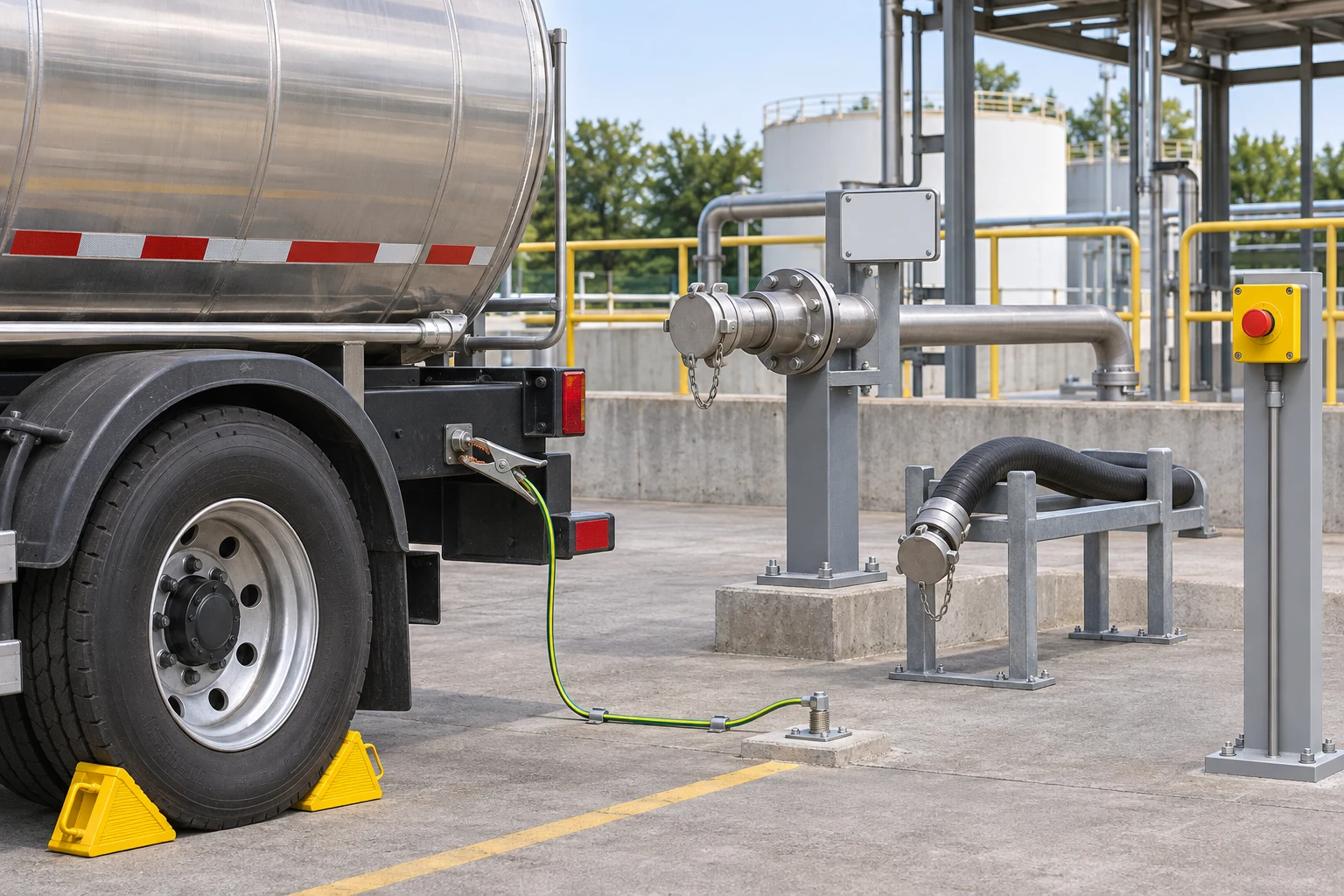
- Wheel chocks: check their actual placement and vehicle securing.
- Receiving connection and plate: match the material and destination to the connection.
- Vehicle grounding clamp: check the designated point and cable condition.
- Emergency-stop button: confirm its location and scope with the responsible person.
Prepare connections with the vehicle secured
KOSHA’s Practical Safety Guide (Other Chemical Products Manufacturing, 2023) addresses wheel chocks and the parking brake when preparing tanker loading or unloading. The driver secures the vehicle for its type and parking position; the site representative checks whether hoses and connections can be prepared with the vehicle secured. If slope or possible movement makes the securing condition uncertain, agree the parking conditions with the responsible person before preparing connections.
Check where the chocks are actually placed at the wheels, rather than merely whether they are available in storage. Parking-brake operation and chock placement are separate checks. The driver follows the procedure suitable for the vehicle and bay, while the site representative confirms readiness for connection. Choose an inspection position that keeps people away from a possible vehicle movement path.
Agree how the driver and site personnel will communicate completion of preparation. Confirmation that the vehicle is secured should not be interpreted as permission to start transfer. Use a separate start communication after identification and connection checks. If the driver changes or the vehicle must move again, reassess the changed preparation conditions rather than carrying forward the earlier confirmation.
Read the connection identification through to the destination
The mixing-prevention guidance in KOSHA’s Practical Safety Guide advises checking pipe colours or names before connecting a hose. Read the material and equipment identity alongside the colour and match it to the actual connection. If identification is obscured or faded, verify the actual point rather than inferring it from a neighbouring one. Check that the identification required by Article 260 can be read at the intended connection.
The objects to match are the vehicle outlet and the receiving connection at the site. Similar names do not by themselves establish the correct transfer route. Use the designated information and field identification to confirm the receiving tank and connected line. Resolve differences between temporary and permanent markings. Having the person interpreting the drawing point to the actual connection helps prevent agreement while looking at different locations.
A photograph can communicate a location but cannot establish whether the site has changed since it was taken. Compare earlier photographs with the current connection while relying on present identification and responsible-person confirmation. Complete identification before connecting, rather than discovering a wrong destination afterwards. Keep the task at the preparation stage until an uncertain connection has been identified.
Where identification needs renewal, distinguish a temporary confirmation from correction of the permanent marking. Agreement between the current personnel does not establish that the next worker will receive the same information. Keeping identification legible and aligned with the actual connection supports preparation for subsequent work.
- MaterialIdentifiers for this transfer
- DestinationReceiving equipment and actual connection
- VehicleParking brake and wheel chocks
- PersonnelStart, observation and stop communications
Separate mechanical fit from suitability for use
KOSHA’s Practical Safety Guide calls for matching connection specifications. Confirm that parts which appear to engage really have the same specification, using product information and the physical parts; do not force them together. Checking size or form is separate from checking the destination. A correct destination with incompatible parts is not ready, and compatible parts connected to the wrong destination do not establish acceptable transfer conditions.
Check hose and connection materials, operating conditions and inspection criteria against equipment and product information. First match the prepared component’s identification to that information. Follow the site procedure and product instructions for removing caps and making connections, and do not force a connection while leakage or pressure hazards remain unresolved. Obtain information on compatibility with the contents as well as checking visible form.
Confirm that the checked components are the ones actually used. Substituting a hose or adding a temporary connection changes the checked arrangement. Review the replacement's conditions and the destination rather than leaving an earlier tick in place. Retain enough identification in the preparation record for the next person to distinguish the actual components.
Distinguish a grounding cable from verified grounding
Article 325 requires measures to suppress or remove static electricity where the specified equipment presents a fire or explosion risk. It identifies several methods, including grounding and conductive materials; the presence of a single clamp is not a universal acceptance test. Select controls for the material and equipment, then check that the specified controls are maintained.
KOSHA’s Practical Safety Guide advises grounding the tanker body. The responsible person checks the designated vehicle connection point, clamp and cable. Assess equipment with measurement or monitoring functions against approved criteria and record both connection condition and assessment. Distinguishing the clamp position visible in a photograph from performance established by measurement or monitoring helps identify items checked only visually.
Connect the preparation check with maintenance of the condition during transfer, since vehicle movement or hose handling can change connections. Agree who stops transfer and who investigates an abnormal indication. Use the equipment’s approved resistance and flow criteria. Record the criterion’s source and the assessment against the same equipment, and defer the start decision if the criterion or object remains unclear.
Assign attendance roles before transfer starts
KOSHA’s Practical Safety Guide includes attendance by a site manager during unloading. Assign what the driver, operations representative and observer will check and which communications they will receive. The observer checks whether the connection and transfer condition can be observed from the assigned position, and agrees how any obscured area will be monitored. Before changing position during transfer, communicate who will take over the role.
For work subject to a permit, section 6.2(6) of current KOSHA GUIDE C-C-49-2026 provides the principle of matching the actual work object to the permitted object. It is technical guidance and does not automatically place every routine tanker transfer in the same permit category. Where the site's applicable procedure requires a permit, connect the physical connection checked during preparation with the permitted object.
If different people start and stop transfer, agree their communications and stop authority. Establish from the equipment procedure which functions the emergency-stop device actually stops. Manage energy and material remaining after a stop through the equipment-specific safety measures. Any functional test must follow specified conditions and assigned responsibilities rather than being improvised during transfer.
Leave a preparation record that can be handed over
Record material–destination–connection matching, vehicle securing, specified static controls, attendance and communication separately. Compare these with items required by the site risk assessment and procedure, distinguishing checked conditions from outstanding ones. When personnel change, hand over responsibility for unresolved items and the next check point. Before advancing, also check whether the object verified at the previous stage has changed.
Record the checked object and the basis for the decision rather than only a generic normal tick. Identify which connection and receiving equipment were matched, and what vehicle-securing measures were checked. Hand over unresolved items explicitly when personnel change. Manage an unresolved starting condition as awaiting resolution by the responsible person, rather than allowing a blank field to accompany a progressing job.
Do not assume the next transfer has the same destination after the current job ends. A different vehicle or product requires preparation for a new material–destination pair. Before reusing a record, compare the identifiers for this job instead of copying earlier conclusions. Linking initial identification with the final handover helps prevent the visible presence of a connected hose from being mistaken for completed preparation.
On receiving the transfer-end notification, the assigned person checks the actual transfer condition and the status of connected equipment. End notification, hose handling and permission to move the vehicle proceed when their respective procedural conditions are met. The driver receives the handover and confirms readiness to move; abnormalities found during clearing are recorded for the next transfer. If personnel change during closure, hand over remaining connections and outstanding actions.
From arrival to transfer closure
| Stage | Responsible people | Progress and decision criteria | Record |
|---|---|---|---|
| Arrival and parking | Driver and site representative | Confirm parking position and vehicle securing before connection preparation | Vehicle, location, chock/brake checks |
| Object matching | Operations and connection personnel | Proceed when material, receiving equipment and connection identification agree | Identifiers checked, verifier and discrepancies resolved |
| Connection preparation | Connection personnel and site representative | Check hose/connection conditions and specified static controls | Actual components and assessment basis |
| Start decision | Operations representative and observer | Start under the procedure when preparation and communications are ready | Start decision, observation roles and stop communication |
| During transfer | Observer and operations representative | Use the agreed stop and communication procedure if an abnormality appears | Observed condition, response and role handover |
| Closure and handover | Operations, connection personnel and driver | Confirm transfer completion and connected-equipment status before movement decision | Completion, remaining connections/actions and vehicle handover |