Hold unidentified decanted containers and restore information
Hold use when identity is lost. Connect evidence and ownership, then consider release after contents, labels and handling information have been verified.
Communicate a hold when container identity is lost
Hold use and notify the responsible handler when a decanted container’s name is unreadable or its label cannot be linked to its contents. Report its location, exterior, readable markings and whether it was in use. Filling in a name from memory can turn an assumption into apparently verified information. Link the specific container to supporting evidence before returning it to service.
Make the hold apparent to anyone who might pick up the container. Apply the site’s access and use controls, distinguish it from usable stock, and identify the verification owner and contact route. Where contents or condition are uncertain, have the responsible person determine safe management rather than relocating it casually. Leakage or deformation requires restricted access and the site’s emergency notification and response process.
Article 115(2) of the Occupational Safety and Health Act sets the warning-labelling duty for workplace containers of substances subject to safety data sheet requirements. Applicability depends on the substance and statutory scope and exceptions. Do not assume an unidentified product is exempt. Assign the hold and verification responsibility first, then assess the requirements for the identified product.
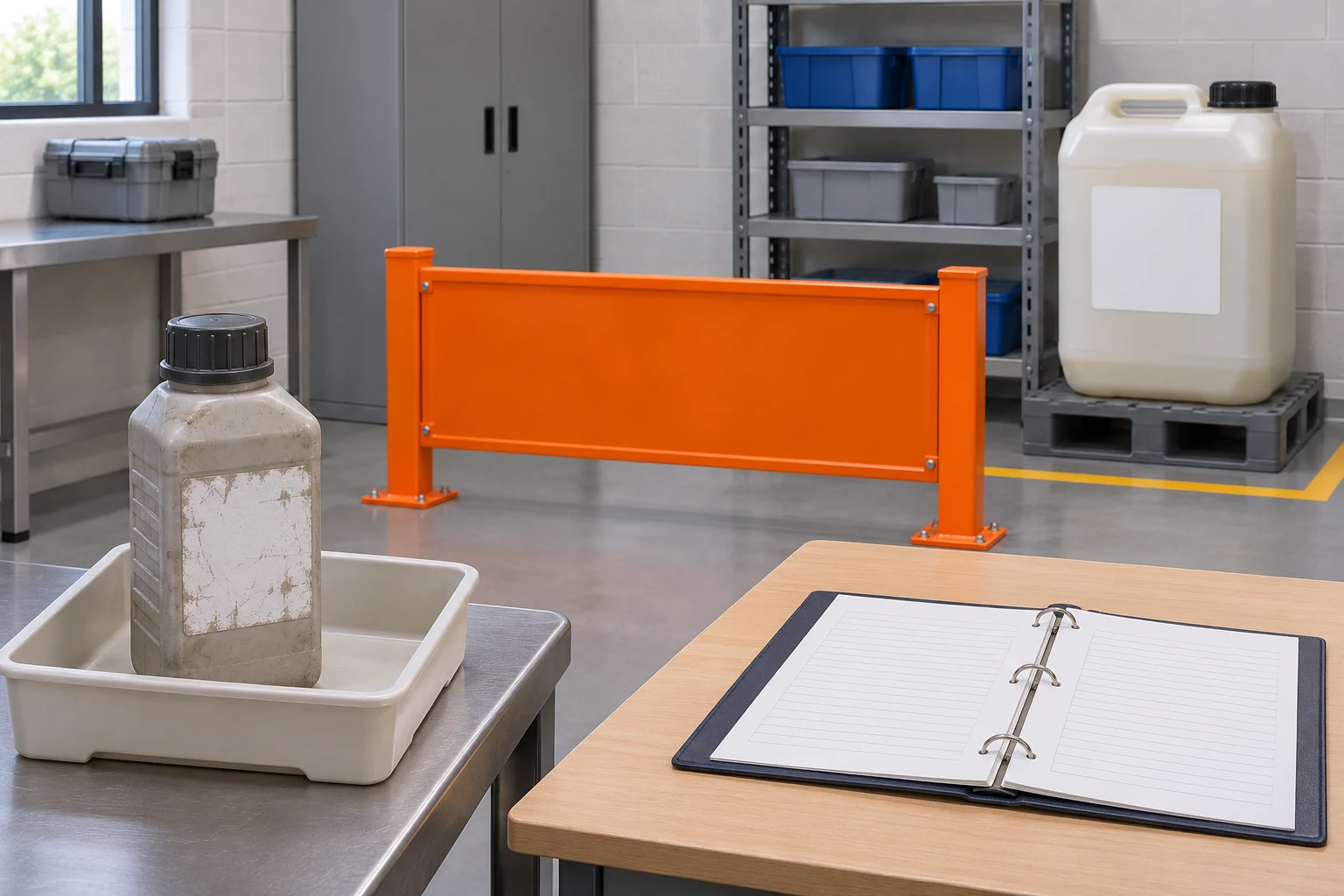
- Damaged container label: record readable clues separately from unresolved information.
- Use-control boundary: connect the held object to its verification owner and prevent unauthorised use.
- Original-container comparison target: verify the link through receipt and decanting records.
- Verification folder: link evidence, open conditions and recipient to the same object.
Separate available evidence from unresolved information
Keep observed facts separate from assumptions. Record readable fragments, the discovery location, relevant work timing and the handler’s confirmed information distinctly. An unreadable product name and a conclusion that the contents changed are different findings. Identify which container each record concerns and leave unresolved links open for the next verifier.
If the person who decanted it or the original container can be located, compare that information with receipt and decanting records. Proximity alone does not establish identical contents. Look for a traceable connection to when and for which task the transfer occurred. Keep evidence for separate containers distinct and record the actual scope verified rather than releasing similar-looking containers together.
Read remaining markings only where it is safe. Do not open the closure, smell the contents or mix substances to identify them. If record comparison is insufficient, refer the choice and execution of further verification to the responsible substance manager. Maintain the hold and identify who will check which additional evidence instead of improvising field tests.
Connect the identified product to supplier information
Once objective evidence is available, connect the product name and supplier to its safety data sheet. KOSHA Technical Support Regulation (KOSHA GUIDE) W-2-2021 includes consistency between the SDS product name and warning label, and the presence of supplier information, in its reliability checklist. Use these checks for an identified product; finding a similar name in a search does not identify an unknown container.
Compare the product form and actual supply information as well as its name. Cleaners or coatings with the same intended use can have different suppliers and compositions. Record the evidence linking the container to the product and pass it to the person checking the document. Separating substance identification from document suitability makes outstanding work visible.
Specify mismatched names or supplier details when requesting clarification. If an old label and newer document are found together, establish their relationship through supply and management records instead of choosing whichever appears newer. Separate documents under review from verified information. Record the reasoning and scope of the final verification.
Handover sequence
| Stage | Owner | Decision or check | Record |
|---|---|---|---|
| Discover and hold | Finder and handler | Prevent use and report abnormal condition | Location, exterior, readable marks |
| Collect evidence | Verification owner | Link receipt, decanting and original container | Evidence, mismatch, unknowns |
| Verify product and SDS | Substance manager | Assess product and supplier information | Scope and reasoning |
| Restore information and condition | Restoration owner and reviewer | Check label, access and container condition | Restoration and open actions |
| Release or retain hold | Decision owner and recipient | Match object, conditions and receipt | Decision, owner, location |
| Close and prevent recurrence | Management owner | Review disposition and next decanting preparation | Outcome, open issues, actions |
Complete information restoration and container checks together
After identifying the contents, restore the correct warning label and handling information. Article 170(1) of the Enforcement Rule requires substance-specific warning labels attached, printed or otherwise displayed clearly on the container and packaging. Check that the prepared label belongs to this container and is readable in position. Also check for old product names or other confusing markings.
Inspect compatibility, leakage and damage separately. Identified contents may still be in an unsuitable or damaged container. The responsible person must review continued use. If replacement is required, assign the work under the verified substance’s handling conditions and approved site method. Preparing a label should not automatically lead to an improvised transfer of the contents.
KOSHA’s Practical Guide describes clear hazard information on labelled or printed containers and packaging. In the field, check readability at the handling position and conditions that could contaminate or abrade the restored label. Any revised placement should preserve visibility of product and warning information, with the resulting condition recorded.
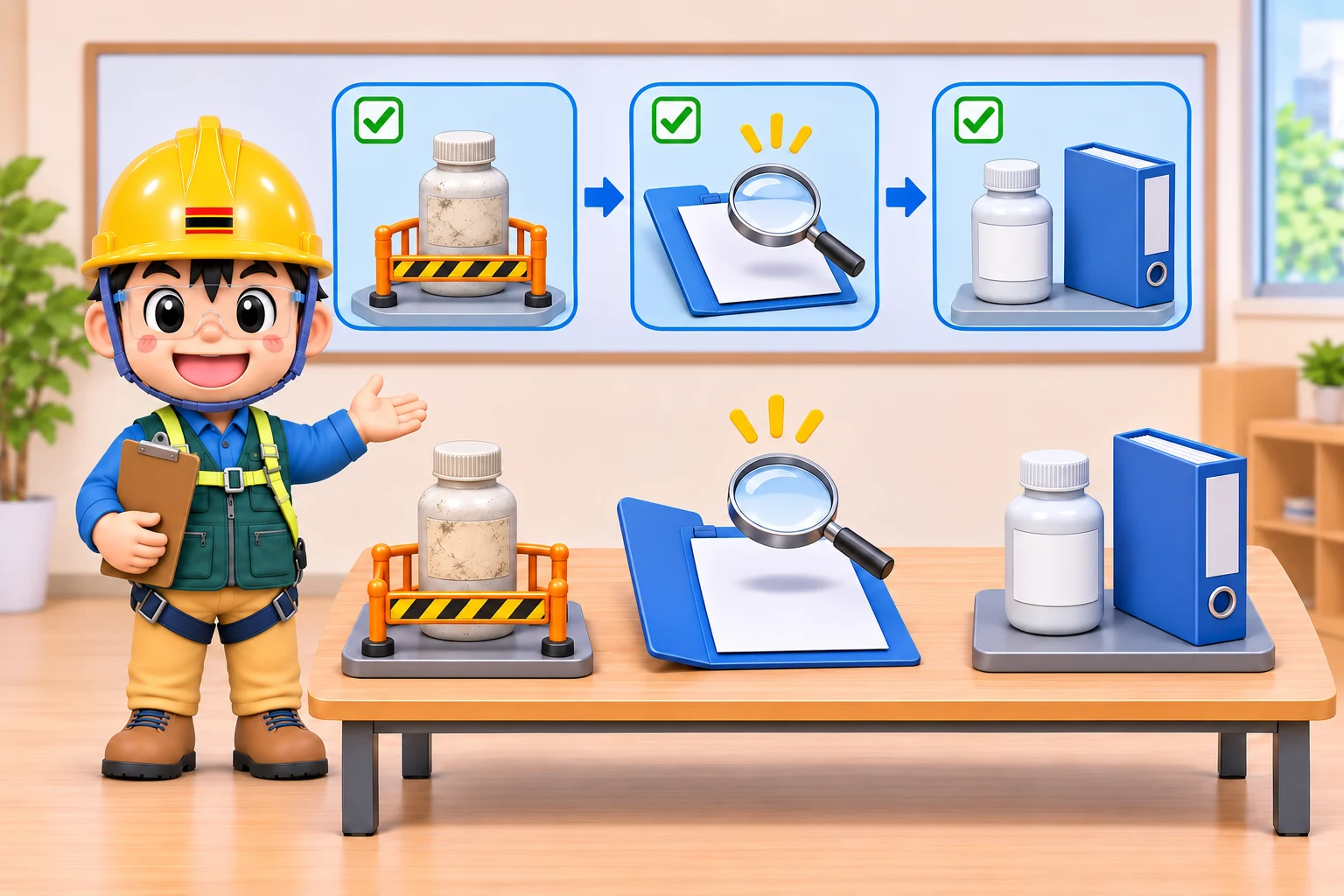
Restore access to information used by workers
Before considering resumed use, connect the container identity to information workers can retrieve. Article 114 requires accessible SDS provision, process-specific management information and appropriate measures including training for substances within its scope. Check access to the correct product information rather than returning only a replacement label.
KOSHA’s Practical Guide also addresses SDS availability, workers’ access through computer equipment and process management information. Check that workers can find the restored product name and relevant precautions. Where permissions or equipment prevent access to an existing file, arrange another suitable means of supplying the necessary information and verify readiness.
If identification changes the assumed handling conditions, notify those responsible for protective equipment, ventilation and the work method. Review measures for the actual substance and task, including applicable training and records. Distinguish notification of identification from authorisation to resume use. Explain the information and conditions supporting the resumption decision to the work team.
Hand over containers whose identity remains unresolved
If records are insufficient or inconsistent, maintain the hold and use the unidentified-substance management process. Do not return the container to normal storage under a familiar assumed name. Link the evidence still needed, present location and controls, and next decision owner so the state survives a shift change. Keep unresolved items visible in the record.
Where relocation is necessary, the responsible manager first reviews handling hazards and the method. For an authorised move, update location and recipient together. Distinguish normal stock tidying from handling an unidentified container and verify that the team understands the required controls.
Maintain clear communication ownership while the question remains unresolved. Track the request, the scope actually confirmed in a reply and any further decision needed. Assign the next action so delays do not prompt casual use or disposal. When a disposition is decided, record the responsible handling process and receipt, distinguishing that closure from release for use.
Align the conditions for changing from hold to use
Check identification, document consistency, restored labelling, container condition and handling requirements separately before release. Record each verifier’s scope rather than relying on one completion mark. If the label replacer and release decision owner differ, compare the physical container with the record. Pass outstanding actions intact to the decision owner.
Article 170(4) provides exceptions concerning containers already bearing warning labels and temporary use to transfer from a labelled container. Assess the actual use and storage against those conditions rather than merely calling it temporary. Where a container remains in service across shifts or multiple users and its information is unclear, have the responsible person review applicability instead of assuming an exception.
Align the release decision with the hold information still present in the field. Communicate what is cleared and what remains restricted, and agree when controls change. Changing the visible use status before delivering documents and handling conditions splits the information again. Have the recipient confirm the object and conditions before changing its use status.
Preserve identification in the next decanting task
After restoration, review where the identification link was lost. Prepare suitable containers and labels before the task and match them to the actual product being transferred. Keep preparation for different products distinct. Arrange the work to preserve identity at transfer rather than asking workers to reconstruct the name later from memory.
Review locations and handling practices that damage labels. Hand over container compatibility, readable information and the means of finding the SDS to the next user. Avoid beverage containers and other packaging that creates confusion, and assign storage or return responsibility for remaining decanted containers. Information should remain verifiable after the person who knows the product leaves.
Connect the discovered problem, verification evidence, restored information, container condition and release or other disposition in the final record. Retain unfinished items with an owner and separate improvements for the next task. If defects recur, examine where preparation or communication loses the identification link instead of merely counting replacement labels. Feed the findings into the next preparation sequence.
Related reading
Original sources
- Korean Occupational Safety and Health Act — Articles 114 and 115
- Enforcement Rule of the Occupational Safety and Health Act — Article 170
- KOSHA Technical Support Regulation (KOSHA GUIDE) W-2-2021 — Annex 1, product name and supplier information
- KOSHA Practical Guide 69: Other Chemical Product Manufacturing (2023), printed pp. 98–99