Before excavation: connect utility plans to the work boundary
Before the first cut: what does an unmarked area mean?
The excavation boundary is marked on the ground, and a pipe line appears on the plan. Where the two intersect is unclear. Before setting the equipment to work, connect the line on the drawing to its position in the field. Distinguish facilities shown in records, facilities checked in the field and areas whose positions remain uncertain.
A buried-services investigation can easily become a simple yes-or-no entry. A record of a pipe becomes useful for planning when it is connected to the excavation boundary, protection after exposure and the direction from which machinery will approach. An unmarked area should not automatically be treated as an area without services.
Before excavation, match drawings, investigation findings and work boundaries. Related reading covers the general permit process. Here the focus is the boundary where buried facilities could be damaged and the conditions governing excavation machinery.
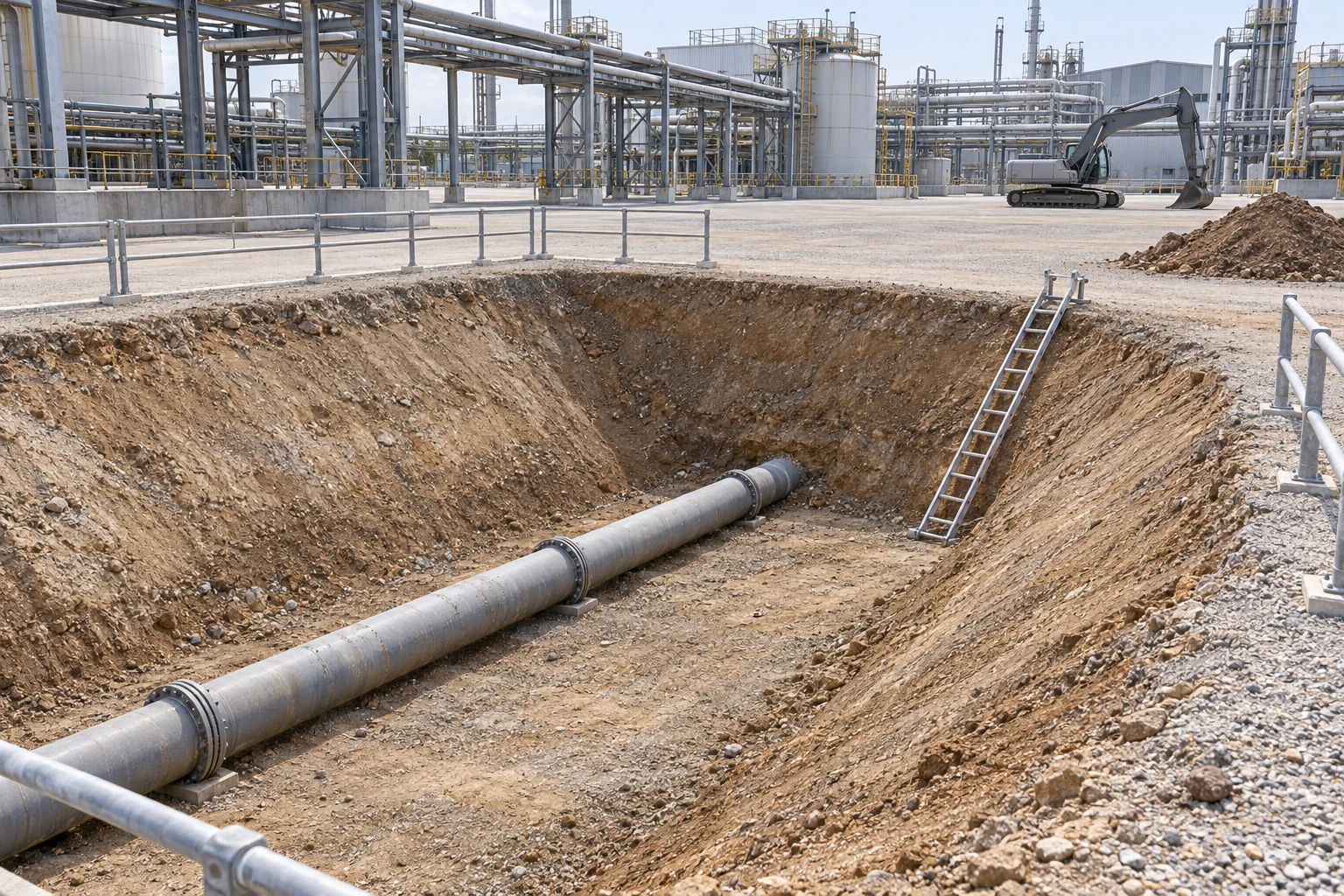
- Exposed pipe: Before continuing excavation, compare its location and service with drawings and the operator's confirmation.
- Excavated face: Before entry, look for cracks, loose soil and water ingress; stop work if something is wrong.
- Edge guardrails: Before approaching, check for gaps in the rails and places where someone could fall.
- Spoil stockpile: Place spoil away from the excavation edge and check during work that it is not piled back toward the edge.
- Access ladder: Before descending, check its securing and the space for footing.
The two-metre threshold and utility damage are separate questions
Article 38(1)6 of the Rules on Occupational Safety and Health Standards (산업안전보건기준에 관한 규칙) requires a work plan for ground excavation with an excavation face at least two metres high. Annex 4, item 6 covers terrain, geology and strata, cracking, water and freezing conditions, the presence and condition of buried facilities, and groundwater level. The plan connects these findings to the excavation method and sequence, spoil removal, staffing and equipment, and relocation or protection of services.
A shallower excavation may still present utility-damage risks. Articles 341 and 342 address protection and suspension of excavation machinery where damage to buried facilities could endanger workers. The work-plan height threshold and the conditions for specific risk controls therefore require separate consideration.
Work using vehicle-type construction machinery also falls within Article 38(1)3 and Annex 4, item 3. Connect machine type and capacity, travel routes and work methods to the buried-services investigation. Separate plans for the ground and the machinery need a common boundary.
Protection before and after exposure
Article 341(1) requires reinforcement, relocation or other necessary measures when excavation near buried facilities, masonry walls or retaining walls could damage them and endanger workers. The provision addresses the approach to the facility, rather than waiting until excavation makes it visible.
If an exposed buried facility could be damaged, paragraph 2 requires protection, relocation or other necessary measures. Paragraph 3 places that work under a supervisor’s direction. Showing access space and the protection work area alongside the facility on the plan helps identify competing activities in the same location.
Ground conditions also change. Article 338 addresses loose material, cracks and changes in water or freezing conditions. Article 339 addresses excavation-face inclination, collapse prevention and measures against rainwater penetration. Even after locating a pipe, changes in the face or surrounding ground call for a fresh look at the working conditions.
- Investigated facility: Match the drawing to the field position.
- Planned excavation: Check overlap with facilities.
- Uncertain location: Identify it for further verification.
- Protection review point: Review damage risk before and after exposure.
- Machinery approach boundary: Stop machine excavation where damage could endanger workers.
Define the machinery stopping boundary first
Article 342, item 1 requires excavation using the relevant machinery to stop when it could damage gas pipes, underground electrical lines or other underground structures and endanger workers. The starting point is the risk of damage and danger, rather than whether the machine has already struck a pipe. Digging further with machinery to resolve an uncertain location may conflict with that assessment.
For field use, distinguish investigated facilities, the planned excavation and uncertain areas on one drawing. Link the person and contact method for boundary checks, and the conditions for resuming work after protection, to the work plan. This is a way to make investigation findings usable. Approach distances and locating accuracy depend on the actual ground, facility and equipment information.
Spoil loading and machine travel also affect the boundary. Article 342, item 2 requires travel routes and access to spoil-loading areas to be established and communicated to the relevant workers. Include the collapse and falling-material measures under Article 340 so that the review covers people and machine access as well as the excavation line.
Four checks at the excavation boundary
Where do the facility shown on the drawing and the checked field position agree? Separate the checking method from areas that remain uncertain in the investigation record. Marking those areas for further verification rather than leaving them blank is an editorial record suggestion that helps the next worker read the same plan.
Who will protect the exposed facility, and by what measures? Review areas requiring reinforcement, protection or relocation, work requiring supervisory direction and space shared with other activities. Explain any difference between the machinery stopping boundary and the protection work area.
Will the machine cross the same boundary while moving to load spoil? Check travel routes and access arrangements. Also identify who will recheck the ground and assess working conditions after rain or changes in water or cracking.
Field information needed before choosing numerical limits
Burial depth, separation between facilities, the detection range of locating equipment and the distance at which to switch to manual excavation require ground and facility information. Determine them in the individual work plan after obtaining the Annex 4 investigation results and the information needed to manage the facilities.
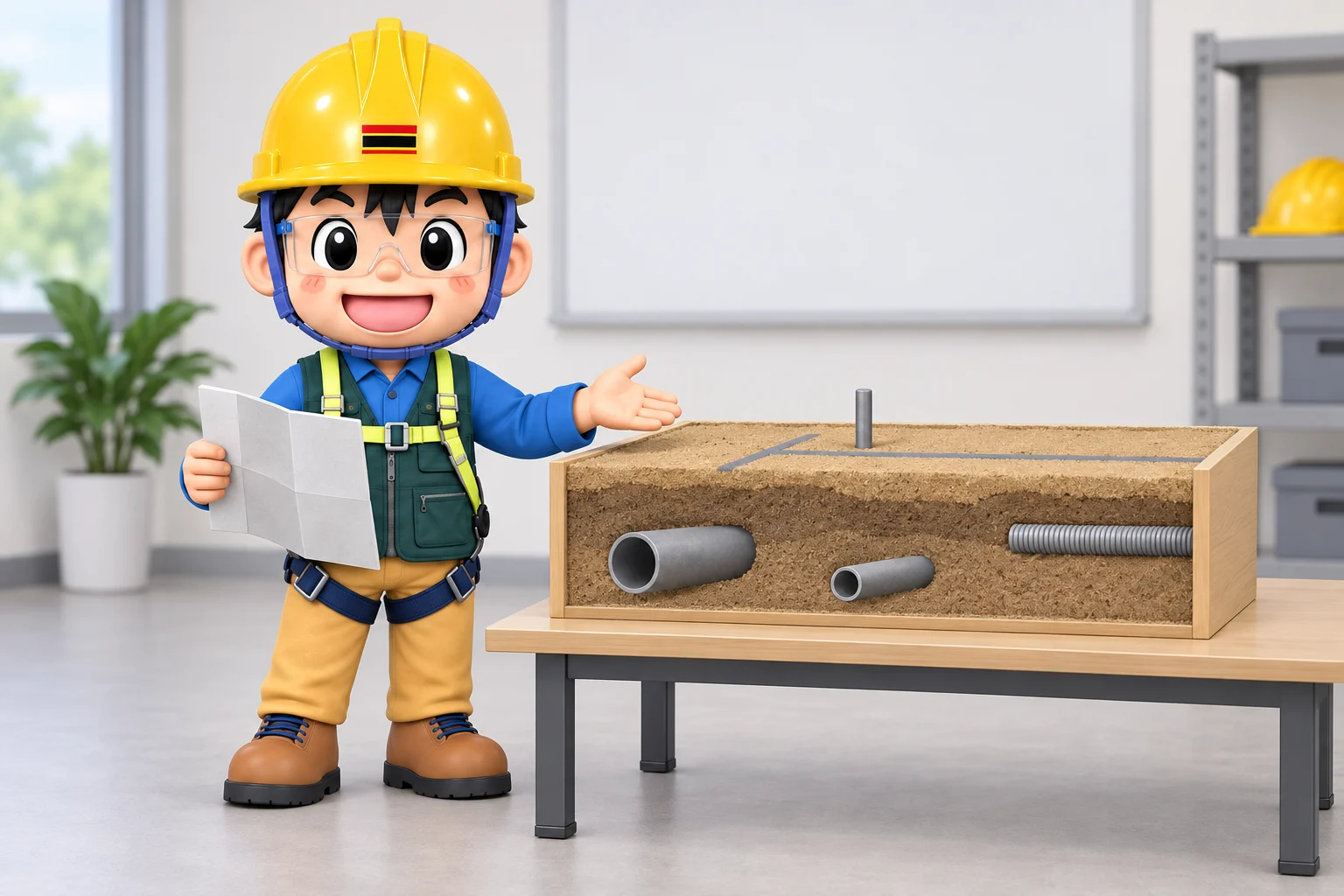
The grey pipes in the educational model show spatial relationships. Their colours do not identify gas, electrical or water services, and the model is not an actual underground layout. Field decisions depend on verified facility information and identification.